

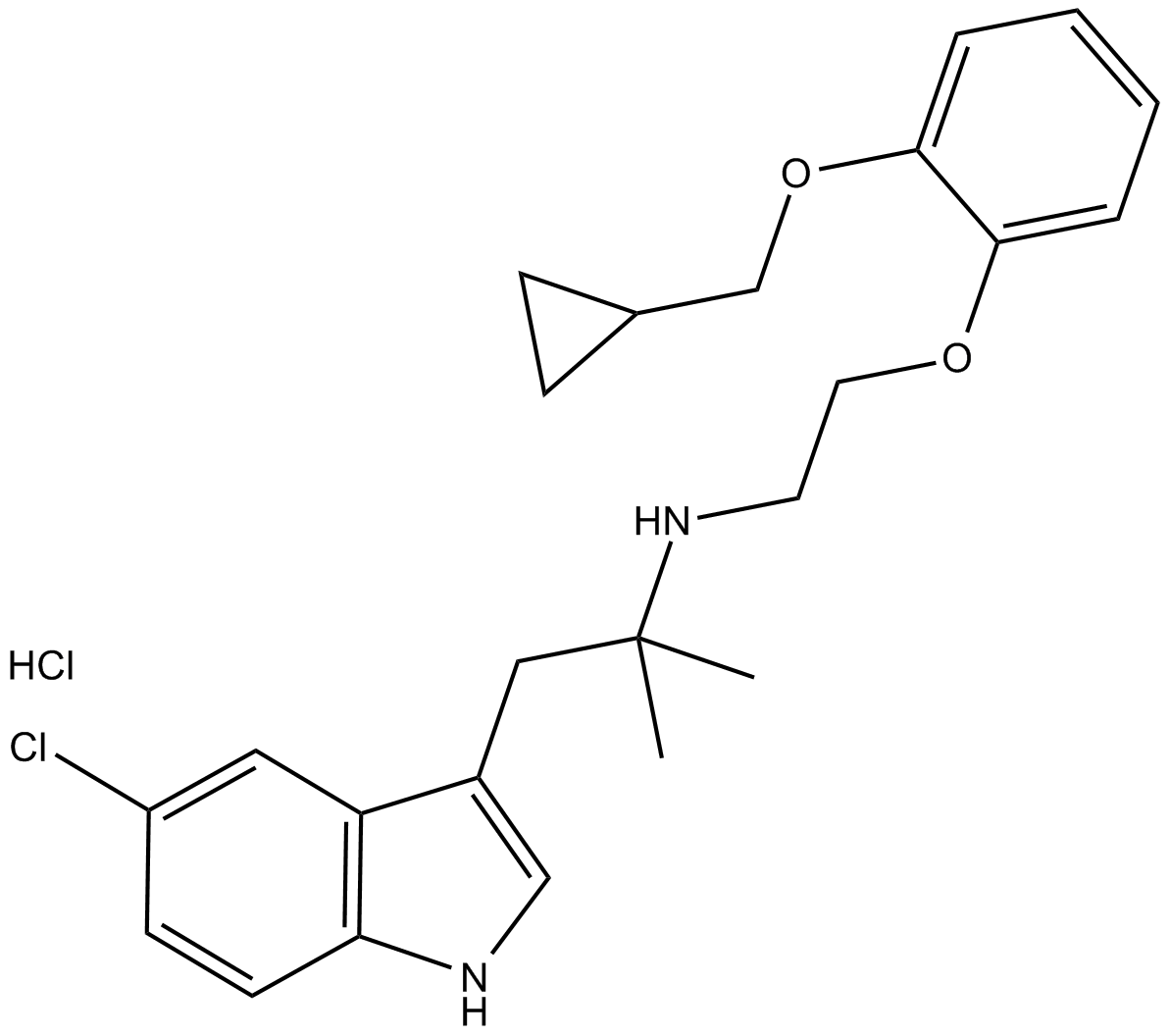
RS 17053 hydrochloride (Synonyms: RS-17053) |
Catalog No.GC17070
 One-Click Copy Product Info
|

El clorhidrato de RS 17053 es un potente y selectivo antagonista de los receptores adrenérgicos α1A, con un valor de pKi de 9,1 en la membrana celular nativa y un valor de pA2 de 9,8 en ensayos funcionales.
Products are for research use only. Not for human use. We do not sell to patients.
Cas No.: 169505-93-5
Sample solution is provided at 25 µL, 10mM.
_1-3.$$$39978408@51.jpg');)
_1-9.$$$38538795@65.jpg');)
_1-9.$$$39112701@51.jpg');)
_1-7.$$$37316672@70.jpg');)
_366-372.$$$36198801@70.jpg');)
.$$$38565142@65.jpg');)
_1867-1883.$$$33248023@67.jpg');)
_eads6055.$$$39977546@45.jpg');)
_eadm9805.$$$40080571@45.jpg');)
_eadj3020.$$$39666821@45.jpg');)
_1-20.$$$39757301@28.jpg');)
_1-24.$$$38898113@28.jpg');)
_273-287.$$$36806353@46.jpg');)
_1-16.$$$37156877@44.jpg');)
_1-19.$$$37460805@44.jpg');)
_1291-1307.$$$34518654@46.jpg');)
RS 17053 hydrochloride is a novel and selective α1A-adrenoceptor antagonist [1].
α1A-adrenoceptor are widely distributed and activated either by epinephrine released from the adrenal medulla or by norepinephrine released from sympathetic nerve terminals. α1A-adrenoceptor mediate a variety of functions, including cardiac stimulation, contraction of smooth muscle, activation of hepatic gluconeogenesis, glycogenolysis, cellular proliferation and apoptosis.
In rat several tissues, RS-17053 had high affinity for the α1A -adrenoceptor and a 30 ~100-fold selectivity over the α1B - and the α1D -adrenoceptor subtypes [1]. RS 17053 had over 100-fold lower affinity for the α1A -adrenoceptor mediating contraction of the rat portal vein (pKB 7.1) and human prostate (pKB 7.1) compared with its affinity for the α1A -adrenoceptor in the rat epididymal vas deferens or the expressed α1A -clone. Therefore, RS 17053 may distinguish between subtypes of the α1A -adrenoceptor in the rat portal vein and human prostate compared with those in the rat epididymal vas deferens or the expressed α1A -clones [2].
References:
[1]. Ford AP, Arredondo NF, Blue DR Jr, et al. RS 17053 (N-[2-(2-cyclopropylmethoxyphenoxy)ethyl]-5-chloro-α,α-dimethyl-1H-indole-3-ethanamine hydrochloride, a selective α1A-adrenoceptor antagonist, displays low affinity for functional α1-adrenoceptors in human prostate: implications for adrenoceptor classification. Mol Pharmacol, 1996, 49(2): 209-215.
[2]. Marshall I, Burt RP, Green GM, et al. Different subtypes of α1A-adrenoceptor mediating contraction of rat epididymal vas deferens, rat hepatic portal vein and human prostate distinguished by the antagonist RS 17053. Br J Pharmaco, 1996, 119(2): 407-415.
Animal experiment: | Rats[2]Adult male rats (n=56 to 8 per group) are pretreated (IP) with either 0, 0.1, 0.5, 2.5, or 10.0 mg/kg RS 17053 hydrochloride or with 2.0 mg/kg of the prototypical α1-Adrenoceptor antagonist prazosin. Five minutes later, each rat was treated (IP) with either 0, 5, 10 or 15 mg/kg PPA. Food and water intakes are recorded for a 30 min period starting 10 min after the treatment injection. Rats pretreated with vehicle and then treated with PPA exhibite a dose-dependent suppression of feeding with a maximal effect evident at the 15 mg/kg dose of PPA. Pretreatment with 2.0 mg/kg prazosin reverses the anorexic activity of PPA[2]. |
References: [1]. Ford AP, et al. RS-17053 (N-[2-(2-cyclopropylmethoxyphenoxy)ethyl]-5-chloro-alpha, alpha-dimethyl-1H-indole-3-ethanamine hydrochloride), a selective alpha 1A-adrenoceptor antagonist, displays low affinity for functional alpha 1-adrenoceptors in human prostate: implications for adrenoceptor classification. Mol Pharmacol. 1996 Feb;49(2):209-15. | |
| Cas No. | 169505-93-5 | SDF | |
| Sinónimos | RS-17053 | ||
| Chemical Name | 1-(5-chloro-1H-indol-3-yl)-N-(2-(2-(cyclopropylmethoxy)phenoxy)ethyl)-2-methylpropan-2-amine hydrochloride | ||
| Canonical SMILES | CC(CC1=CNC2=C1C=C(Cl)C=C2)(NCCOC3=CC=CC=C3OCC4CC4)C.Cl | ||
| Formula | C24H29N2O2Cl.HCl | M.Wt | 449.42 |
| Solubility | <22.47mg/ml in DMSO | Storage | Store at RT |
| General tips | Please select the appropriate solvent to prepare the stock solution according to the
solubility of the product in different solvents; once the solution is prepared, please store it in
separate packages to avoid product failure caused by repeated freezing and thawing.Storage method
and period of the stock solution: When stored at -80°C, please use it within 6 months; when stored
at -20°C, please use it within 1 month. To increase solubility, heat the tube to 37°C and then oscillate in an ultrasonic bath for some time. |
||
| Shipping Condition | Evaluation sample solution: shipped with blue ice. All other sizes available: with RT, or with Blue Ice upon request. | ||
| Prepare stock solution | |||

|
1 mg | 5 mg | 10 mg |
| 1 mM | 2.2251 mL | 11.1255 mL | 22.2509 mL |
| 5 mM | 445 μL | 2.2251 mL | 4.4502 mL |
| 10 mM | 222.5 μL | 1.1125 mL | 2.2251 mL |
Step 1: Enter information below (Recommended: An additional animal making an allowance for loss during the experiment)
 g
μL
g
μL
Step 2: Enter the in vivo formulation (This is only the calculator, not formulation. Please contact us first if there is no in vivo formulation at the solubility Section.)
Calculation results:
Working concentration: mg/ml;
Method for preparing DMSO master liquid: mg drug pre-dissolved in μL DMSO ( Master liquid concentration mg/mL, Please contact us first if the concentration exceeds the DMSO solubility of the batch of drug. )
Method for preparing in vivo formulation: Take μL DMSO master liquid, next addμL PEG300, mix and clarify, next addμL Tween 80, mix and clarify, next add μL saline, mix and clarify.
Method for preparing in vivo formulation: Take μL DMSO master liquid, next add μL Corn oil, mix and clarify.
Note: 1. Please make sure the liquid is clear before adding the next solvent.
2. Be sure to add the solvent(s) in order. You must ensure that the solution obtained, in the previous addition, is a clear solution before proceeding to add the next solvent. Physical methods such as vortex, ultrasound or hot water bath can be used to aid dissolving.
3. All of the above co-solvents are available for purchase on the GlpBio website.
Quality Control & SDS
- View current batch:
- Purity: >99.00% Appearance: A solid
- COA (Certificate of Analysis)
- SDS (Safety Data Sheet)
- Datasheet
Average Rating: 5 (Based on Reviews and 40 reference(s) in Google Scholar.)