

Sulfo-SMCC sodium |
Catalog No.GC30045
 One-Click Copy Product Info
|

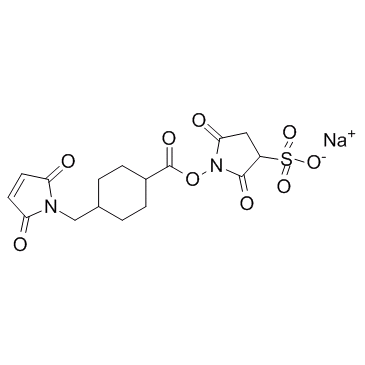
Sulfo-SMCC sodium es un reticulante heterobifuncional soluble en agua, consiste en una maleimida y un grupo de éster de N-hydroxysuccinimide (NHS) para unirse a grupos de sulfhidrilo y aminas primarias, respectivamente
Products are for research use only. Not for human use. We do not sell to patients.
Cas No.: 92921-24-9
Sample solution is provided at 25 µL, 10mM.
_1-3.$$$39978408@51.jpg');)
_1-9.$$$38538795@65.jpg');)
_1-9.$$$39112701@51.jpg');)
_1-7.$$$37316672@70.jpg');)
_366-372.$$$36198801@70.jpg');)
.$$$38565142@65.jpg');)
_1867-1883.$$$33248023@67.jpg');)
_eads6055.$$$39977546@45.jpg');)
_eadm9805.$$$40080571@45.jpg');)
_eadj3020.$$$39666821@45.jpg');)
_1-20.$$$39757301@28.jpg');)
_1-24.$$$38898113@28.jpg');)
_273-287.$$$36806353@46.jpg');)
_1-16.$$$37156877@44.jpg');)
_1-19.$$$37460805@44.jpg');)
_1291-1307.$$$34518654@46.jpg');)
Sulfo-SMCC sodium es un reticulante heterobifuncional soluble en agua, consiste en una maleimida y un grupo de éster de N-hydroxysuccinimide (NHS) para unirse a grupos de sulfhidrilo y aminas primarias, respectivamente [1]. Sulfo-SMCC sodium se utiliza comúnmente en el campo de la bioconjugación, incluyendo el marcado de péptidos y proteínas [2], los conjugados anticuerpo-fármaco (ADCs)[3][4], y las biomoléculas de marcado para la detección y la obtención de imágenes [5][6].
References:
[1]. Prabhune M, von Roden K, Rehfeldt F, et al. Sulfo-SMCC Prevents Annealing of Taxol-Stabilized Microtubules In Vitro. PLoS One. 2016 Aug 25;11(8):e0161623. doi: 10.1371/journal.pone.0161623. PMID: 27561096; PMCID: PMC4999061.
[2]. Wängler B, Kostikov AP, Niedermoser S, et al. Protein labeling with the labeling precursor [(18)F]SiFA-SH for positron emission tomography. Nat Protoc. 2012 Nov;7(11):1964-9. doi: 10.1038/nprot.2012.111. Epub 2012 Oct 4. PMID: 23037311.
[3]. Singh R, Setiady YY, Ponte J, et al. A New Triglycyl Peptide Linker for Antibody-Drug Conjugates (ADCs) with Improved Targeted Killing of Cancer Cells. Mol Cancer Ther. 2016 Jun;15(6):1311-20. doi: 10.1158/1535-7163.MCT-16-0021. Epub 2016 Mar 29. PMID: 27197308.
[4]. Si Y, Xu Y, Guan J, et al. Anti-EGFR antibody-drug conjugate for triple-negative breast cancer therapy. Eng Life Sci. 2020 Oct 7;21(1-2):37-44. doi: 10.1002/elsc.202000027. PMID: 33531889; PMCID: PMC7837297.
[5]. Tiwari DK, Tanaka S, Inouye Y, et al. Synthesis and Characterization of Anti-HER2 Antibody Conjugated CdSe/CdZnS Quantum Dots for Fluorescence Imaging of Breast Cancer Cells. Sensors (Basel). 2009;9(11):9332-64. doi: 10.3390/s91109332. Epub 2009 Nov 19. PMID: 22291567; PMCID: PMC3260644.
[6]. Wang G, Li W, Shi G, et al. Sensitive and specific detection of breast cancer lymph node metastasis through dual-modality magnetic particle imaging and fluorescence molecular imaging: a preclinical evaluation. Eur J Nucl Med Mol Imaging. 2022 Jul;49(8):2723-2734. doi: 10.1007/s00259-022-05834-5. Epub 2022 May 20. PMID: 35590110; PMCID: PMC9206605.
Protocolo para el etiquetado de proteínas con Sulfo-SMCC Sodium
1. Disuelva la cantidad necesaria de Sulfo-SMCC sodium en DMSO anhidro a una concentración de 1-10mM y úselo inmediatamente antes de que ocurra la hidrólisis.
2. Disuelva las proteínas que contienen amina (Protein-NH2) y que contienen sulfhydryl-containing proteins (Protein-SH) en PBS a una concentración de 1-10mg/mL.
3. Agregue la solución Sulfo-SMCC a la solución de proteína que contiene amina en una proporción molar de 10:1 a 20:1 (Sulfo-SMCC: Protein-NH2).
4. Incubar la mezcla de reacción a temperatura ambiente con agitación suave durante 30 minutos a 1 hora.
5. Elimine el Sulfo-SMCC no reaccionado por diálisis o usando una solumna de desal para garantizar que solo queda la proteína conjugada.
6. Agregue la solución de proteína conjugada a una solución que contenga las proteínas que contienen sulfhydryl (Protein-SH) en una proporción molar correspondiente a la deseada para el conjugado final y consistente con el número relactivo de sulfhydryl y aminas activadas que existen en las dos proteínas.
7. Incubar a temperatura ambiente con agitación suave durante 1-2 horas.
8. Purifique la proteína marcada utilizando métodos apropiados como la cromatografía de afinidad o la cromatografía de exclusión de tamaño.
Este protocolo solo proporciona una guía y debe modificarse de acuerdo con sus necesidades específicas.
References:
[1]. Liu X, Mao D, Song Y, et al. Computer-aided design of reversible hybridization chain reaction (CAD-HCR) enables multiplexed single-cell spatial proteomics imaging. Sci Adv. 2022 Jan 14;8(2):eabk0133. doi: 10.1126/sciadv.abk0133. Epub 2022 Jan 14. PMID: 35030012; PMCID: PMC8759754.
| Cas No. | 92921-24-9 | SDF | |
| Canonical SMILES | O=C(C1CCC(CN2C(C=CC2=O)=O)CC1)ON3C(C(S(=O)([O-])=O)CC3=O)=O.[Na+] | ||
| Formula | C16H17N2NaO9S | M.Wt | 436.37 |
| Solubility | Water : 6 mg/mL (13.75 mM) | Storage | 4°C, away from moisture and light |
| General tips | Please select the appropriate solvent to prepare the stock solution according to the
solubility of the product in different solvents; once the solution is prepared, please store it in
separate packages to avoid product failure caused by repeated freezing and thawing.Storage method
and period of the stock solution: When stored at -80°C, please use it within 6 months; when stored
at -20°C, please use it within 1 month. To increase solubility, heat the tube to 37°C and then oscillate in an ultrasonic bath for some time. |
||
| Shipping Condition | Evaluation sample solution: shipped with blue ice. All other sizes available: with RT, or with Blue Ice upon request. | ||
| Prepare stock solution | |||

|
1 mg | 5 mg | 10 mg |
| 1 mM | 2.2916 mL | 11.4582 mL | 22.9163 mL |
| 5 mM | 458.3 μL | 2.2916 mL | 4.5833 mL |
| 10 mM | 229.2 μL | 1.1458 mL | 2.2916 mL |
Step 1: Enter information below (Recommended: An additional animal making an allowance for loss during the experiment)
 g
μL
g
μL
Step 2: Enter the in vivo formulation (This is only the calculator, not formulation. Please contact us first if there is no in vivo formulation at the solubility Section.)
Calculation results:
Working concentration: mg/ml;
Method for preparing DMSO master liquid: mg drug pre-dissolved in μL DMSO ( Master liquid concentration mg/mL, Please contact us first if the concentration exceeds the DMSO solubility of the batch of drug. )
Method for preparing in vivo formulation: Take μL DMSO master liquid, next addμL PEG300, mix and clarify, next addμL Tween 80, mix and clarify, next add μL saline, mix and clarify.
Method for preparing in vivo formulation: Take μL DMSO master liquid, next add μL Corn oil, mix and clarify.
Note: 1. Please make sure the liquid is clear before adding the next solvent.
2. Be sure to add the solvent(s) in order. You must ensure that the solution obtained, in the previous addition, is a clear solution before proceeding to add the next solvent. Physical methods such as vortex, ultrasound or hot water bath can be used to aid dissolving.
3. All of the above co-solvents are available for purchase on the GlpBio website.
Quality Control & SDS
- View current batch:
- Purity: >98.00% Appearance: A solid
- COA (Certificate of Analysis)
- SDS (Safety Data Sheet)
- Datasheet
Average Rating: 5 (Based on Reviews and 10 reference(s) in Google Scholar.)