

BMS-303141 |
رقم الكتالوجGC10884
 One-Click Copy Product Info
|

مثبط ATP-citrate lyase، فعال.
Products are for research use only. Not for human use. We do not sell to patients.
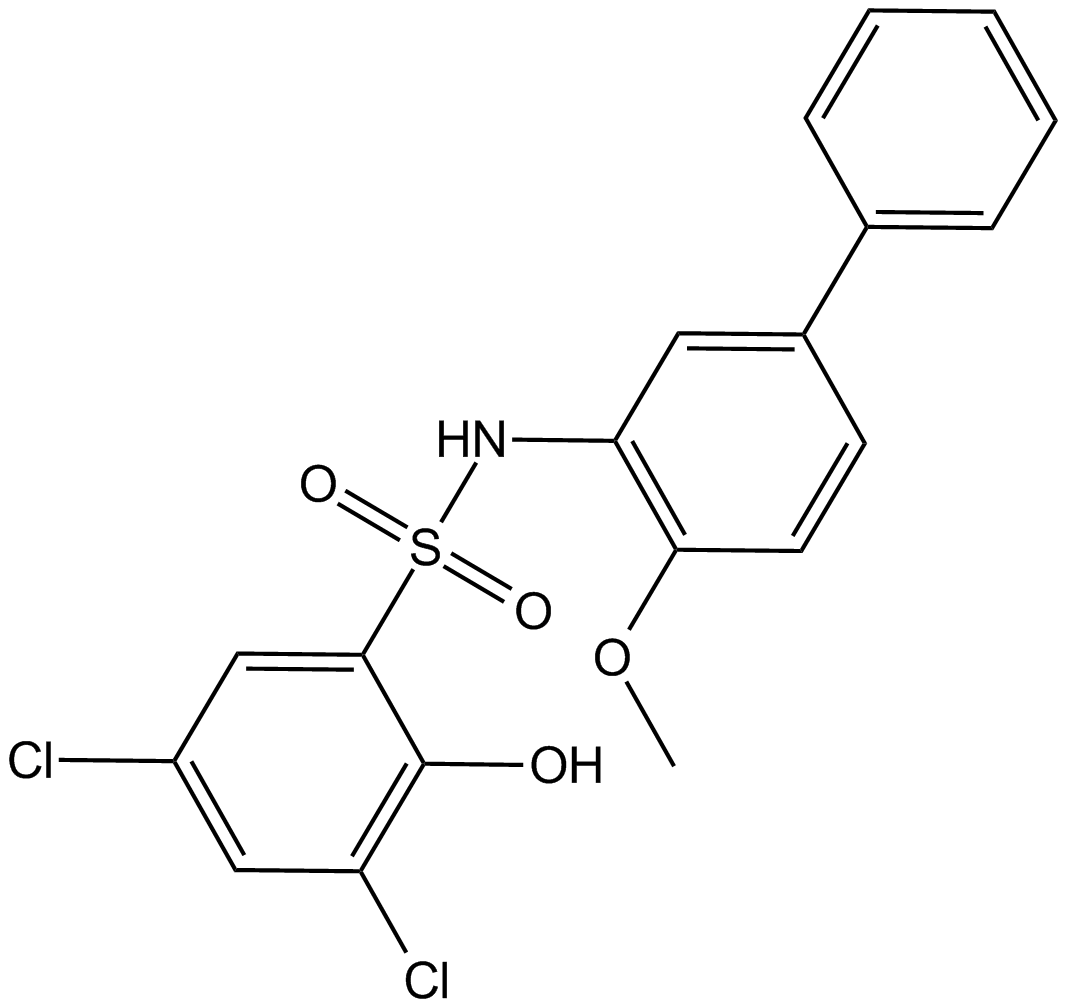
Cas No.: 943962-47-8
Sample solution is provided at 25 µL, 10mM.
BMS-303141 is a highly potent and cell-permeable ATP-citrate lyase (ACL) inhibitor with an IC50 value of 0.13μM[1]. ACL is a cytosolic enzyme responsible for the production of cytosolic acetyl-CoA, a precursor required for the de novo biosynthesis of cholesterol and fatty acids[2]. BMS-303141 can be used to block glycolytic activity and mitochondrial pyruvate carrier activity[3].
In vitro, treatment of ESCC cells with BMS-303141 (0-80μM) for 24-96h significantly inhibited cell survival and significantly reduced ACLY protein levels in a time- and dose-dependent manner[4]. Pretreatment of HUVEC cells with BMS-303141 (10μM) 4h before LPS stimulation reversed the LPS-induced upregulation of soluble vascular cell adhesion molecule 1 (VCAM-1), soluble E-selectin, and monocyte chemoattractant protein-1 (MCP-1) without affecting cell viability[5].
In vivo, oral administration of BMS-303141 (5mg/kg/day) for 8 days inhibited the growth of liver cancer cells in mice bearing HepG2 cell xenografts. Combination therapy of BMS-303141 and sorafenib significantly reduced tumor volume and weight and inhibited the expression of Ki-67 in tumor tissues[6]. Oral treatment of spontaneous type 2 diabetic mice with BMS-303141 (50mg/kg/day) for 30 days reduced the levels of serum lipids and renal lipogenic enzymes acetyl-CoA carboxylase (ACC), fatty acid synthase (FAS), and HMG-CoA reductase (HMGCR), and alleviated ectopic lipid accumulation (ELA) and inflammation in the kidneys[7].
References:
[1] Li J J, Wang H, Tino J A, et al. 2-hydroxy-N-arylbenzenesulfonamides as ATP-citrate lyase inhibitors[J]. Bioorganic & medicinal chemistry letters, 2007, 17(11): 3208-3211.
[2] Pinkosky S L, Groot P H E, Lalwani N D, et al. Targeting ATP-citrate lyase in hyperlipidemia and metabolic disorders[J]. Trends in molecular medicine, 2017, 23(11): 1047-1063.
[3] Haggadone M D, Speth J, Hong H, et al. ATP Citrate Lyase Links Increases in Glycolytic Flux to Diminished Release of Vesicular Suppressor of Cytokine Signaling 3 by Alveolar Macrophages[M]//TP2. TP002 IMMUNOLOGY AND INFLAMMATION IN PULMONARY INFECTIONS. American Thoracic Society, 2021: A1268-A1268.
[4] Zhang X, Xu Y, Li S, et al. SIRT2‐mediated deacetylation of ACLY promotes the progression of oesophageal squamous cell carcinoma[J]. Journal of Cellular and Molecular Medicine, 2024, 28(6): e18129.
[5] Li R, Meng M, Chen Y, et al. ATP-citrate lyase controls endothelial gluco-lipogenic metabolism and vascular inflammation in sepsis-associated organ injury[J]. Cell Death & Disease, 2023, 14(7): 401.
[6] Zheng Y, Zhou Q, Zhao C, et al. ATP citrate lyase inhibitor triggers endoplasmic reticulum stress to induce hepatocellular carcinoma cell apoptosis via p‐eIF2α/ATF4/CHOP axis[J]. Journal of Cellular and Molecular Medicine, 2021, 25(3): 1468-1479.
[7] Zhan Z, Li A, Zhang W, et al. ATP-citrate lyase inhibitor improves ectopic lipid accumulation in the kidney in a db/db mouse model[J]. Frontiers in Endocrinology, 2022, 13: 914865.
| Cell experiment [1]: | |
Cell lines | ESCC cells |
Preparation Method | ESCC cells were seeded into 96-well plates with 3×10³ cells per well and cultured for 24h. They were treated with different concentrations (0, 10, 20, 30, 40, 50, 60, 70, and 80μM) of BMS-303141 or different concentrations (0, 4, 8, 12, 16, and 20μM) of SIRT2 inhibitor AGK2. CCK-8 solution was added at 24, 48, 72, and 96h, and the absorbance at 450nm was measured with a microplate reader 2h later. |
Reaction Conditions | 0, 10, 20, 30, 40, 50, 60, 70, and 80μM; 24, 48, 72, and 96h |
Applications | BMS-303141 significantly inhibited the survival rate of ESCC cells in a time- and dose-dependent manner. |
| Animal experiment [2]: | |
Animal models | BALB/c nude mice |
Preparation Method | HepG2 cells (5×10⁷ cells/mouse) were injected subcutaneously into the abdomen of the forelimb of BALB/c nude mice. When the tumor volume reached 100mm3, they were randomly divided into 4 groups (4 mice in each group) and gavaged with normal saline, BMS-303141, sorafenib, and BMS-303141 combined with sorafenib at the same concentration of tumor suspension at a dose of 5mg/kg/day for 8 consecutive days. After 8 days of treatment, the tumor volume was measured every 2 days. |
Dosage form | 5mg/kg/day for 8 days; p.o. |
Applications | Treatment of BMS-303141 alone inhibited HCC cells. Moreover, combined treatment with BMS-303141 and sorafenib markedly reduced HepG2 tumour volume and weight compared to sorafenib alone group. |
References: [1]Zhang X, Xu Y, Li S, et al. SIRT2‐mediated deacetylation of ACLY promotes the progression of oesophageal squamous cell carcinoma[J]. Journal of Cellular and Molecular Medicine, 2024, 28(6): e18129. [2]Zheng Y, Zhou Q, Zhao C, et al. ATP citrate lyase inhibitor triggers endoplasmic reticulum stress to induce hepatocellular carcinoma cell apoptosis via p‐eIF2α/ATF4/CHOP axis[J]. Journal of Cellular and Molecular Medicine, 2021, 25(3): 1468-1479. | |
| Cas No. | 943962-47-8 | SDF | |
| Chemical Name | 3,5-dichloro-2-hydroxy-N-(4-methoxy-[1,1'-biphenyl]-3-yl)benzenesulfonamide | ||
| Canonical SMILES | COC1=C(NS(C2=CC(Cl)=CC(Cl)=C2O)(=O)=O)C=C(C3=CC=CC=C3)C=C1 | ||
| Formula | C19H15Cl2NO4S | M.Wt | 424.3 |
| الذوبان | ≥ 21.2mg/mL in DMSO | Storage | Store at -20°C |
| General tips | Please select the appropriate solvent to prepare the stock solution according to the
solubility of the product in different solvents; once the solution is prepared, please store it in
separate packages to avoid product failure caused by repeated freezing and thawing.Storage method
and period of the stock solution: When stored at -80°C, please use it within 6 months; when stored
at -20°C, please use it within 1 month. To increase solubility, heat the tube to 37°C and then oscillate in an ultrasonic bath for some time. |
||
| Shipping Condition | Evaluation sample solution: shipped with blue ice. All other sizes available: with RT, or with Blue Ice upon request. | ||
| Prepare stock solution | |||

|
1 mg | 5 mg | 10 mg |
| 1 mM | 2.3568 mL | 11.7841 mL | 23.5682 mL |
| 5 mM | 471.4 μL | 2.3568 mL | 4.7136 mL |
| 10 mM | 235.7 μL | 1.1784 mL | 2.3568 mL |
Step 1: Enter information below (Recommended: An additional animal making an allowance for loss during the experiment)
 g
μL
g
μL
Step 2: Enter the in vivo formulation (This is only the calculator, not formulation. Please contact us first if there is no in vivo formulation at the solubility Section.)
Calculation results:
Working concentration: mg/ml;
Method for preparing DMSO master liquid: mg drug pre-dissolved in μL DMSO ( Master liquid concentration mg/mL, Please contact us first if the concentration exceeds the DMSO solubility of the batch of drug. )
Method for preparing in vivo formulation: Take μL DMSO master liquid, next addμL PEG300, mix and clarify, next addμL Tween 80, mix and clarify, next add μL saline, mix and clarify.
Method for preparing in vivo formulation: Take μL DMSO master liquid, next add μL Corn oil, mix and clarify.
Note: 1. Please make sure the liquid is clear before adding the next solvent.
2. Be sure to add the solvent(s) in order. You must ensure that the solution obtained, in the previous addition, is a clear solution before proceeding to add the next solvent. Physical methods such as vortex, ultrasound or hot water bath can be used to aid dissolving.
3. All of the above co-solvents are available for purchase on the GlpBio website.
Quality Control & SDS
- View current batch:
- Purity: >98.00% Appearance: A solid
- COA (Certificate of Analysis)
- SDS (Safety Data Sheet)
- Datasheet
Average Rating: 5 (Based on Reviews and 31 reference(s) in Google Scholar.)