

BMS-303141 |
Catalog No.GC10884
 One-Click Copy Product Info
|

BMS-303141 es un inhibidor de ATP-citrato liasa (ACL) altamente potente y permeable a las células, con un valor de IC50 de 0.13μM.
Products are for research use only. Not for human use. We do not sell to patients.
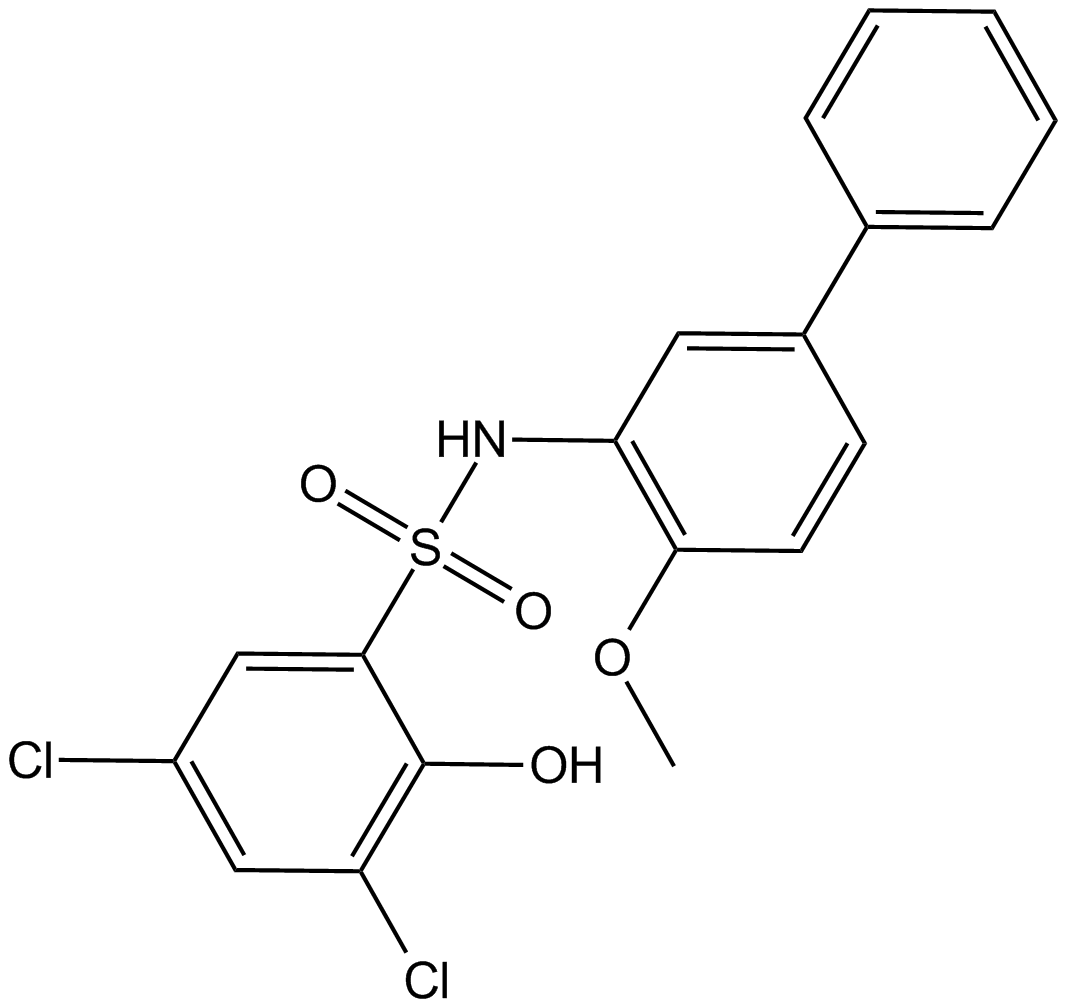
Cas No.: 943962-47-8
Sample solution is provided at 25 µL, 10mM.
BMS-303141 es un inhibidor de ATP-citrato liasa (ACL) altamente potente y permeable a las células, con un valor de IC50 de 0.13μM[1]. La ACL es una enzima citosólica responsable de la producción de acetil-CoA citosólica, un precursor necesario para la biosíntesis de novo de colesterol y ácidos grasos[2]. BMS-303141 puede usarse para bloquear la actividad glucolítica y la actividad del transportador de piruvato mitocondrial[3].
In vitro, el tratamiento de células ESCC con BMS-303141 (0-80μM) durante 24-96 horas inhibió significativamente la supervivencia celular y redujo significativamente los niveles de la proteína ACLY de manera dependiente del tiempo y la dosis[4]. La pretratación de células HUVEC con BMS-303141 (10μM) 4 horas antes de la estimulación con LPS revirtió el aumento inducido por LPS de la molécula de adhesión celular vascular soluble 1 (VCAM-1), la E-selectina soluble y la proteína quimioatrayente de monocitos 1 (MCP-1), sin afectar la viabilidad celular[5].
In vivo, la administración oral de BMS-303141 (5mg/kg/día) durante 8 días inhibió el crecimiento de células de cáncer de hígado en ratones con xenoinjertos de células HepG2. La terapia combinada de BMS-303141 y sorafenib redujo significativamente el volumen y el peso del tumor e inhibió la expresión de Ki-67 en los tejidos tumorales[6]. El tratamiento oral de ratones diabéticos tipo 2 espontáneos con BMS-303141 (50mg/kg/día) durante 30 días redujo los niveles de lípidos séricos y de las enzimas lipogénicas renales carboxilasa de acetil-CoA (ACC), sintasa de ácidos grasos (FAS) y HMG-CoA reductasa (HMGCR), además de aliviar la acumulación ectópica de lípidos (ELA) y la inflamación en los riñones[7].
References:
[1] Li J J, Wang H, Tino J A, et al. 2-hydroxy-N-arylbenzenesulfonamides as ATP-citrate lyase inhibitors[J]. Bioorganic & medicinal chemistry letters, 2007, 17(11): 3208-3211.
[2] Pinkosky S L, Groot P H E, Lalwani N D, et al. Targeting ATP-citrate lyase in hyperlipidemia and metabolic disorders[J]. Trends in molecular medicine, 2017, 23(11): 1047-1063.
[3] Haggadone M D, Speth J, Hong H, et al. ATP Citrate Lyase Links Increases in Glycolytic Flux to Diminished Release of Vesicular Suppressor of Cytokine Signaling 3 by Alveolar Macrophages[M]//TP2. TP002 IMMUNOLOGY AND INFLAMMATION IN PULMONARY INFECTIONS. American Thoracic Society, 2021: A1268-A1268.
[4] Zhang X, Xu Y, Li S, et al. SIRT2‐mediated deacetylation of ACLY promotes the progression of oesophageal squamous cell carcinoma[J]. Journal of Cellular and Molecular Medicine, 2024, 28(6): e18129.
[5] Li R, Meng M, Chen Y, et al. ATP-citrate lyase controls endothelial gluco-lipogenic metabolism and vascular inflammation in sepsis-associated organ injury[J]. Cell Death & Disease, 2023, 14(7): 401.
[6] Zheng Y, Zhou Q, Zhao C, et al. ATP citrate lyase inhibitor triggers endoplasmic reticulum stress to induce hepatocellular carcinoma cell apoptosis via p‐eIF2α/ATF4/CHOP axis[J]. Journal of Cellular and Molecular Medicine, 2021, 25(3): 1468-1479.
[7] Zhan Z, Li A, Zhang W, et al. ATP-citrate lyase inhibitor improves ectopic lipid accumulation in the kidney in a db/db mouse model[J]. Frontiers in Endocrinology, 2022, 13: 914865.
| Experimentos celulares [1]: | |
Líneas celulares | Células de carcinoma de células escamosas esofágicas (ESCC). |
Método de preparación | Las células ESCC se sembraron en placas de 96 pocillos con 3×10³ células por pocillo y se cultivaron durante 24 horas. Se trataron con diferentes concentraciones (0, 10, 20, 30, 40, 50, 60, 70 y 80μM) de BMS-303141 o con diferentes concentraciones (0, 4, 8, 12, 16 y 20μM) del inhibidor de SIRT2 AGK2. Se agregó la solución CCK-8 a las 24, 48, 72 y 96 horas, y se midió la absorbancia a 450nm con un lector de microplacas 2 horas después. |
Condiciones de reacción | 0, 10, 20, 30, 40, 50, 60, 70 y 80μM; 24, 48, 72 y 96 horas. |
Áreas de aplicación | BMS-303141 inhibió significativamente la tasa de supervivencia de las células ESCC de manera dependiente del tiempo y la dosis. |
| Experimentos con animales [2]: | |
Modelos animales | Ratones BALB/c desnudos. |
Método de preparación | Se inyectaron células HepG2 (5×10⁷ células/ratón) subcutáneamente en el abdomen del miembro anterior de ratones BALB/c desnudos. Cuando el volumen del tumor alcanzó 100mm³, se dividieron aleatoriamente en 4 grupos (4 ratones por grupo) y se les administró por vía oral solución salina normal, BMS-303141, sorafenib y la combinación de BMS-303141 con sorafenib a la misma concentración de suspensión tumoral, con una dosis de 5mg/kg/día durante 8 días consecutivos. Después de 8 días de tratamiento, el volumen del tumor se midió cada 2 días. |
Forma de dosificación | 5mg/kg/día durante 8 días; administración oral. |
Áreas de aplicación | El tratamiento con BMS-303141 solo inhibió las células de carcinoma hepatocelular (HCC). Además, el tratamiento combinado de BMS-303141 y sorafenib redujo notablemente el volumen y el peso del tumor HepG2 en comparación con el grupo tratado solo con sorafenib. |
Referencias: [1] Zhang X, Xu Y, Li S, et al. SIRT2‐mediated deacetylation of ACLY promotes the progression of oesophageal squamous cell carcinoma[J]. Journal of Cellular and Molecular Medicine, 2024, 28(6): e18129. [2] Zheng Y, Zhou Q, Zhao C, et al. ATP citrate lyase inhibitor triggers endoplasmic reticulum stress to induce hepatocellular carcinoma cell apoptosis via p‐eIF2α/ATF4/CHOP axis[J]. Journal of Cellular and Molecular Medicine, 2021, 25(3): 1468-1479. | |
| Cas No. | 943962-47-8 | SDF | |
| Chemical Name | 3,5-dichloro-2-hydroxy-N-(4-methoxy-[1,1'-biphenyl]-3-yl)benzenesulfonamide | ||
| Canonical SMILES | COC1=C(NS(C2=CC(Cl)=CC(Cl)=C2O)(=O)=O)C=C(C3=CC=CC=C3)C=C1 | ||
| Formula | C19H15Cl2NO4S | M.Wt | 424.3 |
| Solubility | ≥ 21.2mg/mL in DMSO | Storage | Store at -20°C |
| General tips | Please select the appropriate solvent to prepare the stock solution according to the
solubility of the product in different solvents; once the solution is prepared, please store it in
separate packages to avoid product failure caused by repeated freezing and thawing.Storage method
and period of the stock solution: When stored at -80°C, please use it within 6 months; when stored
at -20°C, please use it within 1 month. To increase solubility, heat the tube to 37°C and then oscillate in an ultrasonic bath for some time. |
||
| Shipping Condition | Evaluation sample solution: shipped with blue ice. All other sizes available: with RT, or with Blue Ice upon request. | ||
| Prepare stock solution | |||

|
1 mg | 5 mg | 10 mg |
| 1 mM | 2.3568 mL | 11.7841 mL | 23.5682 mL |
| 5 mM | 471.4 μL | 2.3568 mL | 4.7136 mL |
| 10 mM | 235.7 μL | 1.1784 mL | 2.3568 mL |
Step 1: Enter information below (Recommended: An additional animal making an allowance for loss during the experiment)
 g
μL
g
μL
Step 2: Enter the in vivo formulation (This is only the calculator, not formulation. Please contact us first if there is no in vivo formulation at the solubility Section.)
Calculation results:
Working concentration: mg/ml;
Method for preparing DMSO master liquid: mg drug pre-dissolved in μL DMSO ( Master liquid concentration mg/mL, Please contact us first if the concentration exceeds the DMSO solubility of the batch of drug. )
Method for preparing in vivo formulation: Take μL DMSO master liquid, next addμL PEG300, mix and clarify, next addμL Tween 80, mix and clarify, next add μL saline, mix and clarify.
Method for preparing in vivo formulation: Take μL DMSO master liquid, next add μL Corn oil, mix and clarify.
Note: 1. Please make sure the liquid is clear before adding the next solvent.
2. Be sure to add the solvent(s) in order. You must ensure that the solution obtained, in the previous addition, is a clear solution before proceeding to add the next solvent. Physical methods such as vortex, ultrasound or hot water bath can be used to aid dissolving.
3. All of the above co-solvents are available for purchase on the GlpBio website.
Quality Control & SDS
- View current batch:
- Purity: >98.00% Appearance: A solid
- COA (Certificate of Analysis)
- SDS (Safety Data Sheet)
- Datasheet
Average Rating: 5 (Based on Reviews and 31 reference(s) in Google Scholar.)