

Calpeptin |
رقم الكتالوجGC10342
 One-Click Copy Product Info
|

Calpeptin is a reversible and cell-permeable cysteine cathepsin inhibitor. The ID50 values of Calpeptin for calpain I and II (porcine), papain, and platelet calpain I are 52nM, 34nM, 138nM, and 20nM, respectively. Calpeptin alleviates apoptosis and secondary inflammatory changes in muscle cells.
Products are for research use only. Not for human use. We do not sell to patients.
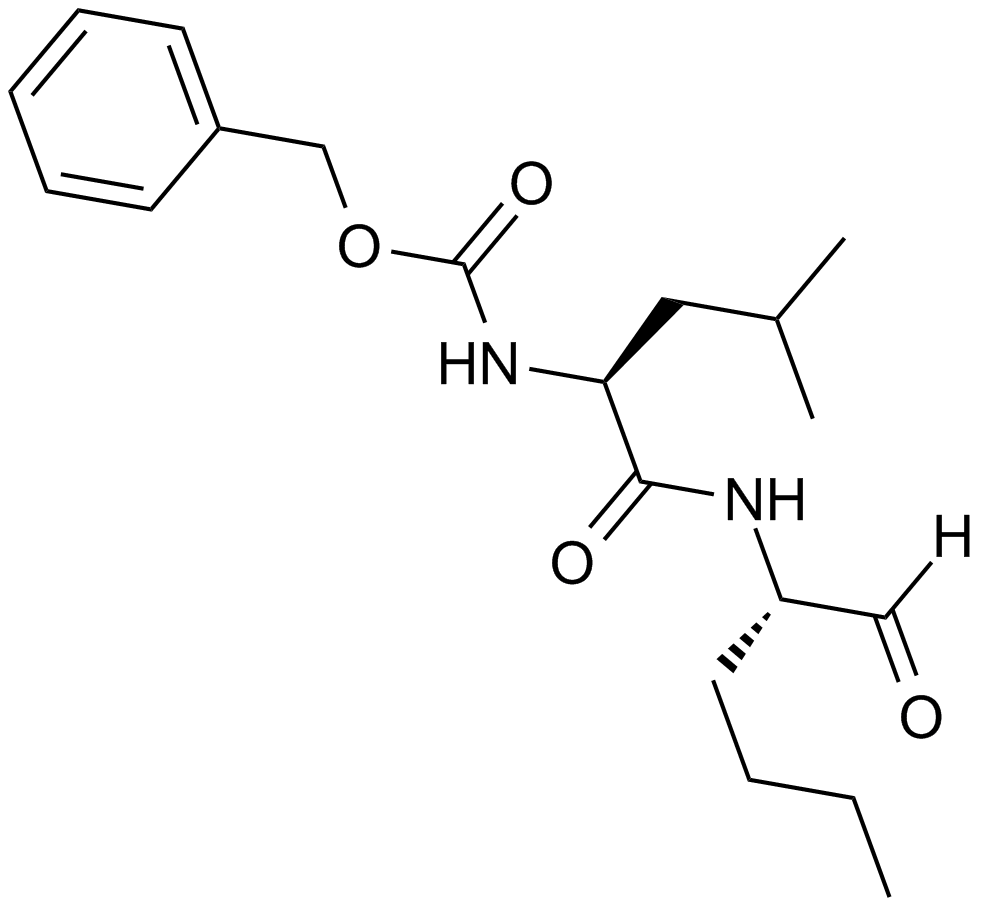
Cas No.: 117591-20-5
Sample solution is provided at 25 µL, 10mM.
Calpeptin is a reversible and cell-permeable cysteine cathepsin inhibitor. The ID50 values of Calpeptin for calpain I and II (porcine), papain, and platelet calpain I are 52nM, 34nM, 138nM, and 20nM, respectively[1]. Calpeptin alleviates apoptosis and secondary inflammatory changes in muscle cells[2].
In vitro, Calpeptin (1 and 5μM; 24h) attenuates apoptosis and secondary inflammatory changes induced by extracellular inflammatory stimulation in the muscle cells[2]. Calpeptin (0, 25, 50 and 100μmol/L; 4 days) inhibited PSC activation and proliferation and promoted PSC apoptosis[3].
In vivo, Calpeptin (1.75mg/kg/day; 1 week; i.p.) effectively reduced the expression of Calpain‐2 and TXNIP/NLRP3 inflammasome-related proteins, improved the decreased pericyte marker (PDGFR‐β) and cognitive impairment in hippocampus of DM rats[4]. Calpeptin (2mg/kg/100μl; 2 or 8 days; i.p.) administration after birth affects synaptic development in neonatal rats by inhibiting the Akt/mTOR signaling pathway, thereby perturbing hippocampal function[5]. Calpeptin (200μg/kg; 4 week; i.p.) is neuroprotective against acrylamide-induced neuropathy in rats[6].
References:
[1] Tsujinaka T, Kajiwara Y, Kambayashi J, et al. Synthesis of a new cell penetrating calpain inhibitor (calpeptin). Biochem Biophys Res Commun. 1988 Jun 30;153(3):1201-8.
[2] Shen J, Xiao W, Zong G, et al. Calpain Inhibitor Calpeptin Improves Pancreatic Fibrosis in Mice with Chronic Pancreatitis by Inhibiting the Activation of Pancreatic Stellate Cells. Curr Mol Pharmacol. 2024;17:e18761429241425.
[3] Nozaki K, Das A, Ray SK, et al. Calpeptin attenuated apoptosis and intracellular inflammatory changes in muscle cells. J Neurosci Res. 2011 Apr;89(4):536-43.
[4] Qiao L, Yi S, Li T, et al. Calpeptin improves the cognitive function in Alzheimer's disease-like complications of diabetes mellitus rats by regulating TXNIP/NLRP3 inflammasome. J Diabetes Investig. 2024 Oct;15(10):1365-1376.
[5] Song ZJ, Yang SJ, Han L, et al. Postnatal calpeptin treatment causes hippocampal neurodevelopmental defects in neonatal rats. Neural Regen Res. 2019 May;14(5):834-840.
[6] Su B, Guan Q, Wang M, et al. Calpeptin is neuroprotective against acrylamide-induced neuropathy in rats. Toxicology. 2018 May 1;400-401:1-8.
| Cell experiment [1]: | |
Cell lines | L6 rat myoblasts |
Preparation Method | When the L6 rat myoblasts reached 50%-60% confluency, they were washed twice with phosphate-buffered saline (PBS), pH 7.4. The medium was then changed to DMEM containing 1% fetal bovine serum (FBS) overnight, after which recombinant rat interferon-γ (500units/ml) or recombinant rat tumor necrosis factor-α (100ng/ml) was added. The myoblasts were treated with interferon-γ for 6, 12, 24 or 48h under the conditions of 37°C, 5% CO₂, and full humidity. To observe the effect of calpain inhibition, various doses of Calpeptin (1 and 5μM) were added 5min after exposure to interferon-γ (500units/ml) or tumor necrosis factor-α (100ng/ml). The myoblasts were treated with interferon-γ or tumor necrosis factor-α (100ng/ml) or/and Calpeptin for 24h under the conditions of 37°C, 5% CO₂, and full humidity. Subsequently, the cells were used for the detection of apoptotic changes and the expression of specific proteins. |
Reaction Conditions | 1 and 5μM; 24h |
Applications | Calpeptin attenuates apoptosis and secondary inflammatory changes induced by extracellular inflammatory stimulation in the muscle cells. |
| Animal experiment [2]: | |
Animal models | Sprague Dawley (SD) male rats |
Preparation Method | The diabetic (DM) rat model was constructed by a high-fat and high-sugar (HFHS) diet combined with streptozotocin (STZ). Eight-week-old Sprague-Dawley (SD) rats were fed with a HFHS diet (containing 20% sucrose, 10% fat, 2% cholesterol, and 1% sodium cholate) for 4 weeks. After 4 weeks of the HFHS diet, the rats were fasted for 20h and then intraperitoneally injected with streptozotocin at a dose of 30mg/kg/day for 5 consecutive days. After fasting for 8h, blood glucose levels were measured using a portable glucometer. When the blood glucose levels were ≥16.7mM, the rats were considered to be diabetic rats. After 4 weeks of the HFHS diet, the rats were intraperitoneally injected with 1.75mg/kg/day of Calpeptin for 1 week. As a control group, rats were fed with a normal diet and intraperitoneally injected with phosphate-buffered saline (PBS). |
Dosage form | 1.75mg/kg/day; 1 week; i.p. |
Applications | Calpeptin effectively reduced the expression of Calpain‐2 and TXNIP/NLRP3 inflammasome-related proteins, improved the decreased pericyte marker (PDGFR‐β) and cognitive impairment in hippocampus of DM rats. |
References: | |
| Cas No. | 117591-20-5 | SDF | |
| Chemical Name | benzyl N-[4-methyl-1-oxo-1-(1-oxohexan-2-ylamino)pentan-2-yl]carbamate | ||
| Canonical SMILES | CCCCC(C=O)NC(=O)C(CC(C)C)NC(=O)OCC1=CC=CC=C1 | ||
| Formula | C20H30N2O4 | M.Wt | 362.47 |
| الذوبان | ≥ 87.6 mg/mL in DMSO, ≥ 96.6 mg/mL in EtOH | Storage | Desiccate at 4°C |
| General tips | Please select the appropriate solvent to prepare the stock solution according to the
solubility of the product in different solvents; once the solution is prepared, please store it in
separate packages to avoid product failure caused by repeated freezing and thawing.Storage method
and period of the stock solution: When stored at -80°C, please use it within 6 months; when stored
at -20°C, please use it within 1 month. To increase solubility, heat the tube to 37°C and then oscillate in an ultrasonic bath for some time. |
||
| Shipping Condition | Evaluation sample solution: shipped with blue ice. All other sizes available: with RT, or with Blue Ice upon request. | ||
| Prepare stock solution | |||

|
1 mg | 5 mg | 10 mg |
| 1 mM | 2.7588 mL | 13.7942 mL | 27.5885 mL |
| 5 mM | 551.8 μL | 2.7588 mL | 5.5177 mL |
| 10 mM | 275.9 μL | 1.3794 mL | 2.7588 mL |
Step 1: Enter information below (Recommended: An additional animal making an allowance for loss during the experiment)
 g
μL
g
μL
Step 2: Enter the in vivo formulation (This is only the calculator, not formulation. Please contact us first if there is no in vivo formulation at the solubility Section.)
Calculation results:
Working concentration: mg/ml;
Method for preparing DMSO master liquid: mg drug pre-dissolved in μL DMSO ( Master liquid concentration mg/mL, Please contact us first if the concentration exceeds the DMSO solubility of the batch of drug. )
Method for preparing in vivo formulation: Take μL DMSO master liquid, next addμL PEG300, mix and clarify, next addμL Tween 80, mix and clarify, next add μL saline, mix and clarify.
Method for preparing in vivo formulation: Take μL DMSO master liquid, next add μL Corn oil, mix and clarify.
Note: 1. Please make sure the liquid is clear before adding the next solvent.
2. Be sure to add the solvent(s) in order. You must ensure that the solution obtained, in the previous addition, is a clear solution before proceeding to add the next solvent. Physical methods such as vortex, ultrasound or hot water bath can be used to aid dissolving.
3. All of the above co-solvents are available for purchase on the GlpBio website.
Quality Control & SDS
- View current batch:
- Purity: >98.00% Appearance: A solid
- COA (Certificate of Analysis)
- SDS (Safety Data Sheet)
- Datasheet

Average Rating: 5 (Based on Reviews and 30 reference(s) in Google Scholar.)