

Ceftaroline fosamil |
رقم الكتالوجGC35646
 One-Click Copy Product Info
|

Ceftaroline fosamil (TAK-599) ، مشتق من السيفالوسبورين ، هو دواء أولي N-phosphono من المكورات العنقودية الذهبية المقاومة للميثيسيلين (MRSA) T-91825
Products are for research use only. Not for human use. We do not sell to patients.
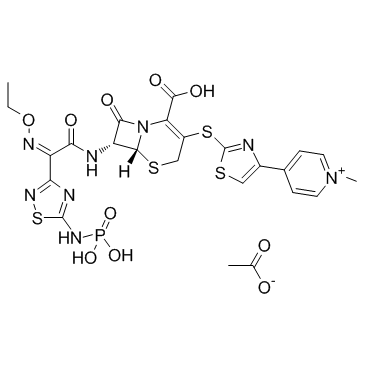
Cas No.: 400827-46-5
Sample solution is provided at 25 µL, 10mM.
_1-3.$$$39978408@51.jpg');)
_1-9.$$$38538795@65.jpg');)
_1-9.$$$39112701@51.jpg');)
_1-7.$$$37316672@70.jpg');)
_366-372.$$$36198801@70.jpg');)
.$$$38565142@65.jpg');)
_1867-1883.$$$33248023@67.jpg');)
_eads6055.$$$39977546@45.jpg');)
_eadm9805.$$$40080571@45.jpg');)
_eadj3020.$$$39666821@45.jpg');)
_1-20.$$$39757301@28.jpg');)
_1-24.$$$38898113@28.jpg');)
_273-287.$$$36806353@46.jpg');)
_1-16.$$$37156877@44.jpg');)
_1-19.$$$37460805@44.jpg');)
_1291-1307.$$$34518654@46.jpg');)
Ceftaroline fosamil is a water-soluble prodrug of the bioactive ceftaroline with the broad-spectrum antibacterial activity [1]. The bactericidal action of Ceftaroline fosamil is mediated through binding to PBPs on bacterial cell walls, leading to irreversible inhibition of cell-wall synthesis[2]. Ceftaroline fosamil has been widely used to kill drug-resistant Gram-positive and Gram-negative bacteria, as well as to treat experimental bacteraemia in animal models[3].
In vitro, Ceftaroline fosamil treatment for 24 hours significantly inhibited SARS-CoV-2 replication in Calu-3 cells with an EC50 value of 1.25µM[4].
In vivo, Ceftaroline fosamil treatment via intramuscular injection at a dose of 60mg/kg/day for 7 days significantly reduced the density of methicillin-resistant Staphylococcus aureus (MRSA) in the rabbit prosthetic joint infection model[5]. Ceftaroline fosamil (40mg/kg) administered intramuscularly every 8 hours for 3 days reduced the activity of MRSA in a rat model of endocarditis[6]. In a rabbit model of acute MRSA-infected osteomyelitis, treatment with Ceftaroline fosamil (10mg/kg) twice intravenously for 4 days significantly reduced bacterial density in synovial fluid, bone marrow, and bone[7].
References:
[1] Ye L, Zhang J, Xiao W, et al. Efficacy and mechanism of actions of natural antimicrobial drugs[J]. Pharmacology & Therapeutics, 2020, 216: 107671.
[2] Poon H, Chang M H, Fung H B. Ceftaroline fosamil: a cephalosporin with activity against methicillin-resistant Staphylococcus aureus[J]. Clinical therapeutics, 2012, 34(4): 743-765.
[3] García P, Moscoso M, Fernández M C, et al. Comparison of the in vivo efficacy of ceftaroline fosamil, vancomycin and daptomycin in a murine model of methicillin-resistant Staphylococcus aureus bacteraemia[J]. International Journal of Antimicrobial Agents, 2023, 62(1): 106836.
[4] Delgado C, Nogara P A, Miranda M D, et al. In Silico and In Vitro Studies of the Approved Antibiotic Ceftaroline Fosamil and Its Metabolites as Inhibitors of SARS-CoV-2 Replication[J]. Viruses, 2025, 17(4): 491.
[5] Gatin L, Saleh-Mghir A, Tasse J, et al. Ceftaroline-Fosamil efficacy against methicillin-resistant Staphylococcus aureus in a rabbit prosthetic joint infection model[J]. Antimicrobial agents and chemotherapy, 2014, 58(11): 6496-6500.
[6] Singh K V, Tran T T, Nannini E C, et al. Efficacy of ceftaroline against methicillin-susceptible Staphylococcus aureus exhibiting the cefazolin high-inoculum effect in a rat model of endocarditis[J]. Antimicrobial Agents and Chemotherapy, 2017, 61(7): 10.1128/aac. 00324-17.
[7] Jacqueline C, Amador G, Caillon J, et al. Efficacy of the new cephalosporin ceftaroline in the treatment of experimental methicillin-resistant Staphylococcus aureus acute osteomyelitis[J]. Journal of antimicrobial chemotherapy, 2010, 65(8): 1749-1752.
| Cell experiment [1]: | |
Cell lines | Calu-3 cells |
Preparation Method | Calu-3 cells were cultured in high-glucose Dulbecco's modified Eagle medium (DMEM) supplemented with 1% penicillin/streptomycin, HEPES buffer, and 10% fetal bovine serum (FBS). The culture conditions were 37℃ and 5% CO2 in a humid environment. The cells were seeded in 96-well plates with a cell density of 1.5×10⁴ cells/well and cultured in an incubator at 37 °C with 5% CO₂. Cells were infected with SARS-CoV-2 at a multiplicity of infection (MOI) of 0.01 and cultured for 1 hour at 37℃ in 5% CO2 atmosphere. Subsequently, the cells were treated with different concentrations of Ceftaroline fosamil (0.1, 0.316, 1, 3.16, and 10µM) for 24h, and 20µl of the supernatant was collected for viral titer determination. |
Reaction Conditions | 0.1, 0.316, 1, 3.16, and 10µM; 24h |
Applications | Ceftaroline fosamil treatment inhibited viral replication of SARS-CoV-2 in SARS-CoV-2 in a dose-dependent manner. |
| Animal experiment [2]: | |
Animal models | New Zealand White rabbits |
Preparation Method | New Zealand white rabbits (2.5-3kg) were housed individually in cages and maintained on a natural light-dark cycle. Each rabbit underwent a partial right knee replacement with a tibial prosthesis. Immediately after surgery, 5×10⁷ CFU of MRSA was inoculated into the rabbits in a 0.5ml volume of phosphate buffer near the knee joint where the prosthesis was located. On day 7 post-infection, rabbits were started to receive Ceftaroline fosamil (60mg/kg/day; s.c.), for 7 days. The control group received no treatment. Rabbit tibia tissues were collected for analysis. |
Dosage form | 60mg/kg/day for 7 days; s.c. |
Applications | Ceftaroline fosamil treatment significantly reduced the density of MRSA in the tibia of rabbit. |
References: | |
| Cas No. | 400827-46-5 | SDF | |
| Canonical SMILES | O=C1[C@@H](NC(/C(C2=NSC(NP(O)(O)=O)=N2)=N\OCC)=O)[C@@]3([H])SCC(SC4=NC(C5=CC=[N+](C)C=C5)=CS4)=C(C(O)=O)N13.CC([O-])=O | ||
| Formula | C24H25N8O10PS4 | M.Wt | 744.74 |
| الذوبان | DMSO: 30 mg/mL (40.28 mM and warming) | Storage | Store at 2-8°C |
| General tips | Please select the appropriate solvent to prepare the stock solution according to the
solubility of the product in different solvents; once the solution is prepared, please store it in
separate packages to avoid product failure caused by repeated freezing and thawing.Storage method
and period of the stock solution: When stored at -80°C, please use it within 6 months; when stored
at -20°C, please use it within 1 month. To increase solubility, heat the tube to 37°C and then oscillate in an ultrasonic bath for some time. |
||
| Shipping Condition | Evaluation sample solution: shipped with blue ice. All other sizes available: with RT, or with Blue Ice upon request. | ||
| Prepare stock solution | |||

|
1 mg | 5 mg | 10 mg |
| 1 mM | 1.3428 mL | 6.7138 mL | 13.4275 mL |
| 5 mM | 268.6 μL | 1.3428 mL | 2.6855 mL |
| 10 mM | 134.3 μL | 671.4 μL | 1.3428 mL |
Step 1: Enter information below (Recommended: An additional animal making an allowance for loss during the experiment)
 g
μL
g
μL
Step 2: Enter the in vivo formulation (This is only the calculator, not formulation. Please contact us first if there is no in vivo formulation at the solubility Section.)
Calculation results:
Working concentration: mg/ml;
Method for preparing DMSO master liquid: mg drug pre-dissolved in μL DMSO ( Master liquid concentration mg/mL, Please contact us first if the concentration exceeds the DMSO solubility of the batch of drug. )
Method for preparing in vivo formulation: Take μL DMSO master liquid, next addμL PEG300, mix and clarify, next addμL Tween 80, mix and clarify, next add μL saline, mix and clarify.
Method for preparing in vivo formulation: Take μL DMSO master liquid, next add μL Corn oil, mix and clarify.
Note: 1. Please make sure the liquid is clear before adding the next solvent.
2. Be sure to add the solvent(s) in order. You must ensure that the solution obtained, in the previous addition, is a clear solution before proceeding to add the next solvent. Physical methods such as vortex, ultrasound or hot water bath can be used to aid dissolving.
3. All of the above co-solvents are available for purchase on the GlpBio website.
Quality Control & SDS
- View current batch:
- Purity: >99.00% Appearance: A solid
- COA (Certificate of Analysis)
- SDS (Safety Data Sheet)
- Datasheet
Average Rating: 5 (Based on Reviews and 34 reference(s) in Google Scholar.)