

GS-9620 (Vesatolimod) (Synonyms: Vesatolimod) |
رقم الكتالوجGC12555
 One-Click Copy Product Info
|

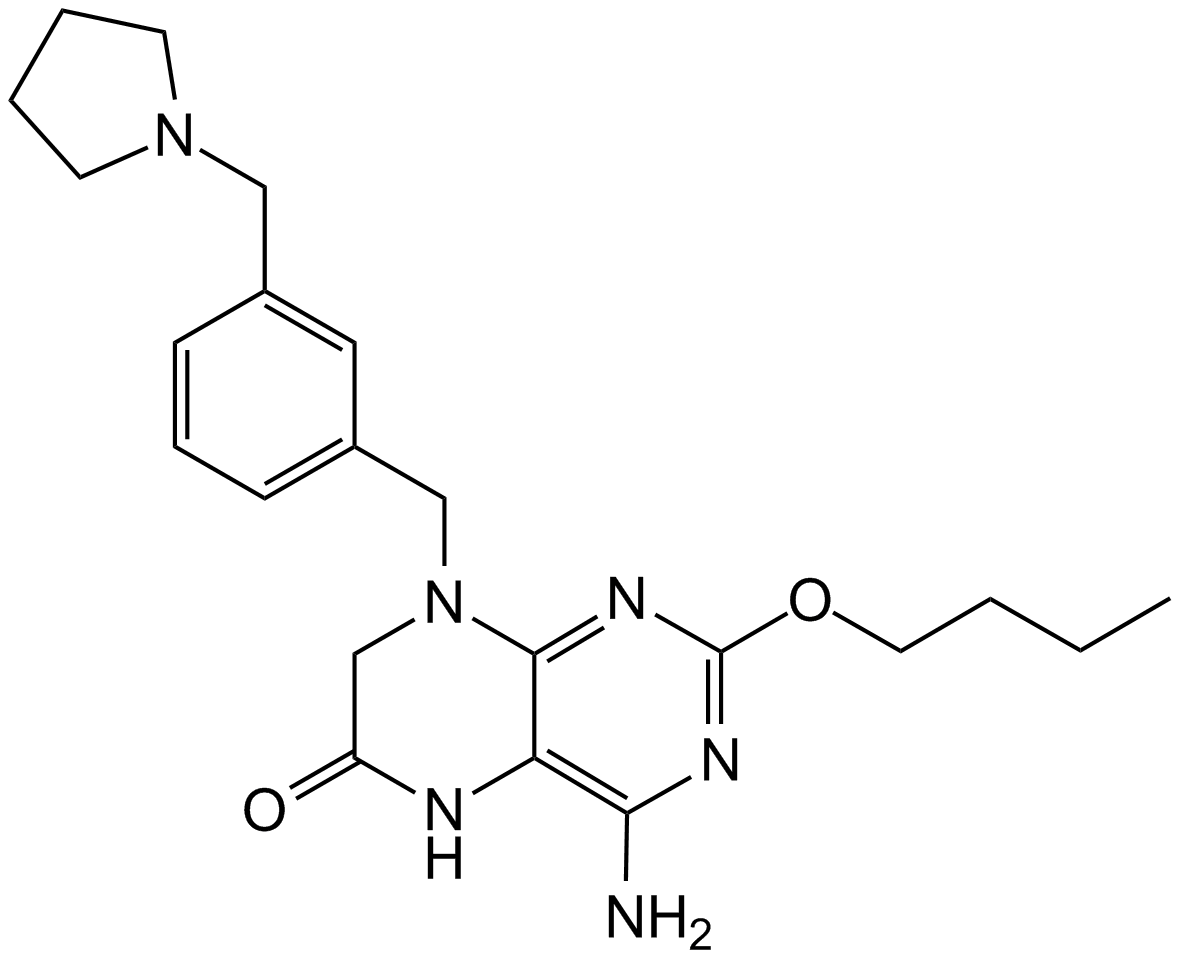
GS-9620 (Vesatolimod) is a potent, orally active Toll-like receptor 7 (TLR7) agonist with an EC50 value of 291nM, exhibiting antiviral activity.
Products are for research use only. Not for human use. We do not sell to patients.
Cas No.: 1228585-88-3
Sample solution is provided at 25 µL, 10mM.
_1-3.$$$39978408@51.jpg');)
_1-9.$$$38538795@65.jpg');)
_1-9.$$$39112701@51.jpg');)
_1-7.$$$37316672@70.jpg');)
_366-372.$$$36198801@70.jpg');)
.$$$38565142@65.jpg');)
_1867-1883.$$$33248023@67.jpg');)
_eads6055.$$$39977546@45.jpg');)
_eadm9805.$$$40080571@45.jpg');)
_eadj3020.$$$39666821@45.jpg');)
_1-20.$$$39757301@28.jpg');)
_1-24.$$$38898113@28.jpg');)
_273-287.$$$36806353@46.jpg');)
_1-16.$$$37156877@44.jpg');)
_1-19.$$$37460805@44.jpg');)
_1291-1307.$$$34518654@46.jpg');)
GS-9620 (Vesatolimod) is a potent, orally active Toll-like receptor 7 (TLR7) agonist with an EC50 value of 291nM, exhibiting antiviral activity[1, 2]. TLR7 is a pathogen recognition receptor that plays a critical role in pathogen detection and in mediating innate immune responses against pathogens[3]. GS-9620 is capable of enhancing HIV-specific cytotoxicity and anti-HIV antibody-mediated immunity[4].
In vitro, treatment of peripheral blood mononuclear cells (PBMCs) with GS-9620 (10-1000nM) for 36h significantly increased cytokine levels in the culture supernatant; specifically, Interleukin-6 (IL-6) levels increased 218-fold, IFN-α increased 186-fold, and IFN-β increased 81-fold[5]. Treatment of FMDV-infected LFBK cells with GS-9620 (78-625μM) for 48 and 72h reduced intracellular viral copy numbers in a dose-dependent manner and elevated IFN-α levels in the cell supernatant[6].
In vivo, oral administration of GS-9620 (4.5mg/kg) three times to mice infected with the EV71 virus significantly alleviated clinical symptoms and improved survival rates. Furthermore, it significantly reduced serum levels of pro-inflammatory cytokines—such as IFN-α, IFN-γ, and MCP-1, and activated the NF-κB and PI3K/AKT signaling pathways within limb muscle cells[7].
References:
[1] Wang Y K, Wei L, Hu W, et al. Medicinal chemistry of anti-HIV-1 latency chemotherapeutics: biotargets, binding modes and structure-activity relationship investigation[J]. Molecules, 2022, 28(1): 3.
[2] Lopatin U, Wolfgang G, Tumas D, et al. Safety, pharmacokinetics and pharmacodynamics of GS-9620, an oral Toll-like receptor 7 agonist[J]. Antiviral therapy, 2013, 18(3): 409-418.
[3] Kawai T, Akira S. Pathogen recognition with Toll-like receptors[J]. Current opinion in immunology, 2005, 17(4): 338-344.
[4] Tsai A, Irrinki A, Kaur J, et al. Toll-like receptor 7 agonist GS-9620 induces HIV expression and HIV-specific immunity in cells from HIV-infected individuals on suppressive antiretroviral therapy[J]. Journal of virology, 2017, 91(8): 10.1128/jvi. 02166-16.
[5] Bam R A, Hansen D, Irrinki A, et al. TLR7 agonist GS-9620 is a potent inhibitor of acute HIV-1 infection in human peripheral blood mononuclear cells[J]. Antimicrobial agents and chemotherapy, 2017, 61(1): 10.1128/aac. 01369-16.
[6] Lee G, Kang H R, Kim A, et al. Antiviral effect of vesatolimod (GS-9620) against foot-and-mouth disease virus both in vitro and in vivo[J]. Antiviral Research, 2022, 205: 105384.
[7] Zhang Q, Zhao B, Chen X, et al. GS-9620 inhibits enterovirus 71 replication mainly through the NF-κB and PI3K-AKT signaling pathways[J]. Antiviral Research, 2018, 153: 39-48.
| Cell experiment [1]: | |
Cell lines | Peripheral blood mononuclear cells (PBMCs) |
Preparation Method | TLR7 agonist-induced cytokine levels observed in resting PBMCs at 36h posttreatment with GS-9620 (10 to 1000nM), imiquimod (0.5 to 10g/mL), or gardiquimod (0.1 to 2.5g/mL) versus those observed in PBMCs treated with DMSO, as determined by Luminex analysis of cell-free culture supernatants. |
Reaction Conditions | 10-1000nM; 36h |
Applications | Relative to the levels in DMSO-treated cultures, GS-9620-conditioned supernatants showed the greatest fold increase in interleukin-6 (IL-6; 218-fold), IFN-α (186-fold), and IFN-γ (81-fold) levels. |
| Animal experiment [2]: | |
Animal models | EV71-infected mice |
Preparation Method | Mice were orally administered a dose of 4.5mg/kg three times. The survival rates and clinical symptoms of the GS-9620-treated, EV71-infected mice were compared with those of untreated mice, and hind-limb muscle tissues were collected from the mice for subsequent analysis. |
Dosage form | 4.5mg/kg; p.o. |
Applications | GS-9620 treatment significantly increased the survival rates and ameliorated the clinical symptoms of EV71-infected mice. GS-9620 activated TLR7 in the limb muscle cells, which stimulated the NF-κB and PI3K/AKT signaling pathways. |
References: | |
| Cas No. | 1228585-88-3 | SDF | |
| المرادفات | Vesatolimod | ||
| Chemical Name | 4-amino-2-butoxy-8-[[3-(pyrrolidin-1-ylmethyl)phenyl]methyl]-5,7-dihydropteridin-6-one | ||
| Canonical SMILES | CCCCOC1=NC2=C(C(=N1)N)NC(=O)CN2CC3=CC(=CC=C3)CN4CCCC4 | ||
| Formula | C22H30N6O2 | M.Wt | 410.51 |
| الذوبان | ≥ 20.55 mg/mL in DMSO, ≥ 9.9 mg/mL in EtOH with ultrasonic and warming | Storage | Store at -20°C |
| General tips | Please select the appropriate solvent to prepare the stock solution according to the
solubility of the product in different solvents; once the solution is prepared, please store it in
separate packages to avoid product failure caused by repeated freezing and thawing.Storage method
and period of the stock solution: When stored at -80°C, please use it within 6 months; when stored
at -20°C, please use it within 1 month. To increase solubility, heat the tube to 37°C and then oscillate in an ultrasonic bath for some time. |
||
| Shipping Condition | Evaluation sample solution: shipped with blue ice. All other sizes available: with RT, or with Blue Ice upon request. | ||
| Prepare stock solution | |||

|
1 mg | 5 mg | 10 mg |
| 1 mM | 2.436 mL | 12.18 mL | 24.3599 mL |
| 5 mM | 487.2 μL | 2.436 mL | 4.872 mL |
| 10 mM | 243.6 μL | 1.218 mL | 2.436 mL |
Step 1: Enter information below (Recommended: An additional animal making an allowance for loss during the experiment)
 g
μL
g
μL
Step 2: Enter the in vivo formulation (This is only the calculator, not formulation. Please contact us first if there is no in vivo formulation at the solubility Section.)
Calculation results:
Working concentration: mg/ml;
Method for preparing DMSO master liquid: mg drug pre-dissolved in μL DMSO ( Master liquid concentration mg/mL, Please contact us first if the concentration exceeds the DMSO solubility of the batch of drug. )
Method for preparing in vivo formulation: Take μL DMSO master liquid, next addμL PEG300, mix and clarify, next addμL Tween 80, mix and clarify, next add μL saline, mix and clarify.
Method for preparing in vivo formulation: Take μL DMSO master liquid, next add μL Corn oil, mix and clarify.
Note: 1. Please make sure the liquid is clear before adding the next solvent.
2. Be sure to add the solvent(s) in order. You must ensure that the solution obtained, in the previous addition, is a clear solution before proceeding to add the next solvent. Physical methods such as vortex, ultrasound or hot water bath can be used to aid dissolving.
3. All of the above co-solvents are available for purchase on the GlpBio website.
Quality Control & SDS
- View current batch:
- Purity: >99.50% Appearance: A solid
- COA (Certificate of Analysis)
- SDS (Safety Data Sheet)
- Datasheet
Average Rating: 5 (Based on Reviews and 30 reference(s) in Google Scholar.)