

Thioguanine (Synonyms: NSC 752, NSC 76504, 6TG) |
رقم الكتالوجGC14366
 One-Click Copy Product Info
|

Thioguanine is an anti-leukemia and immunosuppressant agent, with IC50 values of 40µM and 25μM for recombinant USP2 and coronaviral PLpro, respectively.
Products are for research use only. Not for human use. We do not sell to patients.
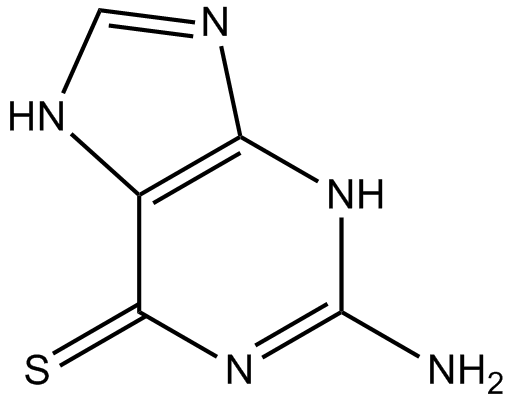
Cas No.: 154-42-7
Sample solution is provided at 25 µL, 10mM.
_1-3.$$$39978408@51.jpg');)
_1-9.$$$38538795@65.jpg');)
_1-9.$$$39112701@51.jpg');)
_1-7.$$$37316672@70.jpg');)
_366-372.$$$36198801@70.jpg');)
.$$$38565142@65.jpg');)
_1867-1883.$$$33248023@67.jpg');)
_eads6055.$$$39977546@45.jpg');)
_eadm9805.$$$40080571@45.jpg');)
_eadj3020.$$$39666821@45.jpg');)
_1-20.$$$39757301@28.jpg');)
_1-24.$$$38898113@28.jpg');)
_273-287.$$$36806353@46.jpg');)
_1-16.$$$37156877@44.jpg');)
_1-19.$$$37460805@44.jpg');)
_1291-1307.$$$34518654@46.jpg');)
Thioguanine is an anti-leukemia and immunosuppressant agent, with IC50 values of 40µM and 25μM for recombinant USP2 and coronaviral PLpro, respectively [1]. Thioguanine can be incorporated into CpG sites, affecting methylation of cytosine residues by methyltransferases and reducing the overall methylation level of cytosine[2]. Thioguanine has been widely used to inhibit a wide variety of cancer cells with a high frequency of homozygous deletion of the gene for methylthioadenosine phosphorylase (MTAP) [3].
In vitro, Thioguanine treatment for 48h inhibited the cell viability of MDA-MB-231, HCC1937, and MCF-10A cells with IC50 values of 2.489, 6.3, and 646.5μM, respectively[4]. Thioguanine treatment for 24 hours inhibited Herpes simplex virus 1 (HSV-1) replication in human corneal epithelial cells (HCECs) with an IC50 value of 0.104μM[5]. Treatment with 1µM Thioguanine for 48 hours significantly inhibited DNA polymerase γ replication in HCT116 cells, damaged mitochondrial DNA, and led to mitochondrial dysfunction[6].
In vivo, Thioguanine treatment via oral administration at a dose of 2.5mg/kg/day for 14 days ameliorated dextran sodium sulfate-induced chronic colitis in C57Bl/6 mice [7]. Thioguanine treatment (0.04mg/day; p.o.) for 5 days significantly extended the survival of the mouse model of leptomeningeal carcinomatosis[8].
References:
[1] Chuang S J, Cheng S C, Tang H C, et al. 6-Thioguanine is a noncompetitive and slow binding inhibitor of human deubiquitinating protease USP2[J]. Scientific reports, 2018, 8(1): 3102.
[2] Wang H, Wang Y. 6-Thioguanine perturbs cytosine methylation at the CpG dinucleotide site by DNA methyltransferases in vitro and acts as a DNA demethylating agent in vivo[J]. Biochemistry, 2009, 48(10): 2290-2299.
[3] Munshi P N, Lubin M, Bertino J R. 6-thioguanine: a drug with unrealized potential for cancer therapy[J]. The oncologist, 2014, 19(7): 760-765.
[4] Zhang D, An X, Li Q, et al. Thioguanine induces apoptosis in triple-negative breast cancer by regulating PI3K–AKT pathway[J]. Frontiers in Oncology, 2020, 10: 524922.
[5] Chen D, Liu Y, Zhang F, et al. 6-Thioguanine inhibits herpes simplex virus 1 infection of eyes[J]. Microbiology Spectrum, 2021, 9(3): e00646-21.
[6] Daehn I, Brem R, Barkauskaite E, et al. 6-Thioguanine damages mitochondrial DNA and causes mitochondrial dysfunction in human cells[J]. FEBS letters, 2011, 585(24): 3941-3946.
[7] Oancea I, Movva R, Das I, et al. Colonic microbiota can promote rapid local improvement of murine colitis by thioguanine independently of T lymphocytes and host metabolism[J]. Gut, 2017, 66(1): 59-69.
[8] Nakagawa H, Yui Y, Suzuki T, et al. Investigation of 6-thioguanine as a strategy to overcome methotrexate resistance in a mouse model of leptomeningeal carcinomatosis[J]. Journal of Neuro-Oncology, 2026, 176(1): 64.
| Cell experiment [1]: | |
Cell lines | MDA-MB-231 cells |
Preparation Method | MDA-MB-231 cells were cultured in RPMI 1640 medium supplemented with 10% fetal bovine serum, 100IU/ml penicillin, and 100μg/ml streptomycin. The cells were cultured at 37℃ in a humidified environment with 5% CO2. 6.5×10³ cells were seeded in each well of a 96-well plate and treated with various concentrations of Thioguanine (0.01, 0.1, 1, 10, 100, and 1000µM) for 48 hours. After that, CCK-8 solution was added and absorbance was measured at 450nm wavelength. |
Reaction Conditions | 0.01, 0.1, 1, 10, 100, and 1000µM; 48h |
Applications | Thioguanine treatment decreased the cell viability of MDA-MB-231 cells in a dose-dependent manner. |
| Animal experiment [2]: | |
Animal models | Female C3H/HeSlc mice |
Preparation Method | 10-week-old female C3H/HeSlc mice acclimated to the environment for one week. A mouse model of Leptomeningeal carcinomatosis was established by injecting 0.05 ml of 2×10⁵ methotrexate -resistant MM46 cells into the cisterna magna through a 26-gauge needle under anesthesia. Mice were maintained under SPF-grade conditions with controlled temperature and humidity, 12h light/12h dark cycles, and had ad libitum access to standard diet and sterilized tap water. The body weight, mobility, and food intake of mice were observed daily. Thioguanine was administered by gavage once a day for five consecutive days at a dose of 0.04mg, and the survival rate was analyzed. |
Dosage form | 0.04mg/day for 5 days; p.o. |
Applications | Thioguanine treatment significantly extended survival of mouse model of leptomeningeal carcinomatosis. |
References: | |
| Cas No. | 154-42-7 | SDF | |
| المرادفات | NSC 752, NSC 76504, 6TG | ||
| Chemical Name | 2-amino-3,7-dihydropurine-6-thione | ||
| Canonical SMILES | C1=NC2=C(N1)C(=S)N=C(N2)N | ||
| Formula | C5H5N5S | M.Wt | 167.19 |
| الذوبان | ≥ 8.35 mg/mL in DMSO with gentle warming | Storage | Store at -20°C |
| General tips | Please select the appropriate solvent to prepare the stock solution according to the
solubility of the product in different solvents; once the solution is prepared, please store it in
separate packages to avoid product failure caused by repeated freezing and thawing.Storage method
and period of the stock solution: When stored at -80°C, please use it within 6 months; when stored
at -20°C, please use it within 1 month. To increase solubility, heat the tube to 37°C and then oscillate in an ultrasonic bath for some time. |
||
| Shipping Condition | Evaluation sample solution: shipped with blue ice. All other sizes available: with RT, or with Blue Ice upon request. | ||
| Prepare stock solution | |||

|
1 mg | 5 mg | 10 mg |
| 1 mM | 5.9812 mL | 29.9061 mL | 59.8122 mL |
| 5 mM | 1.1962 mL | 5.9812 mL | 11.9624 mL |
| 10 mM | 598.1 μL | 2.9906 mL | 5.9812 mL |
Step 1: Enter information below (Recommended: An additional animal making an allowance for loss during the experiment)
 g
μL
g
μL
Step 2: Enter the in vivo formulation (This is only the calculator, not formulation. Please contact us first if there is no in vivo formulation at the solubility Section.)
Calculation results:
Working concentration: mg/ml;
Method for preparing DMSO master liquid: mg drug pre-dissolved in μL DMSO ( Master liquid concentration mg/mL, Please contact us first if the concentration exceeds the DMSO solubility of the batch of drug. )
Method for preparing in vivo formulation: Take μL DMSO master liquid, next addμL PEG300, mix and clarify, next addμL Tween 80, mix and clarify, next add μL saline, mix and clarify.
Method for preparing in vivo formulation: Take μL DMSO master liquid, next add μL Corn oil, mix and clarify.
Note: 1. Please make sure the liquid is clear before adding the next solvent.
2. Be sure to add the solvent(s) in order. You must ensure that the solution obtained, in the previous addition, is a clear solution before proceeding to add the next solvent. Physical methods such as vortex, ultrasound or hot water bath can be used to aid dissolving.
3. All of the above co-solvents are available for purchase on the GlpBio website.
Quality Control & SDS
- View current batch:
- Purity: >98.00% Appearance: A solid
- COA (Certificate of Analysis)
- SDS (Safety Data Sheet)
- Datasheet
Average Rating: 5 (Based on Reviews and 30 reference(s) in Google Scholar.)