

7-Dehydrocholesterol (Synonyms: Provitamin D3) |
Catalog No.GC33450
 One-Click Copy Product Info
|

7-Dehydrocholesterol (7-DHC) est un précurseur du cholestérol et de la vitamine D, et est converti en vitamine D3 dans la peau lors de l'exposition à la lumière ultraviolette de type B (UVB). 7-Dehydrocholesterol est un métabolite anti-ferroptotique naturel qui protège les cellules en prévenant la peroxydation lipidique, un processus clé de la ferroptose.
Products are for research use only. Not for human use. We do not sell to patients.
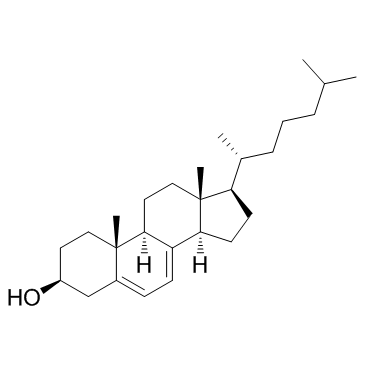
Cas No.: 434-16-2
Sample solution is provided at 25 µL, 10mM.
_1-3.$$$39978408@51.jpg');)
_1-9.$$$38538795@65.jpg');)
_1-9.$$$39112701@51.jpg');)
_1-7.$$$37316672@70.jpg');)
_366-372.$$$36198801@70.jpg');)
.$$$38565142@65.jpg');)
_1867-1883.$$$33248023@67.jpg');)
_eads6055.$$$39977546@45.jpg');)
_eadm9805.$$$40080571@45.jpg');)
_eadj3020.$$$39666821@45.jpg');)
_1-20.$$$39757301@28.jpg');)
_1-24.$$$38898113@28.jpg');)
_273-287.$$$36806353@46.jpg');)
_1-16.$$$37156877@44.jpg');)
_1-19.$$$37460805@44.jpg');)
_1291-1307.$$$34518654@46.jpg');)
7-Dehydrocholesterol (7-DHC) est un précurseur du cholestérol et de la vitamine D, et est converti en vitamine D3 dans la peau lors de l'exposition à la lumière ultraviolette de type B (UVB). 7-Dehydrocholesterol est un métabolite anti-ferroptotique naturel qui protège les cellules en prévenant la peroxydation lipidique, un processus clé de la ferroptose[3]. 7-Dehydrocholesterol s'accumule dans le syndrome de Smith-Lemli-Opitz (SLOS), une maladie causée par des mutations dans le gène DHCR7, caractérisée par de faible niveau de cholestérol dans les tissus et les fluides corporels, une microcéphalie, un handicap intellectuel et des caractéristiques physiques distinctes[4, 5]. 7-Dehydrocholesterol peut être converti en 7-kétocholestérol par le cytochrome P450 7A1 humain (CYP7A1)[6].
References:
[1] Lehmann B, Genehr T, Knuschke P, et al. UVB-induced conversion of 7-dehydrocholesterol to 1α, 25-dihydroxyvitamin D3 in an in vitro human skin equivalent model[J]. Journal of investigative dermatology, 2001, 117(5): 1179-1185.
[2] Shin M H, Lee Y, Kim M K, et al. UV increases skin-derived 1α, 25-dihydroxyvitamin D3 production, leading to MMP-1 expression by altering the balance of vitamin D and cholesterol synthesis from 7-dehydrocholesterol[J]. The Journal of Steroid Biochemistry and Molecular Biology, 2019, 195: 105449.
[3] Li Y, Ran Q, Duan Q, et al. 7-Dehydrocholesterol dictates ferroptosis sensitivity[J]. Nature, 2024, 626(7998): 411-418.
[4] Waterham H R, Wanders R J A. Biochemical and genetic aspects of 7-dehydrocholesterol reductase and Smith-Lemli-Opitz syndrome[J]. Biochimica et Biophysica Acta (BBA)-Molecular and Cell Biology of Lipids, 2000, 1529(1-3): 340-356.
[5] Bianconi S E, Cross J L, Wassif C A, et al. Pathogenesis, epidemiology, diagnosis and clinical aspects of Smith–Lemli–Opitz syndrome[J]. Expert opinion on orphan drugs, 2015, 3(3): 267-280.
[6] Shinkyo R, Xu L, Tallman K A, et al. Conversion of 7-dehydrocholesterol to 7-ketocholesterol is catalyzed by human cytochrome P450 7A1 and occurs by direct oxidation without an epoxide intermediate[J]. Journal of Biological Chemistry, 2011, 286(38): 33021-33028.
| Cas No. | 434-16-2 | SDF | |
| Synonymes | Provitamin D3 | ||
| Chemical Name | cholesta-5,7-dien-3β-ol | ||
| Canonical SMILES | CC(C)CCC[C@@H](C)[C@H]1CC[C@@]2([H])C3=CC=C4C[C@@H](O)CC[C@]4(C)[C@@]3([H])CC[C@]12C | ||
| Formula | C27H44O | M.Wt | 384.64 |
| Solubility | Ethanol: 16.67 mg/mL (43.34 mM); DMSO: < 1 mg/mL (insoluble or slightly soluble) | Storage | Store at -20°C |
| General tips | Please select the appropriate solvent to prepare the stock solution according to the
solubility of the product in different solvents; once the solution is prepared, please store it in
separate packages to avoid product failure caused by repeated freezing and thawing.Storage method
and period of the stock solution: When stored at -80°C, please use it within 6 months; when stored
at -20°C, please use it within 1 month. To increase solubility, heat the tube to 37°C and then oscillate in an ultrasonic bath for some time. |
||
| Shipping Condition | Evaluation sample solution: shipped with blue ice. All other sizes available: with RT, or with Blue Ice upon request. | ||
| Prepare stock solution | |||

|
1 mg | 5 mg | 10 mg |
| 1 mM | 2.5998 mL | 12.9992 mL | 25.9983 mL |
| 5 mM | 520 μL | 2.5998 mL | 5.1997 mL |
| 10 mM | 260 μL | 1.2999 mL | 2.5998 mL |
Step 1: Enter information below (Recommended: An additional animal making an allowance for loss during the experiment)
 g
μL
g
μL
Step 2: Enter the in vivo formulation (This is only the calculator, not formulation. Please contact us first if there is no in vivo formulation at the solubility Section.)
Calculation results:
Working concentration: mg/ml;
Method for preparing DMSO master liquid: mg drug pre-dissolved in μL DMSO ( Master liquid concentration mg/mL, Please contact us first if the concentration exceeds the DMSO solubility of the batch of drug. )
Method for preparing in vivo formulation: Take μL DMSO master liquid, next addμL PEG300, mix and clarify, next addμL Tween 80, mix and clarify, next add μL saline, mix and clarify.
Method for preparing in vivo formulation: Take μL DMSO master liquid, next add μL Corn oil, mix and clarify.
Note: 1. Please make sure the liquid is clear before adding the next solvent.
2. Be sure to add the solvent(s) in order. You must ensure that the solution obtained, in the previous addition, is a clear solution before proceeding to add the next solvent. Physical methods such as vortex, ultrasound or hot water bath can be used to aid dissolving.
3. All of the above co-solvents are available for purchase on the GlpBio website.
Quality Control & SDS
- View current batch:
- Purity: >99.00% Appearance: A solid
- COA (Certificate of Analysis)
- SDS (Safety Data Sheet)
- Datasheet
Average Rating: 5 (Based on Reviews and 23 reference(s) in Google Scholar.)