
Accueil>>Signaling Pathways>> GPCR/G protein>> Adrenergic Receptor>>A 61603 hydrobromide

A 61603 hydrobromide

Catalog No.GC14527

Un bromhydrate 61603 est un agoniste sélectif des récepteurs α1A-adrénergiques.

Products are for research use only. Not for human use. We do not sell to patients.
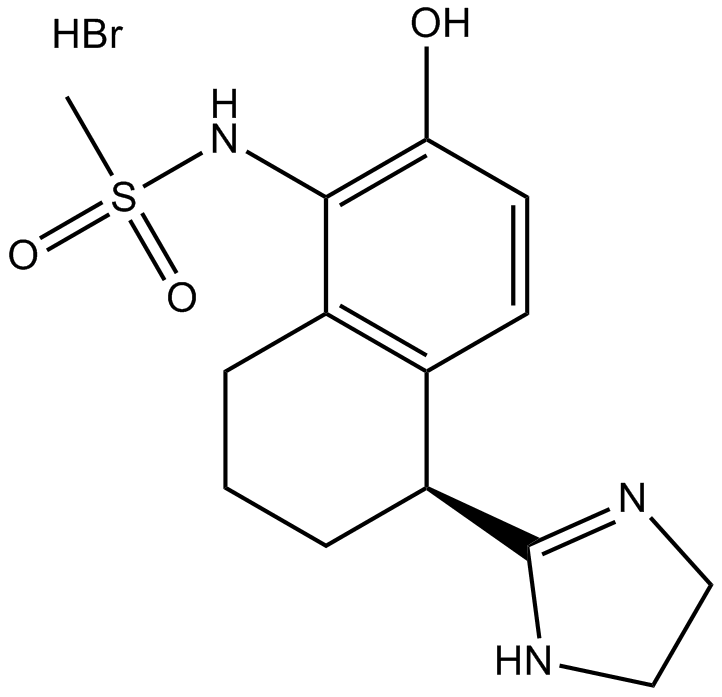
A 61603 hydrobromide Chemical Structure

Cas No.: 107756-30-9

Taille Prix Stock Qté
1mg
45,00 $US
En stock
5mg
140,00 $US
En stock
10mg
195,00 $US
En stock

Tel:(909) 407-4943 Email: sales@glpbio.com


Avis des clients

Based on customer reviews.

Sample solution is provided at 25 µL, 10mM.

Description of A 61603 hydrobromide

A 61603 hydrobromide is a potent and selective agonist of α1A-adrenoceptor [1].

α1A-adrenoceptor (α1A-AR) belongs to α1- adrenergic receptors, which include three subtypes α1A, α1B and α1D and play an important role in regulating cell growth and proliferation.

A 61603 hydrobromide is a potent and selective α1A-adrenoceptor agonist. A-61603 was 35-fold more potent at α1A-AR than at α1B-AR or α1D-AR. In fibroblast cells transfected with α1A-AR, A-61603 significantly stimulated phosphoinositide hydrolysis [1]. A 61603 exhibited affinity for α1A-AR, α1B-AR and α1D-AR with pKi values of 8.05/7.52, 5.68 and 5.87, respectively. Also, A 61603 exhibited agonist activities for α1A-AR, α1B-AR and α1D-AR with pEC50 values of 8.24/7.66, 6.50 and 5.59, respectively [2]. In neonatal rat ventricular myocytes, A61603 significantly increased the frequency of Ca2+ transients with EC50 value of 6.9 nM in a dose-dependent way [3]. In mesenteric vascular bed isolated from mice, A61603 significantly increased perfusion pressure with 235-fold higher potency than phenylephrine, which suggested that α1A-AR plays an important role in the control of blood pressure [4].

References:
[1].  Knepper SM, Buckner SA, Brune ME, et al. A-61603, a potent alpha 1-adrenergic receptor agonist, selective for the alpha 1A receptor subtype. J Pharmacol Exp Ther, 1995, 274(1): 97-103.
[2].  Meyer MD, Altenbach RJ, Hancock AA, et al. Synthesis and in vitro characterization of N-[5-(4,5-dihydro-1H-imidazol-2-yl)-2-hydroxy-5,6,7,8- tetrahydronaphthalen-1-yl]methanesulfonamide and its enantiomers: a novel selective alpha 1A receptor agonist. J Med Chem, 1996, 39(20): 4116-4119.
[3].  Luo DL, Gao J, Fan LL, et al. Receptor subtype involved in alpha 1-adrenergic receptor-mediated Ca2+ signaling in cardiomyocytes. Acta Pharmacol Sin, 2007, 28(7): 968-974.
[4].  Martínez-Salas SG1, Campos-Peralta JM, Pares-Hipolito J, et al. Alpha1A-adrenoceptors predominate in the control of blood pressure in mouse mesenteric vascular bed. Auton Autacoid Pharmacol, 2007, 27(3): 137-142.

Chemical Properties of A 61603 hydrobromide

Cas No. 107756-30-9 SDF
Chemical Name (S)-N-(5-(4,5-dihydro-1H-imidazol-2-yl)-2-hydroxy-5,6,7,8-tetrahydronaphthalen-1-yl)methanesulfonamide hydrobromide
Canonical SMILES OC1=C(C2=C(C=C1)[C@@H](C3=NCCN3)CCC2)NS(=O)(C)=O.Br
Formula C14H19N3O3S.HBr M.Wt 390.29
Solubility DMF: 20 mg/ml,DMSO: 20 mg/ml,Ethanol: 1 mg/ml,PBS (pH 7.2): 10 mg/ml Storage Store at -20°C
General tips Please select the appropriate solvent to prepare the stock solution according to the solubility of the product in different solvents; once the solution is prepared, please store it in separate packages to avoid product failure caused by repeated freezing and thawing.Storage method and period of the stock solution: When stored at -80°C, please use it within 6 months; when stored at -20°C, please use it within 1 month.
To increase solubility, heat the tube to 37°C and then oscillate in an ultrasonic bath for some time.
Shipping Condition Evaluation sample solution: shipped with blue ice. All other sizes available: with RT, or with Blue Ice upon request.

Complete Stock Solution Preparation Table of A 61603 hydrobromide

Prepare stock solution
1 mg 5 mg 10 mg
1 mM 2.5622 mL 12.811 mL 25.622 mL
5 mM 512.4 μL 2.5622 mL 5.1244 mL
10 mM 256.2 μL 1.2811 mL 2.5622 mL
  • Molarity Calculator

  • Dilution Calculator

  • Molecular Weight Calculator

Mass
=
Concentration
x
Volume
x
MW*


**When preparing stock solutions always use the batch-specific molecular weight of the product found on the vial label and MSDS / CoA (available online).

Calculate

In vivo Formulation Calculator (Clear solution) of A 61603 hydrobromide

Step 1: Enter information below (Recommended: An additional animal making an allowance for loss during the experiment)

mg/kg g μL

Step 2: Enter the in vivo formulation (This is only the calculator, not formulation. Please contact us first if there is no in vivo formulation at the solubility Section.)

% DMSO % % Tween 80 % ddH2O
%DMSO %

Calculation results:

Working concentration: mg/ml;

Method for preparing DMSO master liquid: mg drug pre-dissolved in μL DMSO ( Master liquid concentration mg/mL, Please contact us first if the concentration exceeds the DMSO solubility of the batch of drug. )

Method for preparing in vivo formulation: Take μL DMSO master liquid, next addμL PEG300, mix and clarify, next addμL Tween 80, mix and clarify, next add μL ddH2O, mix and clarify.

Method for preparing in vivo formulation: Take μL DMSO master liquid, next add μL Corn oil, mix and clarify.

Note: 1. Please make sure the liquid is clear before adding the next solvent.
2. Be sure to add the solvent(s) in order. You must ensure that the solution obtained, in the previous addition, is a clear solution before proceeding to add the next solvent. Physical methods such as vortex, ultrasound or hot water bath can be used to aid dissolving.
3. All of the above co-solvents are available for purchase on the GlpBio website.

Product Documents

Quality Control & SDS

View current batch:

Avis

Review for A 61603 hydrobromide

Average Rating: 5 ★★★★★ (Based on Reviews and 3 reference(s) in Google Scholar.)

5 Star
100%
4 Star
0%
3 Star
0%
2 Star
0%
1 Star
0%
Review for A 61603 hydrobromide

GLPBIO products are for RESEARCH USE ONLY. Please make sure your review or question is research based.

Required fields are marked with *

You may receive emails regarding this submission. Any emails will include the ability to opt-out of future communications.