

ATN-161 trifluoroacetate salt (ATN-161 TFA salt) (Synonyms: Ac-PHSCN-NH2, PHSCN Peptide) |
Catalog No.GC33837
 One-Click Copy Product Info
|

Le sel de trifluoroacétate d'ATN-161 (sel d'ATN-161 TFA) est un nouvel antagoniste de l'intégrine α5β1, qui inhibe l'angiogenèse et la croissance des métastases hépatiques dans un modèle murin.
Products are for research use only. Not for human use. We do not sell to patients.
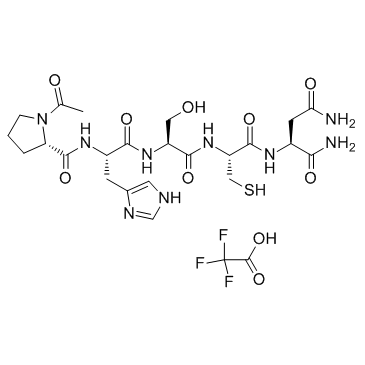
Cas No.: 904763-27-5
Sample solution is provided at 25 µL, 10mM.
_1-3.$$$39978408@51.jpg');)
_1-9.$$$38538795@65.jpg');)
_1-9.$$$39112701@51.jpg');)
_1-7.$$$37316672@70.jpg');)
_366-372.$$$36198801@70.jpg');)
.$$$38565142@65.jpg');)
_1867-1883.$$$33248023@67.jpg');)
_eads6055.$$$39977546@45.jpg');)
_eadm9805.$$$40080571@45.jpg');)
_eadj3020.$$$39666821@45.jpg');)
_1-20.$$$39757301@28.jpg');)
_1-24.$$$38898113@28.jpg');)
_273-287.$$$36806353@46.jpg');)
_1-16.$$$37156877@44.jpg');)
_1-19.$$$37460805@44.jpg');)
_1291-1307.$$$34518654@46.jpg');)
ATN-161 trifluoroacetate salt (ATN-161 TFA salt) is a non-RGD fibronectin-derived pentapeptide integrin α5β1/αVβ3/αVβ5 antagonist. ATN-161 trifluoroacetate salt blocks fibronectin binding and αVβ5 interaction with ACE2/SARS-CoV-2 spike protein to inhibit endothelial migration, angiogenesis, and viral entry into host cells. ATN-161 trifluoroacetate salt reduces tumor metastasis and inflammation by interfering with integrin-mediated adhesion and Rho/NF-κB signaling. ATN-161 trifluoroacetate salt is useful for research on solid tumors and metastasis, choroidal neovascularization, ischemic stroke, and COVID-19[1-4].
In vitro, treatment of TSC2-deficient lung vascular smooth muscle cells with 10μM ATN-161 trifluoroacetate salt for 4 days blocked matrix-induced cell proliferation[5]. Treatment of pluripotent stem cell-derived hematopoietic differentiation cells with 10μM ATN-161 trifluoroacetate salt for 2-6 days did not affect RUNX1, GATA2, and MYB expression. Treatment of pluripotent stem cell-derived hematopoietic differentiation cells with 10μM ATN-161 trifluoroacetate salt for 2-6 days did not affect CD43+ HPCs generation[6]. Pretreatment of periodontal ligament stem cells with 10μM ATN-161 trifluoroacetate salt for 24 hours reduced Porphyromonas gingivalis infection in periodontal ligament stem cells[7].
In vivo, tail vein injection of 30μg/mouse ATN-161 trifluoroacetate salt twice per week for 5 weeks in NSG mice orthotopically injected with LM2 cells inhibited primary tumor growth, whereas ATN-161 trifluoroacetate salt did not reduce spontaneous lung metastasis[8]. A single intravitreal injection of 5μL 0.1-10μg/mL ATN-161 trifluoroacetate salt in Brown-Norway rats after laser-induced choroidal neovascularization inhibited choroidal neovascularization leakage and neovascularization. A single intravitreal injection of 5μL 0.1-10μg/mL ATN-161 trifluoroacetate salt in Brown-Norway rats after laser-induced choroidal neovascularization reduced choroidal neovascularization area and thickness, decreased VEGF expression in the RPE-choroid complex[9]. Intraperitoneal injection of 100mg/kg ATN-161 trifluoroacetate salt every 3 days for 21 days starting from day 4 after intrasplenic injection of CT26 cells in BALB/c mice inhibited liver metastasis tumor angiogenesis. Combination with 100mg/kg 5-FU infusion reduced liver metastasis number and liver weight, decreased tumor cell proliferation, increased tumor cell apoptosis, and improved overall survival[10].
References:[1] Gao RR, Ma LY, Chen JW, et al. ATN-161 alleviates caerulein-induced pancreatitis. J Genet Genomics. 2024 Dec;51(12):1447-1458.
[2] Rabbani G, Ahn SN, Kwon H, et al. Penta-peptide ATN-161 based neutralization mechanism of SARS-CoV-2 spike protein. Biochem Biophys Rep. 2021 Dec;28:101170.
[3] Amruta N, Bix G. ATN-161 Ameliorates Ischemia/Reperfusion-induced Oxidative Stress, Fibro-inflammation, Mitochondrial damage, and Apoptosis-mediated Tight Junction Disruption in bEnd.3 Cells. Inflammation. 2021 Dec;44(6):2377-2394.
[4] Sui A, Zhong Y, Demetriades AM, et al. ATN-161 as an Integrin α5β1 Antagonist Depresses Ocular Neovascularization by Promoting New Vascular Endothelial Cell Apoptosis. Med Sci Monit. 2018 Aug 22;24:5860-5873.
[5] Shen Y, Goncharov D, Pena A, et al. Crosstalk between TSC2 and the extracellular matrix controls pulmonary vascular proliferation and pulmonary hypertension. Sci Signal. 2022 Dec 6;15(763):eabn2743.
[6] Shen J, Zhu Y, Zhang S, et al. Vitronectin-activated αvβ3 and αvβ5 integrin signalling specifies haematopoietic fate in human pluripotent stem cells. Cell Prolif. 2021;54:e13012.
[7] Liu X, Yuan Z, Wan Z, et al. P. gingivalis-host interactions direct antibiotic adjuvants for periodontitis antimicrobial therapy. Int J Oral Sci. 2026;18:50.
[8] Shen M, Jiang Y, Wei Y, et al. Tinagl1 suppresses triple-negative breast cancer progression and metastasis by simultaneously inhibiting integrin/FAK and EGFR signaling. Cancer Cell. 2019 Jan 14;35(1):64-80.
[9] Wang W, Wang F, Lu F, et al. The antiangiogenic effects of integrin α5β1 inhibitor(ATN-161) in vitro and in vivo. Invest Ophthalmol Vis Sci. 2011;52(10):7213-7220.
[10] Stoeltzing O, LiU W, Reinmuth N, et al. Inhibition of integrin α5β1 function with a small peptide(ATN-161) plus continuous 5-FU infusion reduces colorectal liver metastases and improves survival in mice. Int J Cancer. 2003;104(4):496-503.
| Cell experiment [1]: | |
|
Cell lines |
Human periodontal ligament stem cells (PDLSCs) and human oral keratinocytes (HOK) |
|
Preparation Method |
PDLSCs and HOK were pretreated with 10μM ATN-161 trifluoroacetate salt for 24 hours, followed by infection with P. gingivalis ATCC 33277 at MOI 100 for 2 hours, then cells were washed and lysed to release intracellular bacteria for CFU counting, or fixed for immunofluorescence staining. |
|
Reaction Conditions |
10μM; 24h |
|
Applications |
ATN-161 trifluoroacetate salt reduced P. gingivalis infection in PDLSCs, but showed poor inhibitory effect on P. gingivalis infection in HOK. |
| Animal experiment [2]: | |
|
Animal models |
NSG mice |
|
Preparation Method |
Mice were orthotopically injected with 104 LM2 cells into mammary fat pad. When tumors reached 2mm in diameter, mice were intravenously treated with ATN-161 trifluoroacetate salt (30μg/mouse) twice per week for 5 weeks. Primary tumors and lungs were collected for Western blotting, immunohistochemistry staining, and bioluminescence imaging. |
|
Dosage form |
30μg/mouse; i.v.; twice per week for 5 weeks |
|
Applications |
ATN-161 trifluoroacetate salt suppressed focal adhesion kinase activation and tumor cell proliferation in primary tumors, but ATN-161 trifluoroacetate salt did not reduce spontaneous lung metastasis or inhibit tumor cell proliferation in lung metastatic nodules. |
| References: [1] Liu X, Yuan Z, Wan Z, et al. P. gingivalis-host interactions direct antibiotic adjuvants for periodontitis antimicrobial therapy. Int J Oral Sci. 2026;18:50. [2] Shen M, Jiang Y, Wei Y, et al. Tinagl1 suppresses triple-negative breast cancer progression and metastasis by simultaneously inhibiting integrin/FAK and EGFR signaling. Cancer Cell. 2019 Jan 14;35(1):64-80. | |
| Cas No. | 904763-27-5 | SDF | |
| Synonymes | Ac-PHSCN-NH2, PHSCN Peptide | ||
| Canonical SMILES | FC(F)(C(O)=O)F.O=C(N)C[C@@H](C(N)=O)NC([C@H](CS)NC([C@H](CO)NC([C@H](CC1=CNC=N1)NC([C@H]2N(C(C)=O)CCC2)=O)=O)=O)=O | ||
| Formula | C25H36F3N9O10S | M.Wt | 711.67 |
| Solubility | DMSO : 1 mg/mL (1.41 mM) | Storage | Store at -20°C |
| General tips | Please select the appropriate solvent to prepare the stock solution according to the
solubility of the product in different solvents; once the solution is prepared, please store it in
separate packages to avoid product failure caused by repeated freezing and thawing.Storage method
and period of the stock solution: When stored at -80°C, please use it within 6 months; when stored
at -20°C, please use it within 1 month. To increase solubility, heat the tube to 37°C and then oscillate in an ultrasonic bath for some time. |
||
| Shipping Condition | Evaluation sample solution: shipped with blue ice. All other sizes available: with RT, or with Blue Ice upon request. | ||
| Prepare stock solution | |||

|
1 mg | 5 mg | 10 mg |
| 1 mM | 1.4051 mL | 7.0257 mL | 14.0515 mL |
| 5 mM | 281 μL | 1.4051 mL | 2.8103 mL |
| 10 mM | 140.5 μL | 702.6 μL | 1.4051 mL |
Step 1: Enter information below (Recommended: An additional animal making an allowance for loss during the experiment)
 g
μL
g
μL
Step 2: Enter the in vivo formulation (This is only the calculator, not formulation. Please contact us first if there is no in vivo formulation at the solubility Section.)
Calculation results:
Working concentration: mg/ml;
Method for preparing DMSO master liquid: mg drug pre-dissolved in μL DMSO ( Master liquid concentration mg/mL, Please contact us first if the concentration exceeds the DMSO solubility of the batch of drug. )
Method for preparing in vivo formulation: Take μL DMSO master liquid, next addμL PEG300, mix and clarify, next addμL Tween 80, mix and clarify, next add μL saline, mix and clarify.
Method for preparing in vivo formulation: Take μL DMSO master liquid, next add μL Corn oil, mix and clarify.
Note: 1. Please make sure the liquid is clear before adding the next solvent.
2. Be sure to add the solvent(s) in order. You must ensure that the solution obtained, in the previous addition, is a clear solution before proceeding to add the next solvent. Physical methods such as vortex, ultrasound or hot water bath can be used to aid dissolving.
3. All of the above co-solvents are available for purchase on the GlpBio website.
Quality Control & SDS
- View current batch:
- Purity: >98.00% Appearance: A solid
- COA (Certificate of Analysis)
- SDS (Safety Data Sheet)
- Datasheet
Average Rating: 5 (Based on Reviews and 15 reference(s) in Google Scholar.)