

Chicoric acid (Synonyms: L-Chicoric Acid, Dicaffeoyltartaric Acid, NSC 99173) |
Catalog No.GC64993
 One-Click Copy Product Info
|

Chicoric acid est un acide hydroxycinnamique, appartenant à la classe des composés orgnaiques phénylpropanoïdes. Chicoric acid est présent dans diverses plantes, notamment la chicorée, le pissenlit et le basilic, et possède de multiples activités biologiques telles que des effets antioxydants, anti-inflammatoires, anti-diabétiques et antiviraux.
Products are for research use only. Not for human use. We do not sell to patients.
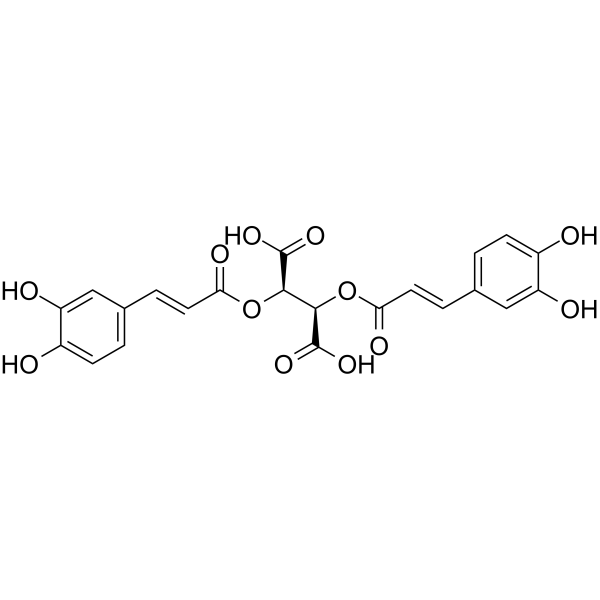
Cas No.: 6537-80-0
Sample solution is provided at 25 µL, 10mM.
_1-3.$$$39978408@51.jpg');)
_1-9.$$$38538795@65.jpg');)
_1-9.$$$39112701@51.jpg');)
_1-7.$$$37316672@70.jpg');)
_366-372.$$$36198801@70.jpg');)
.$$$38565142@65.jpg');)
_1867-1883.$$$33248023@67.jpg');)
_eads6055.$$$39977546@45.jpg');)
_eadm9805.$$$40080571@45.jpg');)
_eadj3020.$$$39666821@45.jpg');)
_1-20.$$$39757301@28.jpg');)
_1-24.$$$38898113@28.jpg');)
_273-287.$$$36806353@46.jpg');)
_1-16.$$$37156877@44.jpg');)
_1-19.$$$37460805@44.jpg');)
_1291-1307.$$$34518654@46.jpg');)
Chicoric acid est un acide hydroxycinnamique, appartenant à la classe des composés orgnaiques phénylpropanoïdes. Chicoric acid est présent dans diverses plantes, notamment la chicorée, le pissenlit et le basilic, et possède de multiples activités biologiques telles que des effets antioxydants, anti-inflammatoires, anti-diabétiques et antiviraux[1, 2]. Chicoric acid peut favoriser la libération d'insuline et la captation du glucose[3].Il peut également atténuer les troubles cognitifs induits par le stress oxydatif[4].
In vitro, le prétraitement des cellules endothéliales de la veine ombilicale humaine (HUVECs) avec Chicoric acid (25-200µM) pendant 30min a inhibé l'apoptose induite par un milieu riche en glucose et en graisses (HG+HF), et a réduit la phosphorylation et la dégradation de IκBα ainsi que la translocation nucléaire subséquente de p65 NFκB induites par HG+HF[5]. Le traitement des préadipocytes 3T3-L1 avec Chicoric acid (10-200µM) pendant 24-72h a inhibé la viabilité cellulaire de manière dose-et temps-dépendante, a induit l'apoptose et a réduit le potentiel de membrane mitochondrial (MMP)[6].
In vivo, l'administration de Chicoric acid (20mg/kg) par injection intrapéritonéal à des souris souffrant d'un choc anaphylactique induit par le composé 48/80 a réduit les taux sériques d'histamine et la mortalité[7].
References:
[1] Duda Ł, Kłosiński K K, Budryn G, et al. Medicinal use of chicory (Cichorium intybus L.)[J]. Scientia Pharmaceutica, 2024, 92(2): 31.
[2] Ferrare K, Bidel L P R, Awwad A, et al. Increase in insulin sensitivity by the association of chicoric acid and chlorogenic acid contained in a natural chicoric acid extract (NCRAE) of chicory (Cichorium intybus L.) for an antidiabetic effect[J]. Journal of ethnopharmacology, 2018, 215: 241-248.
[3] Tousch D, Lajoix A D, Hosy E, et al. Chicoric acid, a new compound able to enhance insulin release and glucose uptake[J]. Biochemical and biophysical research communications, 2008, 377(1): 131-135.
[4] Wang Y, Diao Z, Li J, et al. Chicoric acid supplementation ameliorates cognitive impairment induced by oxidative stress via promotion of antioxidant defense system[J]. RSC advances, 2017, 7(57): 36149-36162.
[5] Ma X, Zhang J, Wu Z, et al. Chicoric acid attenuates hyperglycemia-induced endothelial dysfunction through AMPK-dependent inhibition of oxidative/nitrative stresses[J]. Journal of Receptors and Signal Transduction, 2021, 41(4): 378-392.
[6] Xiao H, Wang J, Yuan L, et al. Chicoric acid induces apoptosis in 3T3-L1 preadipocytes through ROS-mediated PI3K/Akt and MAPK signaling pathways[J]. Journal of agricultural and food chemistry, 2013, 61(7): 1509-1520.
[7] Lee N Y, Chung K S, Jin J S, et al. Effect of chicoric acid on mast cell-mediated allergic inflammation in vitro and in vivo[J]. Journal of natural products, 2015, 78(12): 2956-2962.
| Expériences cellulaires [1]: | |
Lignées cellulaires | Les cellules endothéliales de la veine ombilicale humaine (HUVEC) |
Méthode de préparation | Les cellules ont été prétraitées avec différentes dose de chicoric acid (25, 50, 100, 200µM) pendant 30min avant d'être exposées à un milieu riche en glucose et en graisses (HGþHF) supplémenté avec du glucose (25mM) et de l'acide palmitique, un acide gras saturé libre (500µM) pendant 24h. Les cellules du groupe témoin ont été incubées avec une quantité égale de BSA sans palmitate et de glucose (5mM). L'apoptose des HUVEC a été déterminée par un test TUNEL (Terminal deoxynucleotidyl transferase dUTP nick end-labeling). |
Conditions de réaction | 25, 50, 100, 200µM; 30min |
Domaines d'application | Chicoric acid a inhibé l'apoptose induite par HG+HF dans les cellules HUVEC. |
| Expériences animales [2]: | |
Modèles animaux | Les souris ICR |
Méthode de préparation | Des souris ICR ont reçu une injection intrapéritonéale de PBS ou de composé 48/80 (8mg/kg dissous dans du PBS). Chicoric acid a été administré à des doses de 20mg/kg, 1h avant l'injection du composé 48/80. La moralité a été surveillée pendant 1 heure après l'induction du choc anaphylactique, après quoi le sang a été prélevé au niveau du coeur de chaque souris pour mesurer la teneur en histamine sérique. Le sang a été laissé coaguler pendant 1 heure à température ambiante, puis centrifugé pendant 20min à 3,000g et à 4°C pour obtenir le sérum. |
Forme de dosage | 20mg/kg; i.p. |
Domaines d'application | Chicoric acid, à une dose de 20mg/kg, a réduit les taux d'histamine sérique induits par le composé 48/80. Les résultats du test de mortalité corrélaient avec les taux d'histamine sérique mesurés. |
References: | |
| Cas No. | 6537-80-0 | SDF | |
| Synonymes | L-Chicoric Acid, Dicaffeoyltartaric Acid, NSC 99173 | ||
| Formula | C22H18O12 | M.Wt | 474.37 |
| Solubility | Water : 100 mg/mL (210.81 mM; Need ultrasonic)|DMSO : 1 mg/mL (2.11 mM; Need ultrasonic) | Storage | Store at -20°C |
| General tips | Please select the appropriate solvent to prepare the stock solution according to the
solubility of the product in different solvents; once the solution is prepared, please store it in
separate packages to avoid product failure caused by repeated freezing and thawing.Storage method
and period of the stock solution: When stored at -80°C, please use it within 6 months; when stored
at -20°C, please use it within 1 month. To increase solubility, heat the tube to 37°C and then oscillate in an ultrasonic bath for some time. |
||
| Shipping Condition | Evaluation sample solution: shipped with blue ice. All other sizes available: with RT, or with Blue Ice upon request. | ||
| Prepare stock solution | |||

|
1 mg | 5 mg | 10 mg |
| 1 mM | 2.1081 mL | 10.5403 mL | 21.0806 mL |
| 5 mM | 421.6 μL | 2.1081 mL | 4.2161 mL |
| 10 mM | 210.8 μL | 1.054 mL | 2.1081 mL |
Step 1: Enter information below (Recommended: An additional animal making an allowance for loss during the experiment)
 g
μL
g
μL
Step 2: Enter the in vivo formulation (This is only the calculator, not formulation. Please contact us first if there is no in vivo formulation at the solubility Section.)
Calculation results:
Working concentration: mg/ml;
Method for preparing DMSO master liquid: mg drug pre-dissolved in μL DMSO ( Master liquid concentration mg/mL, Please contact us first if the concentration exceeds the DMSO solubility of the batch of drug. )
Method for preparing in vivo formulation: Take μL DMSO master liquid, next addμL PEG300, mix and clarify, next addμL Tween 80, mix and clarify, next add μL saline, mix and clarify.
Method for preparing in vivo formulation: Take μL DMSO master liquid, next add μL Corn oil, mix and clarify.
Note: 1. Please make sure the liquid is clear before adding the next solvent.
2. Be sure to add the solvent(s) in order. You must ensure that the solution obtained, in the previous addition, is a clear solution before proceeding to add the next solvent. Physical methods such as vortex, ultrasound or hot water bath can be used to aid dissolving.
3. All of the above co-solvents are available for purchase on the GlpBio website.
Quality Control & SDS
- View current batch:
- Purity: >98.00% Appearance: A solid
- COA (Certificate of Analysis)
- SDS (Safety Data Sheet)
- Datasheet
Average Rating: 5 (Based on Reviews and 30 reference(s) in Google Scholar.)