

Cy5 amine (non-sulfonated) (Synonyms: Cyanine5 amine) |
Catalog No.GC14394
 One-Click Copy Product Info
|

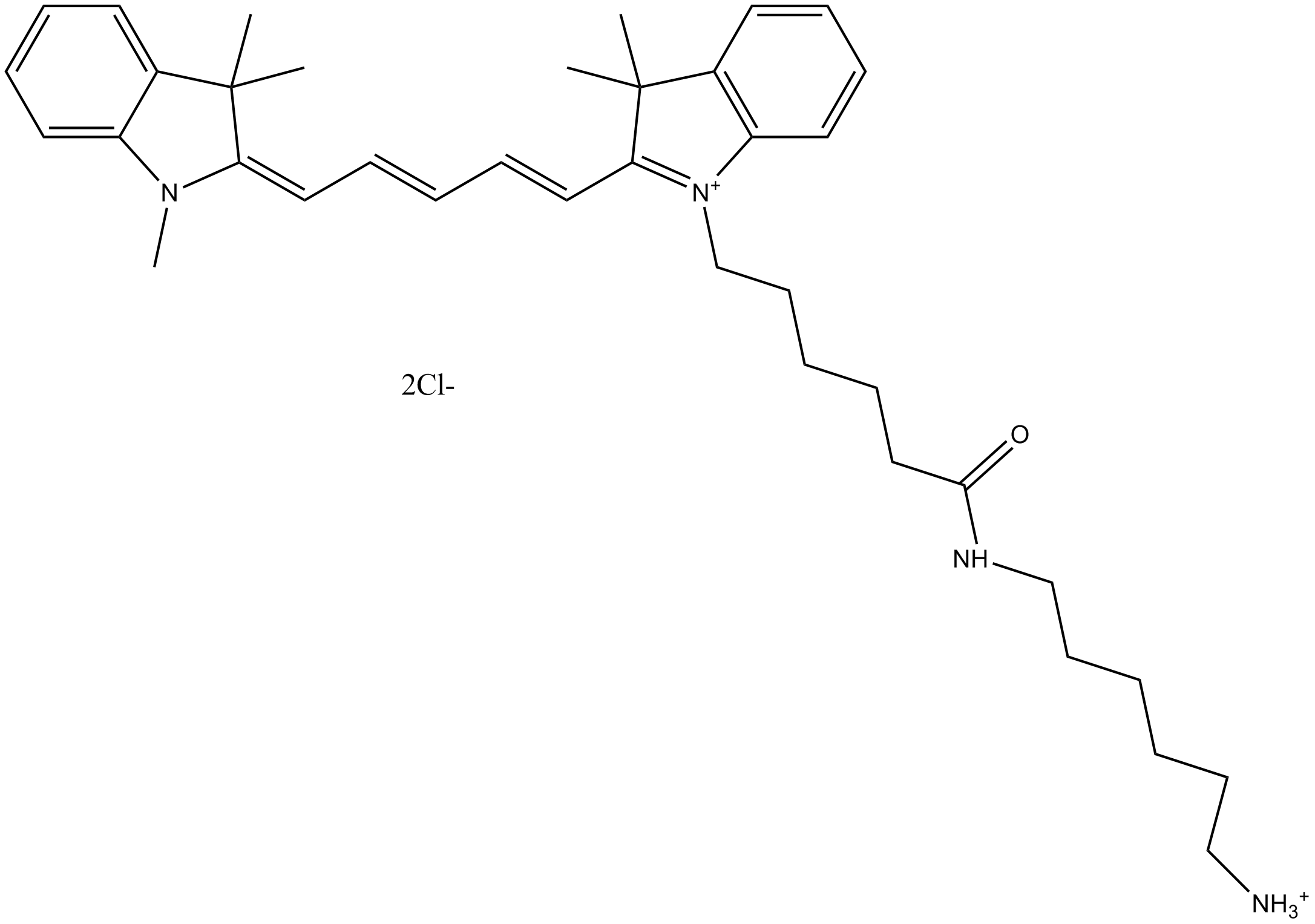
Cy5 amine (non-sulfonated) is a near-infrared fluorescent dye with a primary amine active group, belonging to the Cyanine5 (Cy5) series of fluorescent probes.
Products are for research use only. Not for human use. We do not sell to patients.
Sample solution is provided at 25 µL, 10mM.
_1-3.$$$39978408@51.jpg');)
_1-9.$$$38538795@65.jpg');)
_1-9.$$$39112701@51.jpg');)
_1-7.$$$37316672@70.jpg');)
_366-372.$$$36198801@70.jpg');)
.$$$38565142@65.jpg');)
_1867-1883.$$$33248023@67.jpg');)
_eads6055.$$$39977546@45.jpg');)
_eadm9805.$$$40080571@45.jpg');)
_eadj3020.$$$39666821@45.jpg');)
_1-20.$$$39757301@28.jpg');)
_1-24.$$$38898113@28.jpg');)
_273-287.$$$36806353@46.jpg');)
_1-16.$$$37156877@44.jpg');)
_1-19.$$$37460805@44.jpg');)
_1291-1307.$$$34518654@46.jpg');)
Cy5 amine (non-sulfonated) is a near-infrared fluorescent dye with a primary amine active group, belonging to the Cyanine5 (Cy5) series of fluorescent probes. The basic structure of Cy5 is a cyclic compound with a conjugated double bond system, exhibiting excellent fluorescence properties in the far-infrared region and good photostability. The maximum excitation/emission wavelengths of Cy5 amine (non-sulfonated) is 650/670nm. Cy5 amine (non-sulfonated) is often used as intermediates in coupling reactions with active groups such as NHS esters, activated carboxyl group, and epoxides, thereby enabling fluorescent labeling and imaging of nanoparticles, polymers, proteins, or biomaterials[1][2][3].
References:
[1] Yuan L, Lin W, Zheng K, et al. Far-red to near infrared analyte-responsive fluorescent probes based on organic fluorophore platforms for fluorescence imaging[J]. Chemical Society Reviews, 2013, 42(2): 622-661.
[2] Ferri G L, Isola J, Berger P, et al. Direct eye visualization of Cy5 fluorescence for immunocytochemistry and in situ hybridization[J]. Journal of Histochemistry & Cytochemistry, 2000, 48(3): 437-444.
[3] Malinovskaya, Yulia et al. “Delivery of doxorubicin-loaded PLGA nanoparticles into U87 human glioblastoma cells.” International journal of pharmaceutics vol. 524,1-2 (2017): 77-90.
This plan is based on literature, please modify it to meet your specific needs[1].
1. Solutions of Cy5 amine (non-sulfonated) (1mg in 2ml of dichloromethane [DCM]), diisopropylethylamine (DIPEA; 0.2mg in 1ml of DCM), and N-(3-dimethylaminopropyl)-N′-ethylcarbodiimide hydrochloride (EDC; 1.9mg in 1ml of DCM) were added to a poly(lactic-co-glycolic acid) (PLGA) solution in DCM (600mg in 5ml).
2. The reaction mixture was incubated for 48h under continuous stirring at room temperature in the dark.
3. The obtained solution was washed 3 times with 10ml of deionized water to remove excessive reagents and water-soluble by-products.
4. The organic phase was separated and dried over anhydrous sodium sulfate with subsequent evaporation.
5. The obtained sediment was dissolved in ethyl acetate and precipitated with hexane (30ml), followed by filtration and drying to yield the conjugate in the form of light-blue powder.
6. The PLGA-Cy5 conjugate with a dye-to-polymer ratio of 1: 600 (w/w) was used in the experiments.
References:
[1] Malinovskaya, Yulia et al. “Delivery of doxorubicin-loaded PLGA nanoparticles into U87 human glioblastoma cells.” International journal of pharmaceutics vol. 524,1-2 (2017): 77-90.
| Cas No. | SDF | ||
| Synonymes | Cyanine5 amine | ||
| Chemical Name | 1-(6-((6-ammoniohexyl)amino)-6-oxohexyl)-3,3-dimethyl-2-((1E,3E,5E)-5-(1,3,3-trimethylindolin-2-ylidene)penta-1,3-dien-1-yl)-3H-indol-1-ium | ||
| Canonical SMILES | CC1(C)C2=C(C=CC=C2)[N+](CCCCCC(NCCCCCC[NH3+])=O)=C1/C=C/C=C/C=C3C(C)(C)C4=CC=CC=C4N\3C | ||
| Formula | C38H54Cl2N4O | M.Wt | 653.77 |
| Solubility | ≥ 48mg/mL in DMSO, ≥ 8.84 mg/mL in EtOH | Storage | Store at -20°C |
| General tips | Please select the appropriate solvent to prepare the stock solution according to the
solubility of the product in different solvents; once the solution is prepared, please store it in
separate packages to avoid product failure caused by repeated freezing and thawing.Storage method
and period of the stock solution: When stored at -80°C, please use it within 6 months; when stored
at -20°C, please use it within 1 month. To increase solubility, heat the tube to 37°C and then oscillate in an ultrasonic bath for some time. |
||
| Shipping Condition | Evaluation sample solution: shipped with blue ice. All other sizes available: with RT, or with Blue Ice upon request. | ||
| Prepare stock solution | |||

|
1 mg | 5 mg | 10 mg |
| 1 mM | 1.5296 mL | 7.6479 mL | 15.2959 mL |
| 5 mM | 305.9 μL | 1.5296 mL | 3.0592 mL |
| 10 mM | 153 μL | 764.8 μL | 1.5296 mL |
Step 1: Enter information below (Recommended: An additional animal making an allowance for loss during the experiment)
 g
μL
g
μL
Step 2: Enter the in vivo formulation (This is only the calculator, not formulation. Please contact us first if there is no in vivo formulation at the solubility Section.)
Calculation results:
Working concentration: mg/ml;
Method for preparing DMSO master liquid: mg drug pre-dissolved in μL DMSO ( Master liquid concentration mg/mL, Please contact us first if the concentration exceeds the DMSO solubility of the batch of drug. )
Method for preparing in vivo formulation: Take μL DMSO master liquid, next addμL PEG300, mix and clarify, next addμL Tween 80, mix and clarify, next add μL saline, mix and clarify.
Method for preparing in vivo formulation: Take μL DMSO master liquid, next add μL Corn oil, mix and clarify.
Note: 1. Please make sure the liquid is clear before adding the next solvent.
2. Be sure to add the solvent(s) in order. You must ensure that the solution obtained, in the previous addition, is a clear solution before proceeding to add the next solvent. Physical methods such as vortex, ultrasound or hot water bath can be used to aid dissolving.
3. All of the above co-solvents are available for purchase on the GlpBio website.
Quality Control & SDS
- View current batch:
- Purity: >95.00% Appearance: A solid
- COA (Certificate of Analysis)
- SDS (Safety Data Sheet)
- Datasheet
Average Rating: 5 (Based on Reviews and 30 reference(s) in Google Scholar.)