

Dofetilide (Synonyms: Tikosyn, UK 68789) |
Catalog No.GC17152
 One-Click Copy Product Info
|

Le dofétilide (UK 68789), en tant qu'agent antiarythmique de classe III, est un inhibiteur de l'IKr actif par voie orale, puissant et spécifique.
Products are for research use only. Not for human use. We do not sell to patients.
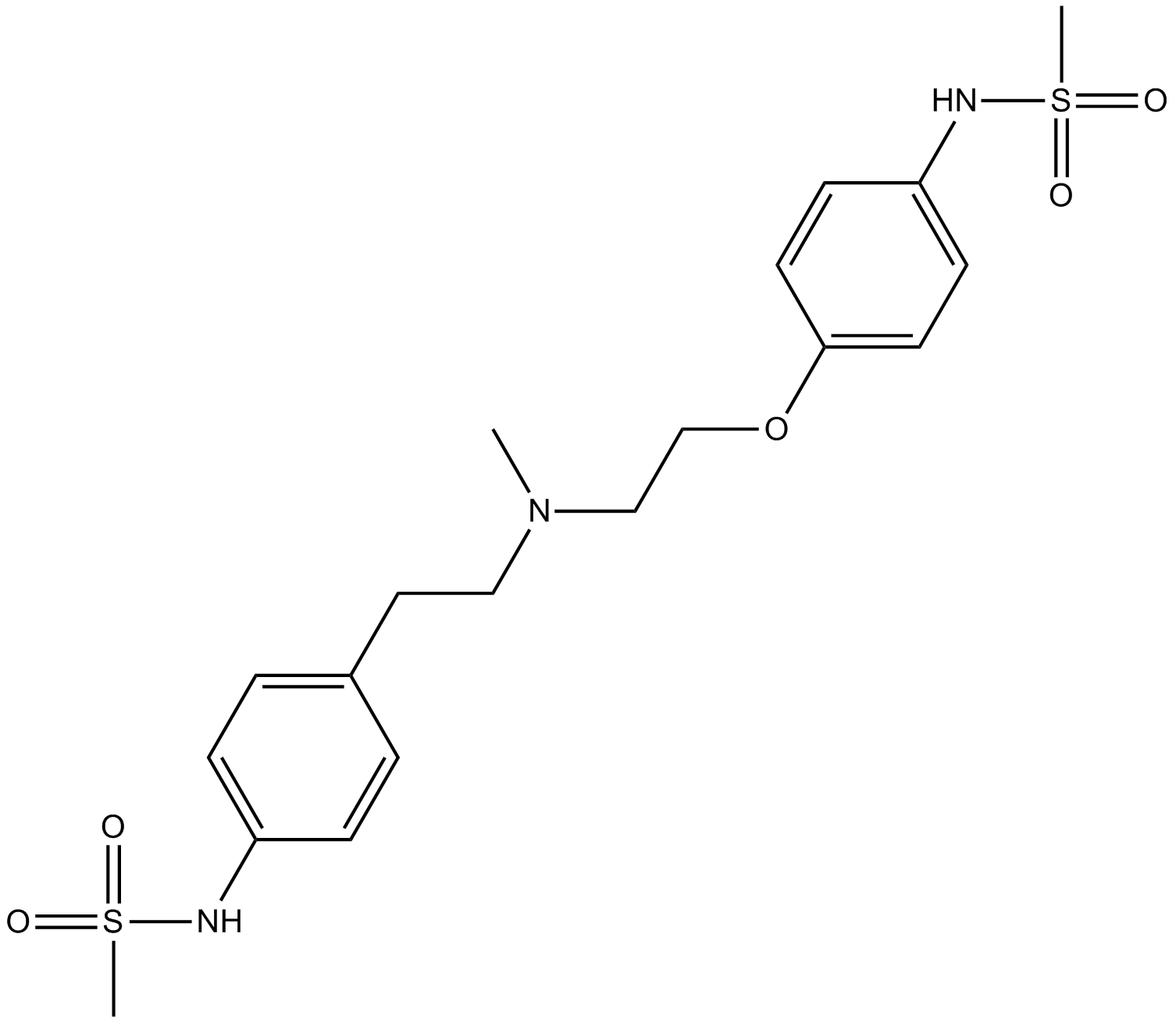
Cas No.: 115256-11-6
Sample solution is provided at 25 µL, 10mM.
_1-3.$$$39978408@51.jpg');)
_1-9.$$$38538795@65.jpg');)
_1-9.$$$39112701@51.jpg');)
_1-7.$$$37316672@70.jpg');)
_366-372.$$$36198801@70.jpg');)
.$$$38565142@65.jpg');)
_1867-1883.$$$33248023@67.jpg');)
_eads6055.$$$39977546@45.jpg');)
_eadm9805.$$$40080571@45.jpg');)
_eadj3020.$$$39666821@45.jpg');)
_1-20.$$$39757301@28.jpg');)
_1-24.$$$38898113@28.jpg');)
_273-287.$$$36806353@46.jpg');)
_1-16.$$$37156877@44.jpg');)
_1-19.$$$37460805@44.jpg');)
_1291-1307.$$$34518654@46.jpg');)
Dofetilide(Tikosyn) is a class III antiarrhythmic agent.Target: Potassium ChannelIn patients with congestive heart failure and reduced left ventricular function, dofetilide was effective in converting atrial fibrillation, preventing its recurrence, and reducing the risk of hospitalization for worsening heart failure. Dofetilide had no effect on mortality [1]. dofetilide preferentially blocks open (or activated) channels and that the fast inactivation may competitively slow the binding kinetics. Dofetilide acts as a slow-onset/slow-offset open channel blocker of this current at nanomolar concentrations [2].
References:
[1]. Maisch, B., et al., [Pregnancy and cardiomyopathies]. Herz, 2003. 28(3): p. 196-208.
[2]. Snyders, D.J. and A. Chaudhary, High affinity open channel block by dofetilide of HERG expressed in a human cell line. Mol Pharmacol, 1996. 49(6): p. 949-55.
| Cell experiment [1,2]: | |
|
Cell lines |
HEK293 cells, guinea pig cardiomyocytes |
|
Preparation method |
The solubility of this compound in DMSO is >21.2 mg/mL. General tips for obtaining a higher concentration: Please warm the tube at 37 ℃ for 10 minutes and/or shake it in the ultrasonic bath for a while. Stock solution can be stored below -20℃ for several months. |
|
Reacting condition |
1 μM |
|
Applications |
In a human cell line and human embryonic kidney 293 transfected with HERG, dofetilide induced channel block with the EC50 of 12 ± 2 nM. Induction of block depended on depolarization beyond the threshold for channel opening. Dofetilide acted as a slow-onset/slow-offset open channel blocker of this current at nanomolar concentrations. Dofetilide (1 μM) reduced the amplitude of IKr to 61% of control currents in guinea pig cardiomyocytes, as measured by 200-ms test pulses and analysis of the deactivating tail currents of IKr. |
| Animal experiment [3]: | |
|
Animal models |
Dogs with old myocardial infarction (MI) |
|
Dosage form |
Intravenous injection, 100 mg/kg |
|
Application |
Dofetilide (100 mg/kg, i.v.) suppressed the reentry arrhythmia induced by PES in dogs with old myocardial infarction (MI). Dofetilide showed antiarrhythmic effect in some dogs with digitalis arrhythmia. Dofetilide increased QT interval and showed negative chronotropic effect. |
|
Other notes |
Please test the solubility of all compounds indoor, and the actual solubility may slightly differ with the theoretical value. This is caused by an experimental system error and it is normal. |
|
References: [1]. Snyders D J, Chaudhary A. High affinity open channel block by dofetilide of HERG expressed in a human cell line[J]. Molecular Pharmacology, 1996, 49(6): 949-955. [2]. Kiehn J, Villena P, Beyer T, et al. Differential effects of the new class III agent dofetilide on potassium currents in guinea pig cardiomyocytes[J]. Journal of cardiovascular pharmacology, 1994, 24(4): 566-572. [3]. Chen J, Xue Y, Eto K, et al. Effects of dofetilide, a class III antiarrhythmic drug, on various ventricular arrhythmias in dogs[J]. Journal of cardiovascular pharmacology, 1996, 28(4): 576-584. | |
| Cas No. | 115256-11-6 | SDF | |
| Synonymes | Tikosyn, UK 68789 | ||
| Chemical Name | N-[4-[2-[2-[4-(methanesulfonamido)phenoxy]ethyl-methylamino]ethyl]phenyl]methanesulfonamide | ||
| Canonical SMILES | CN(CCC1=CC=C(C=C1)NS(=O)(=O)C)CCOC2=CC=C(C=C2)NS(=O)(=O)C | ||
| Formula | C19H27N3O5S2 | M.Wt | 441.56 |
| Solubility | ≥ 21.15mg/mL in DMSO | Storage | Store at -20°C |
| General tips | Please select the appropriate solvent to prepare the stock solution according to the
solubility of the product in different solvents; once the solution is prepared, please store it in
separate packages to avoid product failure caused by repeated freezing and thawing.Storage method
and period of the stock solution: When stored at -80°C, please use it within 6 months; when stored
at -20°C, please use it within 1 month. To increase solubility, heat the tube to 37°C and then oscillate in an ultrasonic bath for some time. |
||
| Shipping Condition | Evaluation sample solution: shipped with blue ice. All other sizes available: with RT, or with Blue Ice upon request. | ||
| Prepare stock solution | |||

|
1 mg | 5 mg | 10 mg |
| 1 mM | 2.2647 mL | 11.3235 mL | 22.647 mL |
| 5 mM | 452.9 μL | 2.2647 mL | 4.5294 mL |
| 10 mM | 226.5 μL | 1.1323 mL | 2.2647 mL |
Step 1: Enter information below (Recommended: An additional animal making an allowance for loss during the experiment)
 g
μL
g
μL
Step 2: Enter the in vivo formulation (This is only the calculator, not formulation. Please contact us first if there is no in vivo formulation at the solubility Section.)
Calculation results:
Working concentration: mg/ml;
Method for preparing DMSO master liquid: mg drug pre-dissolved in μL DMSO ( Master liquid concentration mg/mL, Please contact us first if the concentration exceeds the DMSO solubility of the batch of drug. )
Method for preparing in vivo formulation: Take μL DMSO master liquid, next addμL PEG300, mix and clarify, next addμL Tween 80, mix and clarify, next add μL saline, mix and clarify.
Method for preparing in vivo formulation: Take μL DMSO master liquid, next add μL Corn oil, mix and clarify.
Note: 1. Please make sure the liquid is clear before adding the next solvent.
2. Be sure to add the solvent(s) in order. You must ensure that the solution obtained, in the previous addition, is a clear solution before proceeding to add the next solvent. Physical methods such as vortex, ultrasound or hot water bath can be used to aid dissolving.
3. All of the above co-solvents are available for purchase on the GlpBio website.
Quality Control & SDS
- View current batch:
- Purity: >98.00% Appearance: A solid
- COA (Certificate of Analysis)
- SDS (Safety Data Sheet)
- Datasheet
Average Rating: 5 (Based on Reviews and 8 reference(s) in Google Scholar.)