

Macropa-NH2 TFA |
Catalog No.GC61019
 One-Click Copy Product Info
|

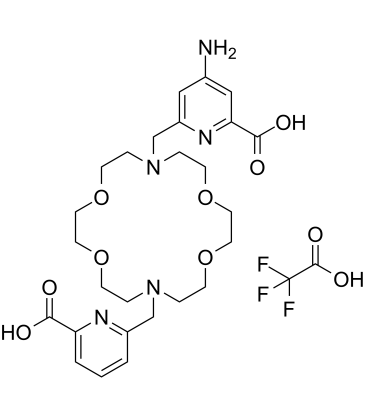
Le Macropa-NH2 TFA est le précurseur du Macropa-NCS.
Products are for research use only. Not for human use. We do not sell to patients.
Cas No.: 2705054-08-4
Sample solution is provided at 25 µL, 10mM.
_1-3.$$$39978408@51.jpg');)
_1-9.$$$38538795@65.jpg');)
_1-9.$$$39112701@51.jpg');)
_1-7.$$$37316672@70.jpg');)
_366-372.$$$36198801@70.jpg');)
.$$$38565142@65.jpg');)
_1867-1883.$$$33248023@67.jpg');)
_eads6055.$$$39977546@45.jpg');)
_eadm9805.$$$40080571@45.jpg');)
_eadj3020.$$$39666821@45.jpg');)
_1-20.$$$39757301@28.jpg');)
_1-24.$$$38898113@28.jpg');)
_273-287.$$$36806353@46.jpg');)
_1-16.$$$37156877@44.jpg');)
_1-19.$$$37460805@44.jpg');)
_1291-1307.$$$34518654@46.jpg');)
Macropa-NH2 TFA is the precursor of Macropa-NCS. Macropa-NCS is conjugated to trastuzumab as well as to the prostate-specific membrane antigen-targeting compound RPS-070 and is a promising therapeutic radionuclide applied in the treatment of soft-tissue metastases[1].
A white suspension of 11•4TFA (0.1598 g, 0.16 mmol) and Na2CO3 (0.2540 g, 2.4 mmol) was heated at reflux in acetone (10 mL) for 30 min before the slow addition of CSCl2 (305 µL of CSCl2, 85%, Acros Organics). The resulting orange suspension was heated at reflux for 3 h and then concentrated at 30 °C under reduced pressure to a pale-orange solid. The solid was dissolved portionwise in 10% ACN/H2O containing 0.2% TFA (8 mL total), filtered, and immediately purified by preparative HPLC using Method C. Pure fractions were combined, concentrated at RT under reduced pressure to remove the organic solvent, and then lyophilized. Fractions that were not able to be concentrated immediately were frozen at -80 °C. Isothiocyanate 12 was obtained as a mixture of white and pale-yellow solid (0.0547 g) and was stored at -80 °C in a jar of Drierite. A stock solution containing 4.4 mg/mL of macropa-NCS was prepared in 0.1 M pH 9.1 NaHCO3 buffer containing 0.154 M NaCl and was stored at -80 °C. To a portion of Tmab in saline (74 μL) were added macropa-NCS (52 μL) and NaHCO3 buffer (266 μL), so that the final concentrations of Tmab and macropa-NCS were 5.1 mg/mL and 0.59 mg/mL, respectively. Macropa-NCS was estimated to be in 16-fold molar excess to Tmab based on a molecular weight of 1045.76 g/mol for macropa-NCS (tetra-TFA salt)[1].
[1]. Thiele NA, et al. An Eighteen-Membered Macrocyclic Ligand for Actinium-225 Targeted Alpha Therapy. Angew Chem Int Ed Engl. 2017;56(46):14712-14717.
| Cas No. | 2705054-08-4 | SDF | |
| Canonical SMILES | O=C(O)C1=NC(CN2CCOCCOCCN(CC3=NC(C(O)=O)=CC=C3)CCOCCOCC2)=CC(N)=C1.O=C(O)C(F)(F)F | ||
| Formula | C28H38F3N5O10 | M.Wt | 661.62 |
| Solubility | DMSO: 200 mg/mL (302.29 mM) | Storage | Store at -20°C |
| General tips | Please select the appropriate solvent to prepare the stock solution according to the
solubility of the product in different solvents; once the solution is prepared, please store it in
separate packages to avoid product failure caused by repeated freezing and thawing.Storage method
and period of the stock solution: When stored at -80°C, please use it within 6 months; when stored
at -20°C, please use it within 1 month. To increase solubility, heat the tube to 37°C and then oscillate in an ultrasonic bath for some time. |
||
| Shipping Condition | Evaluation sample solution: shipped with blue ice. All other sizes available: with RT, or with Blue Ice upon request. | ||
| Prepare stock solution | |||

|
1 mg | 5 mg | 10 mg |
| 1 mM | 1.5114 mL | 7.5572 mL | 15.1144 mL |
| 5 mM | 302.3 μL | 1.5114 mL | 3.0229 mL |
| 10 mM | 151.1 μL | 755.7 μL | 1.5114 mL |
Step 1: Enter information below (Recommended: An additional animal making an allowance for loss during the experiment)
 g
μL
g
μL
Step 2: Enter the in vivo formulation (This is only the calculator, not formulation. Please contact us first if there is no in vivo formulation at the solubility Section.)
Calculation results:
Working concentration: mg/ml;
Method for preparing DMSO master liquid: mg drug pre-dissolved in μL DMSO ( Master liquid concentration mg/mL, Please contact us first if the concentration exceeds the DMSO solubility of the batch of drug. )
Method for preparing in vivo formulation: Take μL DMSO master liquid, next addμL PEG300, mix and clarify, next addμL Tween 80, mix and clarify, next add μL saline, mix and clarify.
Method for preparing in vivo formulation: Take μL DMSO master liquid, next add μL Corn oil, mix and clarify.
Note: 1. Please make sure the liquid is clear before adding the next solvent.
2. Be sure to add the solvent(s) in order. You must ensure that the solution obtained, in the previous addition, is a clear solution before proceeding to add the next solvent. Physical methods such as vortex, ultrasound or hot water bath can be used to aid dissolving.
3. All of the above co-solvents are available for purchase on the GlpBio website.
Quality Control & SDS
- View current batch:
- Purity: >98.00% Appearance: A solid
- COA (Certificate of Analysis)
- SDS (Safety Data Sheet)
- Datasheet
Average Rating: 5 (Based on Reviews and 14 reference(s) in Google Scholar.)