

BTTAA |
Catalog No.GC30061
 One-Click Copy Product Info
|

BTTAA, un stabilisateur de ligand et un catalyseur de (Cu(I)), peut amplifier les réactions de cliquage bio-orthogonales et réduire la cytotoxicité par diminuer la quantité d'ions cuivre utilisés.
Products are for research use only. Not for human use. We do not sell to patients.
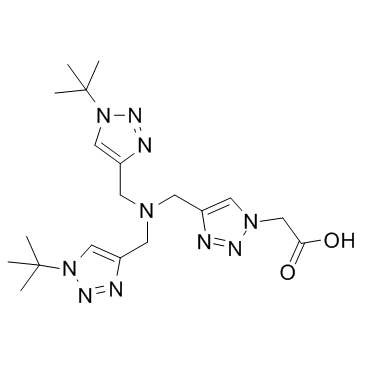
Cas No.: 1334179-85-9
Sample solution is provided at 25 µL, 10mM.
_1-3.$$$39978408@51.jpg');)
_1-9.$$$38538795@65.jpg');)
_1-9.$$$39112701@51.jpg');)
_1-7.$$$37316672@70.jpg');)
_366-372.$$$36198801@70.jpg');)
.$$$38565142@65.jpg');)
_1867-1883.$$$33248023@67.jpg');)
_eads6055.$$$39977546@45.jpg');)
_eadm9805.$$$40080571@45.jpg');)
_eadj3020.$$$39666821@45.jpg');)
_1-20.$$$39757301@28.jpg');)
_1-24.$$$38898113@28.jpg');)
_273-287.$$$36806353@46.jpg');)
_1-16.$$$37156877@44.jpg');)
_1-19.$$$37460805@44.jpg');)
_1291-1307.$$$34518654@46.jpg');)
BTTAA, un stabilisateur de ligand et un catalyseur de (Cu(I)), peut amplifier les réactions de cliquage bio-orthogonales et réduire la cytotoxicité par diminuer la quantité d'ions cuivre utilisés. BTTAA peut être utilisé avec les azotures pour marquer et détecter les complexes marqués à l'azoture dans les cellules Jurkat, les zébrés et les bactéries[1.3].
Les preuves expérimentales montrent que 50 μM complexe BTTAA-Cu(I) ne possède pas l'effet sur la viabilité cellulaire[2]. le catalyseur de BTTAA-Cu(I) a fourni le marquage le plus intense des cellules SiaNAz-présentées, a produit un signal Alexa Fluor 488 cellule - associé 3 à 4 fois supérieur au signal obtenu[3] .Cu-BTTAA en tant que catalyseur, fonctionne significativement mieux que Cu-THPTA ou Cu-TBTA. BTTAA a été montré que ce qui fonctionne beaucoup mieux que THPTA ou TBTA [4.5].
References:
[1] Haldón E, Nicasio MC, Pérez PJ. Copper-catalysed azide-alkyne cycloadditions (CuAAC): an update. Org Biomol Chem. 2015 Oct 7;13(37):9528-50.
[2] Yang M, Yang Y, Chen PR. Transition-Metal-Catalyzed Bioorthogonal Cycloaddition Reactions. Top Curr Chem (Cham). 2016 Feb;374(1):2.
[3]Besanceney-Webler C, Jiang H, Zheng T, Feng L, Soriano del Amo D, Wang W, Klivansky LM, Marlow FL, Liu Y, Wu P. Increasing the efficacy of bioorthogonal click reactions for bioconjugation: a comparative study. Angew Chem Int Ed Engl. 2011 Aug 22;50(35):8051-6.
[4] Besanceney-Webler C, Jiang H, Zheng T, Feng L, Soriano del Amo D, Wang W, Klivansky LM, Marlow FL, Liu Y, Wu P. Increasing the efficacy of bioorthogonal click reactions for bioconjugation: a comparative study. Angew Chem Int Ed Engl. 2011 Aug 22;50(35):8051-6.
[5] Loh CT, Ozawa K, Tuck KL, Barlow N, Huber T, Otting G, Graham B. Lanthanide tags for site-specific ligation to an unnatural amino acid and generation of pseudocontact shifts in proteins. Bioconjug Chem. 2013 Feb 20;24(2):260-8.
| Cas No. | 1334179-85-9 | SDF | |
| Canonical SMILES | O=C(O)CN1N=NC(CN(CC2=CN(C(C)(C)C)N=N2)CC3=CN(C(C)(C)C)N=N3)=C1 | ||
| Formula | C19H30N10O2 | M.Wt | 430.51 |
| Solubility | Water : 5 mg/mL (11.61 mM); DMSO:≥100 mg/mL | Storage | Store at -20°C |
| General tips | Please select the appropriate solvent to prepare the stock solution according to the
solubility of the product in different solvents; once the solution is prepared, please store it in
separate packages to avoid product failure caused by repeated freezing and thawing.Storage method
and period of the stock solution: When stored at -80°C, please use it within 6 months; when stored
at -20°C, please use it within 1 month. To increase solubility, heat the tube to 37°C and then oscillate in an ultrasonic bath for some time. |
||
| Shipping Condition | Evaluation sample solution: shipped with blue ice. All other sizes available: with RT, or with Blue Ice upon request. | ||
| Prepare stock solution | |||

|
1 mg | 5 mg | 10 mg |
| 1 mM | 2.3228 mL | 11.6141 mL | 23.2283 mL |
| 5 mM | 464.6 μL | 2.3228 mL | 4.6457 mL |
| 10 mM | 232.3 μL | 1.1614 mL | 2.3228 mL |
Step 1: Enter information below (Recommended: An additional animal making an allowance for loss during the experiment)
 g
μL
g
μL
Step 2: Enter the in vivo formulation (This is only the calculator, not formulation. Please contact us first if there is no in vivo formulation at the solubility Section.)
Calculation results:
Working concentration: mg/ml;
Method for preparing DMSO master liquid: mg drug pre-dissolved in μL DMSO ( Master liquid concentration mg/mL, Please contact us first if the concentration exceeds the DMSO solubility of the batch of drug. )
Method for preparing in vivo formulation: Take μL DMSO master liquid, next addμL PEG300, mix and clarify, next addμL Tween 80, mix and clarify, next add μL saline, mix and clarify.
Method for preparing in vivo formulation: Take μL DMSO master liquid, next add μL Corn oil, mix and clarify.
Note: 1. Please make sure the liquid is clear before adding the next solvent.
2. Be sure to add the solvent(s) in order. You must ensure that the solution obtained, in the previous addition, is a clear solution before proceeding to add the next solvent. Physical methods such as vortex, ultrasound or hot water bath can be used to aid dissolving.
3. All of the above co-solvents are available for purchase on the GlpBio website.
Quality Control & SDS
- View current batch:
- Purity: >99.50% Appearance: A solid
- COA (Certificate of Analysis)
- SDS (Safety Data Sheet)
- Datasheet
Average Rating: 5 (Based on Reviews and 17 reference(s) in Google Scholar.)