

SSR240612 |
Catalog No.GC19339
 One-Click Copy Product Info
|

SSR240612 est un nouvel antagoniste spécifique du récepteur de la bradyykinine B1 non-peptidique, puissant et actif par voie orale. Il inhibe la formation de monophosphate d'inositol qui est induite par Lys0-desAr9-BK (10nM) dans les fibroblastes humains MRC5, sa valeur d'IC50 est 1,9nM.
Products are for research use only. Not for human use. We do not sell to patients.
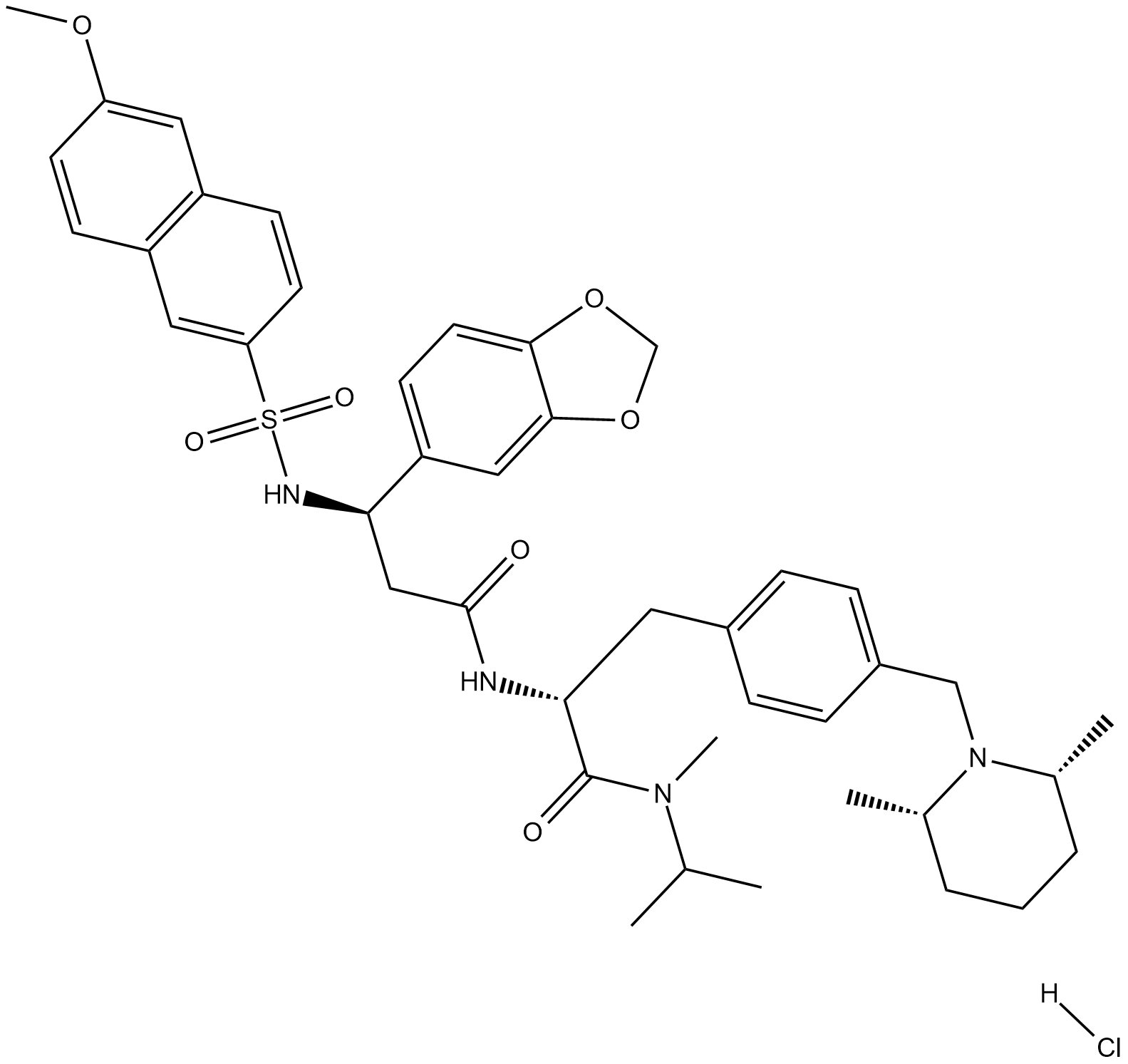
Cas No.: 464930-42-5
Sample solution is provided at 25 µL, 10mM.
SSR240612 est un nouvel antagoniste spécifique du récepteur de la bradyykinine B1 non-peptidique, puissant et actif par voie orale. Il inhibe la formation de monophosphate d'inositol qui est induite par Lys0-desAr9-BK (10nM) dans les fibroblastes humains MRC5, sa valeur d'IC50 est 1,9nM[1]. Le récepteur de la bradykinine B1 (B1R) est un récepteur couplé aux protéines G avec un faible niveau d'expression dans les tissus normaux, mais il peut être induit pour s'exprimer dans les états pathologiques comme l'inflammation, le diabète, la lésion d'ischémie/reperfusion, et participer à la transmission des signaux d'inflammation et de douleur[2]. SSR240612 a déplacé la liaison de [3H]Lys0-des-Arg9-BK aux récepteurs B1 dans les fibroblastes humains MRC5 et aux récepteurs B1 humains recombinants exprimé dans les cellules rénales embryonnaires humaines, avec des constantes d'inhibition (Ki) de 0,48 et 0,73nM, respectivement. L'affinité de SSR240612 pour les récepteurs B2 marqués avec [3H]BK était beaucoup plus faible, sa valeur de Ki est 481nM pour les membranes d'iléon de cobaye et de Ki est 358nM pour les préparations membranaires de cellules CHO qui expriment les récepteurs B2 humains[1]. SSR240612 est généralement utilisé pour la recherche dans les maladies inflammatoires, immunitaires et métaboliques[3][4][5].
Le traitement in vitro avec SSR240612 (10μM) aux cellules RAW 264.7 infectées par M. tuberculosis pendant 4 jours a montré un effet inhibiteur marqué sur le comptage de CFU[6].
In vivo, l'administration orale de SSR240612 (10 et 30mg/kg) pendant 3 heures a bloqué l'allodynie tactile et froide sans affecter la glycémie et l'insuline plasmatiques, la résistance à l'insuline (indice HOMA) et la production d'anions superoxyde aortique chez le rat nourri par glucose par rapport au rat de témoin[7].
References:
[1] Gougat, J., Ferrari, B., Sarran, L., Planchenault, C., Poncelet, M., Maruani, J., Alonso, R., Cudennec, A., Croci, T., Guagnini, F., Urban-Szabo, K., Martinolle, J. P., Soubrié, P., Finance, O., & Le Fur, G. (2004). SSR240612 [(2R)-2-[((3R)-3-(1,3-benzodioxol-5-yl)-3-[[(6-methoxy-2-naphthyl)sulfonyl]amino]propanoyl)amino]-3-(4-[[2R,6S)-2,6-dimethylpiperidinyl]methyl]phenyl)-N-isopropyl-N-methylpropanamide hydrochloride], a new nonpeptide antagonist of the bradykinin B1 receptor: biochemical and pharmacological characterization. The Journal of pharmacology and experimental therapeutics, 309(2), 661–669.
[2] Campos, M. M., Leal, P. C., Yunes, R. A., & Calixto, J. B. (2006). Non-peptide antagonists for kinin B1 receptors: new insights into their therapeutic potential for the management of inflammation and pain. Trends in pharmacological sciences, 27(12), 646–651.
[3] Tidjane, N., Hachem, A., Zaid, Y., Merhi, Y., Gaboury, L., Girolami, J. P., & Couture, R. (2015). A primary role for kinin B1 receptor in inflammation, organ damage, and lethal thrombosis in a rat model of septic shock in diabetes. European journal of inflammation, 13(1), 40–52.
[4] Costa, R., Fernandes, E. S., Menezes-de-Lima, O., Jr, Campos, M. M., & Calixto, J. B. (2006). Effect of novel selective non-peptide kinin B(1) receptor antagonists on mouse pleurisy induced by carrageenan. Peptides, 27(11), 2967–2975.
[5] El Akoum, S., Haddad, Y., & Couture, R. (2017). Impact of pioglitazone and bradykinin type 1 receptor antagonist on type 2 diabetes in high-fat diet-fed C57BL/6J mice. Obesity science & practice, 3(3), 352–362.
[6] Rodrigues-Junior, V. S., Pail, P. B., Villela, A. D., Falcão, V. C. A., Dadda, A. S., Abbadi, B. L., Pesquero, J. B., Santos, D. S., Basso, L. A., & Campos, M. M. (2018). Effect of the bradykinin 1 receptor antagonist SSR240612 after oral administration in Mycobacterium tuberculosis-infected mice. Tuberculosis (Edinburgh, Scotland), 109, 1–7.
[7] Dias, J. P., Ismael, M. A., Pilon, M., de Champlain, J., Ferrari, B., Carayon, P., & Couture, R. (2007). The kinin B1 receptor antagonist SSR240612 reverses tactile and cold allodynia in an experimental rat model of insulin resistance. British journal of pharmacology, 152(2), 280–287.
| Expériences cellulaires [1]: | |
Lignées cellulaires | Cellules RAW 264.7 |
Méthode de préparation | Les cellules RAW 264.7 ont été infectées par M. tuberculosis H37Rv pendant 3 h, suivie du lavage des bactéries extracellulaires. Ensuite, les cellules ont été traitées par les substances testées dans un milieu DMEM: BK (3nM), des-Arg9 -BK (30nM), HOE-140 (1μM), et SSR240612 (10μM). Après 4 jours, les macrophages ont été lysés avec SDS à 0,025% et ces suspensions ont été diluées et ensemencées sur un Agar Middlebrook 7H10 contenant OADC, avant le comptage de CFU. |
Conditions de réaction | 10μM; 4 jours |
Domaines d'application | SSR240612 a montré un effet inhibiteur marqué sur le comptage de CFU. |
| Expériences animales [2]: | |
Modèles animaux | Rats mâles jeunes Sprague–Dawley |
Méthode de préparation | SSR240612 a été administré par voie orale aux rats nourris avec D-glucose pendant 12 semaines, ce qui présentaient des symptômes constants d'anomalies sensorielles. Les effets de quatre doses (0.3, 3.0, 10 et 30mg/kg) de SSR240612 ont été déterminés sur l'allodynie à 1, 3, 6, 24, et 48h après la gavage. SSR240612 a été administré par voie orale à la dose de 10mg/kg aux rats traités pendant 12 semaines avec du glucose (n=8). Les rats ont été mis à jeun pendant la nuit et euthanasiés par asphyxie à CO2 à 6 h après le gavage, ensuite, le sang et l'aorte thoracique ont été collectés pour le dosage du niveau plasmatique de glucose et d'insuline et la détermination de l'anion superoxyde, respectivement. |
Forme de dosage | 0.3, 3.0, 10 et 30mg/kg;1, 3, 6, 24, et 48h; p.o. |
Domaines d'application | SSR240612 a bloqué l'allodynie tactile et froide à 3h (ID50 = 5.5 et 7.1mg/kg,respectivement) chez les rats nourris par glucose, mais ne possède aucun effet dans les rats de témoin. L'antagoniste (10mg/kg) ne possède aucun effet sur la glycémie et l'insuline plasmatiques, la résistance à l'insuline (indice HOMA) et la production d'anions superoxyde aortique chez le rat nourri par glucose. |
References: | |
| Cas No. | 464930-42-5 | SDF | |
| Canonical SMILES | O=S(N[C@@H](C1=CC=C2C(OCO2)=C1)CC(N[C@@H](C(N(C)C(C)C)=O)CC3=CC=C(CN([C@@H]4C)[C@H](CCC4)C)C=C3)=O)(C5=CC(C=CC(OC)=C6)=C6C=C5)=O.Cl[H] | ||
| Formula | C42H53ClN4O7S | M.Wt | 793.41 |
| Solubility | DMSO : ≥ 106.6 mg/mL (134.36 mM) | Storage | Store at -20°C |
| General tips | Please select the appropriate solvent to prepare the stock solution according to the
solubility of the product in different solvents; once the solution is prepared, please store it in
separate packages to avoid product failure caused by repeated freezing and thawing.Storage method
and period of the stock solution: When stored at -80°C, please use it within 6 months; when stored
at -20°C, please use it within 1 month. To increase solubility, heat the tube to 37°C and then oscillate in an ultrasonic bath for some time. |
||
| Shipping Condition | Evaluation sample solution: shipped with blue ice. All other sizes available: with RT, or with Blue Ice upon request. | ||
| Prepare stock solution | |||

|
1 mg | 5 mg | 10 mg |
| 1 mM | 1.2604 mL | 6.3019 mL | 12.6038 mL |
| 5 mM | 252.1 μL | 1.2604 mL | 2.5208 mL |
| 10 mM | 126 μL | 630.2 μL | 1.2604 mL |
Step 1: Enter information below (Recommended: An additional animal making an allowance for loss during the experiment)
 g
μL
g
μL
Step 2: Enter the in vivo formulation (This is only the calculator, not formulation. Please contact us first if there is no in vivo formulation at the solubility Section.)
Calculation results:
Working concentration: mg/ml;
Method for preparing DMSO master liquid: mg drug pre-dissolved in μL DMSO ( Master liquid concentration mg/mL, Please contact us first if the concentration exceeds the DMSO solubility of the batch of drug. )
Method for preparing in vivo formulation: Take μL DMSO master liquid, next addμL PEG300, mix and clarify, next addμL Tween 80, mix and clarify, next add μL saline, mix and clarify.
Method for preparing in vivo formulation: Take μL DMSO master liquid, next add μL Corn oil, mix and clarify.
Note: 1. Please make sure the liquid is clear before adding the next solvent.
2. Be sure to add the solvent(s) in order. You must ensure that the solution obtained, in the previous addition, is a clear solution before proceeding to add the next solvent. Physical methods such as vortex, ultrasound or hot water bath can be used to aid dissolving.
3. All of the above co-solvents are available for purchase on the GlpBio website.
Quality Control & SDS
- View current batch:
- Purity: >95.00% Appearance: A solid
- COA (Certificate of Analysis)
- SDS (Safety Data Sheet)
- Datasheet
Average Rating: 5 (Based on Reviews and 30 reference(s) in Google Scholar.)