

10,12-Tricosadiynoic acid |
Catalog No.GC38881
 One-Click Copy Product Info
|

10,12-Tricosadiynoic acid es un inhibidor muy específico, selectivo y activo por vía oral de la acyl-CoA oxidasa-1 (ACOX1)
Products are for research use only. Not for human use. We do not sell to patients.
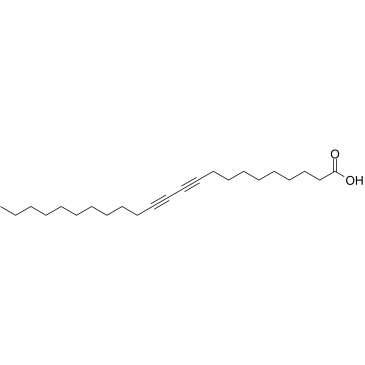
Cas No.: 66990-30-5
Sample solution is provided at 25 µL, 10mM.
_1-3.$$$39978408@51.jpg');)
_1-9.$$$38538795@65.jpg');)
_1-9.$$$39112701@51.jpg');)
_1-7.$$$37316672@70.jpg');)
_366-372.$$$36198801@70.jpg');)
.$$$38565142@65.jpg');)
_1867-1883.$$$33248023@67.jpg');)
_eads6055.$$$39977546@45.jpg');)
_eadm9805.$$$40080571@45.jpg');)
_eadj3020.$$$39666821@45.jpg');)
_1-20.$$$39757301@28.jpg');)
_1-24.$$$38898113@28.jpg');)
_273-287.$$$36806353@46.jpg');)
_1-16.$$$37156877@44.jpg');)
_1-19.$$$37460805@44.jpg');)
_1291-1307.$$$34518654@46.jpg');)
10,12-Tricosadiynoic acid es un inhibidor muy específico, selectivo y activo por vía oral de la acyl-CoA oxidasa-1 (ACOX1)[1]. ACOX1 actúa en los peroxisomas. Se encarga de todo el metabolismo de grasas, de la β-oxidación de ácidos grasos de cadena larga. Además, ayuda mucho a mantener la salud celular y el equilibrio lipídico[2]. Este ácido sirve para tratar enfermedades metabólicas, como las relacionadas con la obesidad. Lo logra mejorar el metabolismo de los lípidos y de las especies reactivas del oxígeno (ROS). Y como cuenta con grupos alquino, también se usa en reacciones de química click[3,4].
En cultivos celulares, al tratar células HL-7702 y HEP-G2 con 10,12-Tricosadiynoic acid (500nM) junto a GW4064 durante 48h, se consigue revertir bien la subida de expresión de mRNA y proteína ACOX1 provocada por GW4064[5]. Al combinarlo con docosahexaenoic acid (DHA, 50μM) y aplicarlo a células cancerosasd SiHa y HCT116 en medio ácido (pH 6.5) durante 24 horas, la viabilidad celular baja mucho[6].
En estudios con animales, a ratas Wistar con dieta alta en grasas, al darles 10,12-Tricosadiynoic acid (100μg/kg/día) por vía oral durante 8 semanas, se reduce el aumento de peso corporal. También baja el peso hepático y el contenido de trigluricéridos, y se atenúa la esteatosis hepática[1]. A los ratones diabéticos con aceite de colza alto y ácido erúcico, que se suministran 100mg/kg/día durante 4 semanas, se inhiben la β-oxidación hepática peroxisómica y la síntesis de colesterol. Además, baja el colesterol VLDL en plasma[7].
References:
[1] ZENG J, DENG S, WANG Y, et al. Specific inhibition of Acyl-CoA oxidase-1 by an acetylenic acid improves hepatic lipid and reactive oxygen species (ROS) metabolism in rats fed a high fat diet[J]. Journal of Biological Chemistry, 2017, 292(9): 3800-3809.
[2] LU D, HE A, TAN M, et al. Liver ACOX1 regulates levels of circulating lipids that promote metabolic health through adipose remodeling[J]. Nature Communications, 2024, 15(1): 4214.
[3] LIU Y, HAN S L, LUO Y, et al. Impaired peroxisomal fat oxidation induces hepatic lipid accumulation and oxidative damage in Nile tilapia[J]. Fish Physiology and Biochemistry, 2020, 46(4): 1229-1242.
[4] CHEN X, ZHOU G, PENG X, et al. Biosensors and chemosensors based on the optical responses of polydiacetylenes[J]. Chemical Society Reviews, 2012, 41(13): 4610-4630.
[5] YANG Y, YUAN W, HE K, et al. Inhibition of ACOX1 enhances the therapeutic efficacy of obeticholic acid in treating non-alcoholic fatty liver disease and mitigates its lipotoxicity[J]. Frontiers in Pharmacology, 2024, 15: 1366479.
[6] IBANEZ S, GIOLITO M V, AL-SIYABI S, et al. Acidosis forces fatty acid uptake and metabolism in cancer cells regardless of genotype[J]. Advanced Science, 2025, 12(40): e05436.
[7] ZHANG X, WANG Y, YAO H, et al. Peroxisomal β-oxidation stimulates cholesterol biosynthesis in the liver in diabetic mice[J]. Journal of Biological Chemistry, 2022, 298(2): 101572.
| Experimentos celulares [1]: | |
Líneas celulares | Células HL-7702 y HEP-G2 |
Método de preparación | Las células fueron tratadas con concentraciones de 65nM y 500nM de GW4064 y 10,12-Tricosadiynoic acid, respectivamente. Después de 48h de incubación de fármacos, las células se cosecharon para extraer RNA total y proteínas para PCR cuantitativa en tiempo real y transferencia Western, respectivamente. |
Condiciones de reacción | 500nM; 48h |
Áreas de aplicación | El tratamiento con 10,12-Tricosadiynoic acid revirtió la regulación ascendente de la proteína ACOX1 y la expresión de mRNA inducida por GW4064. |
| Experimentos con animales [2]: | |
Modelos animales | Ratas Wistar alimentadas con HFD |
Método de preparación | Las ratas Wistar alimentadas con HFD fueron tratadas con 10,12-Tricosadiynoic acid (100μg/kg/día) durante 8 semanas, con el peso corporal medido cada dos semanas. El día 57, todas las ratas fueron sacrificadas, y sus hígados fueron extirpados, pesados y examinados para detectar esteatosis hepática utilizando un microscopio óptico. |
Forma de dosificación | 100μg/kg/día; 8 semanas; p.o. |
Áreas de aplicación | El tratamiento con 10,12-Tricosadiynoic acid (100μg/kg/día) redujo el aumento de peso y el peso del hígado, y alivió la esteatosis hepática. |
References: | |
| Cas No. | 66990-30-5 | SDF | |
| Canonical SMILES | CCCCCCCCCCC#CC#CCCCCCCCCC(O)=O | ||
| Formula | C23H38O2 | M.Wt | 346.55 |
| Solubility | DMSO : 100 mg/mL (288.56 mM) | Storage | Store at 2-8°C,protect from light, stored under argon |
| General tips | Please select the appropriate solvent to prepare the stock solution according to the
solubility of the product in different solvents; once the solution is prepared, please store it in
separate packages to avoid product failure caused by repeated freezing and thawing.Storage method
and period of the stock solution: When stored at -80°C, please use it within 6 months; when stored
at -20°C, please use it within 1 month. To increase solubility, heat the tube to 37°C and then oscillate in an ultrasonic bath for some time. |
||
| Shipping Condition | Evaluation sample solution: shipped with blue ice. All other sizes available: with RT, or with Blue Ice upon request. | ||
| Prepare stock solution | |||

|
1 mg | 5 mg | 10 mg |
| 1 mM | 2.8856 mL | 14.4279 mL | 28.8559 mL |
| 5 mM | 577.1 μL | 2.8856 mL | 5.7712 mL |
| 10 mM | 288.6 μL | 1.4428 mL | 2.8856 mL |
Step 1: Enter information below (Recommended: An additional animal making an allowance for loss during the experiment)
 g
μL
g
μL
Step 2: Enter the in vivo formulation (This is only the calculator, not formulation. Please contact us first if there is no in vivo formulation at the solubility Section.)
Calculation results:
Working concentration: mg/ml;
Method for preparing DMSO master liquid: mg drug pre-dissolved in μL DMSO ( Master liquid concentration mg/mL, Please contact us first if the concentration exceeds the DMSO solubility of the batch of drug. )
Method for preparing in vivo formulation: Take μL DMSO master liquid, next addμL PEG300, mix and clarify, next addμL Tween 80, mix and clarify, next add μL saline, mix and clarify.
Method for preparing in vivo formulation: Take μL DMSO master liquid, next add μL Corn oil, mix and clarify.
Note: 1. Please make sure the liquid is clear before adding the next solvent.
2. Be sure to add the solvent(s) in order. You must ensure that the solution obtained, in the previous addition, is a clear solution before proceeding to add the next solvent. Physical methods such as vortex, ultrasound or hot water bath can be used to aid dissolving.
3. All of the above co-solvents are available for purchase on the GlpBio website.
Quality Control & SDS
- View current batch:
- Purity: >99.00% Appearance: A solid
- COA (Certificate of Analysis)
- SDS (Safety Data Sheet)
- Datasheet
Average Rating: 5 (Based on Reviews and 4 reference(s) in Google Scholar.)