

AMD 3465 hexahydrobromide (Synonyms: GENZ-644494 hexahydrobromide) |
Catalog No.GC16706
 One-Click Copy Product Info
|

El hexahidrobromuro AMD 3465 (GENZ-644494 hexahidrobromuro) es un potente antagonista de CXCR4, inhibe la uniÓn de 12G5 mAb y CXCL12AF647 a CXCR4, con IC50 de 0,75 nM y 18 nM en células SupT1; AMD 3465 también inhibe de forma potente la replicaciÓn de las cepas de VIH X4 (IC50: 1-10 nM), pero no tiene ningÚn efecto sobre los virus que usan CCR5 (R5).
Products are for research use only. Not for human use. We do not sell to patients.
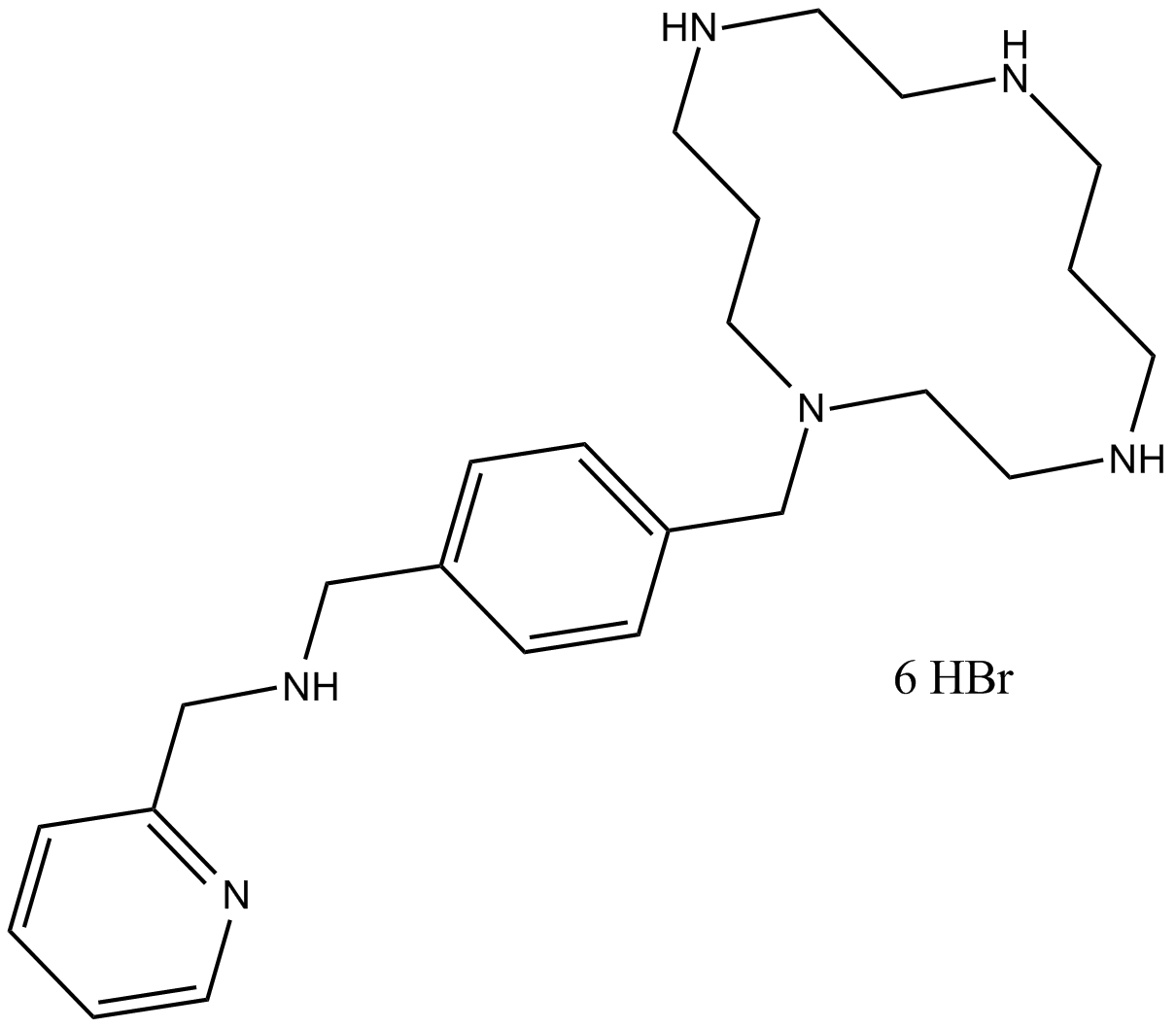
Cas No.: 185991-07-5
Sample solution is provided at 25 µL, 10mM.
_1-3.$$$39978408@51.jpg');)
_1-9.$$$38538795@65.jpg');)
_1-9.$$$39112701@51.jpg');)
_1-7.$$$37316672@70.jpg');)
_366-372.$$$36198801@70.jpg');)
.$$$38565142@65.jpg');)
_1867-1883.$$$33248023@67.jpg');)
_eads6055.$$$39977546@45.jpg');)
_eadm9805.$$$40080571@45.jpg');)
_eadj3020.$$$39666821@45.jpg');)
_1-20.$$$39757301@28.jpg');)
_1-24.$$$38898113@28.jpg');)
_273-287.$$$36806353@46.jpg');)
_1-16.$$$37156877@44.jpg');)
_1-19.$$$37460805@44.jpg');)
_1291-1307.$$$34518654@46.jpg');)
AMD 3465 hexahydrobromide is a potent antagonist of CXCR4, inhibits binding of 12G5 mAb and CXCL12AF647 to CXCR4, with IC50s of 0.75 nM and 18 nM in SupT1 cells; AMD 3465 also potently inhibits the replication of X4 HIV strains (IC50: 1-10 nM), but has no effect on CCR5-using (R5) viruses.
AMD 3465 hexahydrobromide is a potent antagonist of CXCR4, inhibits binding of 12G5 mAb and CXCL12AF647 to CXCR4, with IC50s of 0.75 nM and 18 nM in SupT1 cells. AMD 3465 (50 nM) totally blocks CXCL12-induced calcium mobilization, with an IC50 of 17 nM, but shows no effect on the intracellular calcium fluxes elicited by the CCR5 ligands RANTES, LD78β and MIP-1β in U87.CD4.CCR5 cells. AMD 3465 also potently inhibits the replication of X4 HIV strains (IC50: 1-10 nM), but has no effect on CCR5-using (R5) viruses. AMD3465 is cytotoxic to the X4 HIV-1 strains IIIB, NL4.3, RF and HE with an IC50 ranging from 6 to 12 nM. The IC50 for suppression of the HIV-2 strains ROD and EHO is 12.3 nM[1]. AMD 3465 inhibits CXCL-12-induced growth in U87 and Daoy cells. AMD 3465 treatment stimulates the phosphorylation of Erk1/2 in U87 and Daoy cells[2].
AMD 3465 (2.5 mg/kg/d, s.c. for 5 weeks) significantly blocks the growth of U87 GBM and Daoy xenografts[2].
References:
[1]. Hatse S, et al. AMD3465, a monomacrocyclic CXCR4 antagonist and potent HIV entry inhibitor. Biochem Pharmacol. 2005 Sep 1;70(5):752-61.
[2]. Yang L, et al. Blocking CXCR4-mediated cyclic AMP suppression inhibits brain tumor growth in vivo. Cancer Res. 2007 Jan 15;67(2):651-8.
Cell experiment: | Following serum starvation for 24 h, astrocytes, granule cells, U87 cells, and Daoy cells are treated with 1 μg/mL CXCL12, 2.5 ng/mL AMD 3465, 200 μM rolipram, or 10 μM forskolin. Daoy and U87 cell growth in culture is measured by trypan blue exclusion after 24 and 48 h of treatment, respectively[2]. |
Animal experiment: | Mice[2]Mice are imaged at least twice after implantation of cells to identify those with equivalent tumor growth rates. Two weeks after tumor cell implantation, cohorts of mice with approximately equivalent tumor bioluminescence are divided into equal control and treatment groups. Animals in AMD 3465 experiments receive s.c. osmotic pumps loaded with 10 mg/mL AMD 3465 in sterile PBS or PBS alone. The infusion rate is 0.25 μL/h (50 μg/d). For the experiments with rolipram or caffeine, mice in the treatment groups receive oral administration of rolipram (5 μg/g/d) or caffeine (100 μg/g/d). The concentration of drug in the water is determined from daily measurements of water consumption by each animal over the course of 7 days. Concentrations are adjusted based on water consumption to provide the prescribed dose[2]. |
References: [1]. Hatse S, et al. AMD3465, a monomacrocyclic CXCR4 antagonist and potent HIV entry inhibitor. Biochem Pharmacol. 2005 Sep 1;70(5):752-61. | |
| Cas No. | 185991-07-5 | SDF | |
| Sinónimos | GENZ-644494 hexahydrobromide | ||
| Chemical Name | N-(4-((1,4,8,11-tetraazacyclotetradecan-1-yl)methyl)benzyl)-1-(pyridin-2-yl)methanamine | ||
| Canonical SMILES | N1(CC2=CC=C(CNCC3=NC=CC=C3)C=C2)CCNCCCNCCNCCC1 | ||
| Formula | C24H38N6.6HBr | M.Wt | 896.07 |
| Solubility | DMF: 2.5 mg/ml,DMSO: 3 mg/ml,PBS (pH 7.2): 10 mg/ml | Storage | Store at -20°C |
| General tips | Please select the appropriate solvent to prepare the stock solution according to the
solubility of the product in different solvents; once the solution is prepared, please store it in
separate packages to avoid product failure caused by repeated freezing and thawing.Storage method
and period of the stock solution: When stored at -80°C, please use it within 6 months; when stored
at -20°C, please use it within 1 month. To increase solubility, heat the tube to 37°C and then oscillate in an ultrasonic bath for some time. |
||
| Shipping Condition | Evaluation sample solution: shipped with blue ice. All other sizes available: with RT, or with Blue Ice upon request. | ||
| Prepare stock solution | |||

|
1 mg | 5 mg | 10 mg |
| 1 mM | 1.116 mL | 5.5799 mL | 11.1598 mL |
| 5 mM | 223.2 μL | 1.116 mL | 2.232 mL |
| 10 mM | 111.6 μL | 558 μL | 1.116 mL |
Step 1: Enter information below (Recommended: An additional animal making an allowance for loss during the experiment)
 g
μL
g
μL
Step 2: Enter the in vivo formulation (This is only the calculator, not formulation. Please contact us first if there is no in vivo formulation at the solubility Section.)
Calculation results:
Working concentration: mg/ml;
Method for preparing DMSO master liquid: mg drug pre-dissolved in μL DMSO ( Master liquid concentration mg/mL, Please contact us first if the concentration exceeds the DMSO solubility of the batch of drug. )
Method for preparing in vivo formulation: Take μL DMSO master liquid, next addμL PEG300, mix and clarify, next addμL Tween 80, mix and clarify, next add μL saline, mix and clarify.
Method for preparing in vivo formulation: Take μL DMSO master liquid, next add μL Corn oil, mix and clarify.
Note: 1. Please make sure the liquid is clear before adding the next solvent.
2. Be sure to add the solvent(s) in order. You must ensure that the solution obtained, in the previous addition, is a clear solution before proceeding to add the next solvent. Physical methods such as vortex, ultrasound or hot water bath can be used to aid dissolving.
3. All of the above co-solvents are available for purchase on the GlpBio website.
Quality Control & SDS
- View current batch:
- Purity: >98.00% Appearance: A solid
- COA (Certificate of Analysis)
- SDS (Safety Data Sheet)
- Datasheet
Average Rating: 5 (Based on Reviews and 38 reference(s) in Google Scholar.)