

Cauloside A |
Catalog No.GC60100
 One-Click Copy Product Info
|

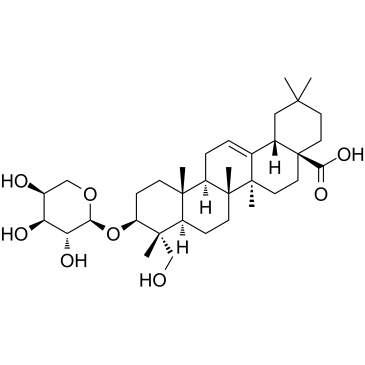
Cauloside A (Leontoside A) es una saponina aislada de las raÍces de Dipsacus asper.
Products are for research use only. Not for human use. We do not sell to patients.
Cas No.: 17184-21-3
Sample solution is provided at 25 µL, 10mM.
_1-3.$$$39978408@51.jpg');)
_1-9.$$$38538795@65.jpg');)
_1-9.$$$39112701@51.jpg');)
_1-7.$$$37316672@70.jpg');)
_366-372.$$$36198801@70.jpg');)
.$$$38565142@65.jpg');)
_1867-1883.$$$33248023@67.jpg');)
_eads6055.$$$39977546@45.jpg');)
_eadm9805.$$$40080571@45.jpg');)
_eadj3020.$$$39666821@45.jpg');)
_1-20.$$$39757301@28.jpg');)
_1-24.$$$38898113@28.jpg');)
_273-287.$$$36806353@46.jpg');)
_1-16.$$$37156877@44.jpg');)
_1-19.$$$37460805@44.jpg');)
_1291-1307.$$$34518654@46.jpg');)
Cauloside A is a triterpenoid saponin isolated from plants such as Dipsacus asper and Caulophyllum thalictroides, possessing anti-inflammatory and antifungal activities[1,2]. Cauloside A disrupts mitochondrial membrane integrity and impairs mitochondrial function[3], and is commonly used in the study of plant fungal disease control, as well as in the development of anti-inflammatory and anti-tumor drugs[4,5].
In vitro, using a whole-plant assay, Cauloside A (500μg/mL) was sprayed on rice and tomato leaves, and 24h later, the leaves were inoculated with the corresponding pathogens (rice blast (RCB), tomato gray mold (TGM), and tomato late blight (TLB)). The control efficacies against RCB, TGM, and TLB reached 95%, 83%, and 97%, respectively[6]. Co-treatment of BV2 microglial cells with Cauloside A (1, 5, 10, 50μg/mL) and lipopolysaccharide (LPS, 100ng/mL) for 24h dose-dependently inhibited LPS-induced NO production, with the most significant inhibitory effect observed at a concentration of 50μg/mL[7].
In vivo, ICR mice were orally pretreated with a crude extract of C. thalictroides containing Cauloside A (200mg/kg) for 30min, followed by intraperitoneal injection of LPS (1mg/kg) for an additional 24h, which significantly inhibited LPS-induced mRNA expression of COX-2, iNOS, TNF-α, IL-1β, and IL-6 in adrenal gland tissues[7].
References:
[1] AVULA B, WANG Y H, RUMALLA C S, et al. Analytical methods for determination of magnoflorine and saponins from roots of Caulophyllum thalictroides (L.) Michx. using UPLC, HPLC and HPTLC[J]. Journal of Pharmaceutical and Biomedical Analysis, 2011, 56(5): 895-903.
[2] ALI Z, KHAN I A. Alkaloids and saponins from blue cohosh[J]. Phytochemistry, 2008, 69(4): 1037-1042.
[3] DATTA S, MAHDI F, ALI Z, et al. Toxins in botanical dietary supplements: blue cohosh components disrupt cellular respiration and mitochondrial membrane potential[J]. Journal of Natural Products, 2014, 77(1): 111-117.
[4] XIA Y G, LI G Y, LIANG J, et al. Genus Caulophyllum: an overview of chemistry and bioactivity[J]. Evidence-Based Complementary and Alternative Medicine, 2014, 2014(1): 684508.
[5] CUI M, YAO G, ZHANG Y, et al. The molecular mechanisms of Caulophyllum robustum Maxim extract inhibition by regulating FAK/PI3K signaling pathway in gastric cancer HGC-27 cells[J]. Journal of Ethnopharmacology, 2025, 337: 118867.
[6] CHOI N H, JANG J Y, CHOI G J, et al. Antifungal activity of sterols and dipsacus saponins isolated from Dipsacus asper roots against phytopathogenic fungi[J]. Pesticide Biochemistry and Physiology, 2017, 141: 103-108.
[7] LEE Y, JUNG J C, ALI Z, et al. Anti-inflammatory effect of triterpene saponins isolated from blue cohosh (Caulophyllum thalictroides)[J]. Evidence-Based Complementary and Alternative Medicine, 2012, 2012(1): 798192.
| Cell experiment [1]: | |
Cell lines | BV2 cells |
Preparation Method | BV2 cells were seeded in 24-well plates at a density of 1×10⁵ cells per well and treated with various concentrations (1, 5, 10, 50μg/mL) of Cauloside A in the presence of LPS (100ng/mL) for 24h. After incubation, 50μL of the culture supernatant was collected and mixed with an equal volume of Griess reagent. The absorbance was measured at 540nm using a microplate reader, and nitrite accumulation was assessed to evaluate NO production. |
Reaction Conditions | 1, 5, 10, 50μg/mL; 24h |
Applications | Treatment with Cauloside A dose-dependently inhibited LPS-induced NO production, with the most significant inhibitory effect observed at a concentration of 50μg/mL. |
| Animal experiment [1]: | |
Animal models | ICR mice |
Preparation Method | ICR mice were orally pretreated with C. thalictroides crude extract (200mg/kg) containing Cauloside A for 30min, followed by intraperitoneal injection of LPS (1mg/kg) for an additional 24h, then mRNA expression levels of COX-2, iNOS, TNF-α, IL-1β, and IL-6 in adrenal gland tissues were analyzed by PCR. |
Dosage form | 200mg/kg; p.o. |
Applications | Treatment with crude extract of C. thalictroides containing Cauloside A significantly inhibited LPS-induced mRNA expression of COX-2, iNOS, TNF-α, IL-1β, and IL-6 in adrenal tissue. |
References: | |
| Cas No. | 17184-21-3 | SDF | |
| Canonical SMILES | C[C@@]1(CC[C@@]2([H])[C@]3(C)CO)[C@@](CC=C([C@]4([H])CC5(C)C)[C@]1(CC[C@]4(CC5)C(O)=O)C)([H])[C@]2(CC[C@@H]3O[C@H](OC[C@@H]6O)[C@@H]([C@H]6O)O)C | ||
| Formula | C35H56O8 | M.Wt | 604.81 |
| Solubility | Storage | Store at 2-8°C | |
| General tips | Please select the appropriate solvent to prepare the stock solution according to the
solubility of the product in different solvents; once the solution is prepared, please store it in
separate packages to avoid product failure caused by repeated freezing and thawing.Storage method
and period of the stock solution: When stored at -80°C, please use it within 6 months; when stored
at -20°C, please use it within 1 month. To increase solubility, heat the tube to 37°C and then oscillate in an ultrasonic bath for some time. |
||
| Shipping Condition | Evaluation sample solution: shipped with blue ice. All other sizes available: with RT, or with Blue Ice upon request. | ||
| Prepare stock solution | |||

|
1 mg | 5 mg | 10 mg |
| 1 mM | 1.6534 mL | 8.2671 mL | 16.5341 mL |
| 5 mM | 330.7 μL | 1.6534 mL | 3.3068 mL |
| 10 mM | 165.3 μL | 826.7 μL | 1.6534 mL |
Step 1: Enter information below (Recommended: An additional animal making an allowance for loss during the experiment)
 g
μL
g
μL
Step 2: Enter the in vivo formulation (This is only the calculator, not formulation. Please contact us first if there is no in vivo formulation at the solubility Section.)
Calculation results:
Working concentration: mg/ml;
Method for preparing DMSO master liquid: mg drug pre-dissolved in μL DMSO ( Master liquid concentration mg/mL, Please contact us first if the concentration exceeds the DMSO solubility of the batch of drug. )
Method for preparing in vivo formulation: Take μL DMSO master liquid, next addμL PEG300, mix and clarify, next addμL Tween 80, mix and clarify, next add μL saline, mix and clarify.
Method for preparing in vivo formulation: Take μL DMSO master liquid, next add μL Corn oil, mix and clarify.
Note: 1. Please make sure the liquid is clear before adding the next solvent.
2. Be sure to add the solvent(s) in order. You must ensure that the solution obtained, in the previous addition, is a clear solution before proceeding to add the next solvent. Physical methods such as vortex, ultrasound or hot water bath can be used to aid dissolving.
3. All of the above co-solvents are available for purchase on the GlpBio website.
Quality Control & SDS
- View current batch:
- Purity: >98.00% Appearance: A solid
- COA (Certificate of Analysis)
- SDS (Safety Data Sheet)
- Datasheet
Average Rating: 5 (Based on Reviews and 6 reference(s) in Google Scholar.)