

Cirsimaritin (Synonyms: 5,4'-Dihydroxy-6,7-dimethoxyflavone) |
Catalog No.GC31120
 One-Click Copy Product Info
|

Cirsimaritin es un dimetoxi flavonoide que se encuentra en las plantas, tiene potencial anticancerígeno y muestra una potente actividad antimicrobiana, antioxidante, antiespasmódica, y también inhibe la ciclooxigenasa-1.
Products are for research use only. Not for human use. We do not sell to patients.
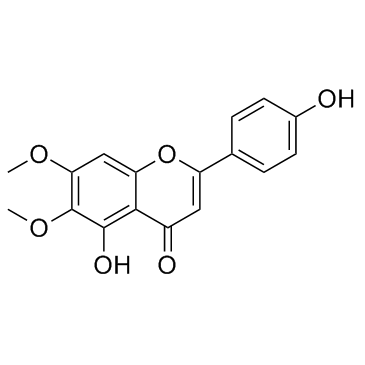
Cas No.: 6601-62-3
Sample solution is provided at 25 µL, 10mM.
_1-3.$$$39978408@51.jpg');)
_1-9.$$$38538795@65.jpg');)
_1-9.$$$39112701@51.jpg');)
_1-7.$$$37316672@70.jpg');)
_366-372.$$$36198801@70.jpg');)
.$$$38565142@65.jpg');)
_1867-1883.$$$33248023@67.jpg');)
_eads6055.$$$39977546@45.jpg');)
_eadm9805.$$$40080571@45.jpg');)
_eadj3020.$$$39666821@45.jpg');)
_1-20.$$$39757301@28.jpg');)
_1-24.$$$38898113@28.jpg');)
_273-287.$$$36806353@46.jpg');)
_1-16.$$$37156877@44.jpg');)
_1-19.$$$37460805@44.jpg');)
_1291-1307.$$$34518654@46.jpg');)
Cirsimaritin es un dimetoxi flavonoide que se encuentra en las plantas, tiene potencial anticancerígeno y muestra una potente actividad antimicrobiana, antioxidante, antiespasmódica, y también inhibe la ciclooxigenasa-1[1-3].
Cirsimaritin disminuyó significativamente la proliferación celular en la línea celular NCIH-520, con un valor de IC50 de 23.29 ± 3.51µM[4]. Cirsimaritin(0–120µg/mL; 20h) inhibió la interleucina-6, el factor de necrosis tumoral-α, y la producción de NO de una manera dependiente de la concentración en células RAW264.7 estimuladas por ipopolisacáridos (LPS)[5]. Cirsimaritin(5-20µg/mL) redujo los títulos virales y la síntesis de RNA (IAV) de una manera dependiente de la dosis[6].
Cirsimaritin(10mg/kg; i.g) previnió eficazmente la inflamación del colon inducida por DSS en ratones al mmitigar el daño de la mucosa y la infiltración de células inflamatorias. Reguló significativamente las citoquinas proinflamatorias como MMP9, NF-κB, COX-2 e iNOS. Además, cirsimaritin revirtió los efectos inducidos por el DSS, incluyendo la pérdida de peso, el acortamiento del colon, el daño tisular, el aumento de las células inflamatorias y la elevada secreción de citoquinas[7]. El tratamiento con cirsimaritin(0.5-1mg/kg; p.o; 8 semanas) redujo la gravedad de la lesión hepática en el modelo experimental de ratón de enfermedad hepática grasa asociada a disfunción metabólica (MAFLD) al inhibir la esteatosis hepática, el estrés oxidativo, la inflamación y la fibrosis hepática[8].
References:
[1]. Benali T, Jaouadi I, et,al. The Current State of Knowledge in Biological Properties of Cirsimaritin. Antioxidants (Basel). 2022 Sep 19;11(9):1842. doi: 10.3390/antiox11091842. PMID: 36139916; PMCID: PMC9495358.
[2]. Ben Sghaier M, Skandrani I, et,al. Flavonoids and sesquiterpenes from Tecurium ramosissimum promote antiproliferation of human cancer cells and enhance antioxidant activity: a structure-activity relationship study. Environ Toxicol Pharmacol. 2011 Nov;32(3):336-48. doi: 10.1016/j.etap.2011.07.003. Epub 2011 Jul 12. PMID: 22004952.
[3]. Nyiligira E, Viljoen AM, et,al. Phytochemistry and in vitro pharmacological activities of South African Vitex (Verbenaceae) species. J Ethnopharmacol. 2008 Oct 28;119(3):680-5. doi: 10.1016/j.jep.2008.07.004. Epub 2008 Jul 16. PMID: 18678237.
[4]. Pathak G, Singh S, et,al. Cirsimaritin, a lung squamous carcinoma cells (NCIH-520) proliferation inhibitor. J Biomol Struct Dyn. 2021 Jun;39(9):3312-3323. doi: 10.1080/07391102.2020.1763198. Epub 2020 May 13. PMID: 32362196.
[5]. Shin MS, Park JY, et,al. Anti-inflammatory effects and corresponding mechanisms of cirsimaritin extracted from Cirsium japonicum var. maackii Maxim. Bioorg Med Chem Lett. 2017 Jul 15;27(14):3076-3080. doi: 10.1016/j.bmcl.2017.05.051. Epub 2017 May 17. PMID: 28554870.
[6]. sYan H, Wang H, et,al. Cirsimaritin inhibits influenza A virus replication by downregulating the NF-κB signal transduction pathway. Virol J. 2018 May 21;15(1):88. doi: 10.1186/s12985-018-0995-6. PMID: 29783993; PMCID: PMC5963025.
[7]. Alqudah A, Qnais E, et,al. Cirsimaritin Alleviates Dextran Sodium Sulfate-Induced Acute Colitis in Experimental Animals: A Therapeutic Approach for Inflammatory Bowel Disease. Prev Nutr Food Sci. 2024 Mar 31;29(1):31-39. doi: 10.3746/pnf.2024.29.1.31. PMID: 38576881; PMCID: PMC10987388.
[8]. Che DN, Shin JY, et,al. Ameliorative effects of Cirsium japonicum extract and main component cirsimaritin in mice model of high-fat diet-induced metabolic dysfunction-associated fatty liver disease. Food Sci Nutr. 2021 Sep 1;9(11):6060-6068. doi: 10.1002/fsn3.2548. PMID: 34760237; PMCID: PMC8565240.
| Experimentos celulares [1]: | |
Líneas celulares | Línea celular NCIH-520 |
Método de preparación | Las células se cultivaron en medios DMEM o RPMI con alto contenido de glucosa y se complementaron con 1% de Ab/Am y 10% de FBS y se colocaron en una incubadora de a CO2 a una temperatura de 37 ℃ en un 95% de humedad. Las células se sembraron en unas placas de cultivo de células de fondo plano estériles de 96 pocillos con aproximadamente 2 × 10³ células/pocillo en cada pozo, y las placas se incubaron durante 24 horas en una incubadora de CO2. Después de 24 horas de incubación, las células se trataron con diferentes concentraciones de cirsimaritin, que oscilaron entre 0.1 y 100μM y fueron seguidas de incubación durante 24 horas. |
Condiciones de reacción | 0.1-100μM; 24h |
Áreas de aplicación | Cirsimaritin disminuyó significativamente la proliferación celular en la línea celular NCIH-520, con un valor de IC50 de 23.29 ± 3.51µM. |
| Experimentos con animales [2]: | |
Modelos animales | Ratones albinos suizos machos |
Método de preparación | A los ratones se les administró un régimen de cirsimaritin, que se administró a una dosis diaria de 10mg/kg de peso corporal (BW) a través de gavage, antes de que se les expusieran a (4% de DSS en su agua potable durante 6 días). |
Forma de dosificación | 10mg/kg; i.g |
Áreas de aplicación | Cirsimaritin mantiene BW (peso corporal) y reduce el DAI (índice de actividad de la enormidad) en ratones con colitis inducida por DSS (sulfato de dextrano sódico). |
References: | |
| Cas No. | 6601-62-3 | SDF | |
| Sinónimos | 5,4'-Dihydroxy-6,7-dimethoxyflavone | ||
| Canonical SMILES | O=C1C=C(C2=CC=C(O)C=C2)OC3=CC(OC)=C(OC)C(O)=C13 | ||
| Formula | C17H14O6 | M.Wt | 314.29 |
| Solubility | DMSO : 22.73 mg/mL (72.32 mM; Need ultrasonic) | Storage | Store at -20°C,protect from light |
| General tips | Please select the appropriate solvent to prepare the stock solution according to the
solubility of the product in different solvents; once the solution is prepared, please store it in
separate packages to avoid product failure caused by repeated freezing and thawing.Storage method
and period of the stock solution: When stored at -80°C, please use it within 6 months; when stored
at -20°C, please use it within 1 month. To increase solubility, heat the tube to 37°C and then oscillate in an ultrasonic bath for some time. |
||
| Shipping Condition | Evaluation sample solution: shipped with blue ice. All other sizes available: with RT, or with Blue Ice upon request. | ||
| Prepare stock solution | |||

|
1 mg | 5 mg | 10 mg |
| 1 mM | 3.1818 mL | 15.9089 mL | 31.8177 mL |
| 5 mM | 636.4 μL | 3.1818 mL | 6.3635 mL |
| 10 mM | 318.2 μL | 1.5909 mL | 3.1818 mL |
Step 1: Enter information below (Recommended: An additional animal making an allowance for loss during the experiment)
 g
μL
g
μL
Step 2: Enter the in vivo formulation (This is only the calculator, not formulation. Please contact us first if there is no in vivo formulation at the solubility Section.)
Calculation results:
Working concentration: mg/ml;
Method for preparing DMSO master liquid: mg drug pre-dissolved in μL DMSO ( Master liquid concentration mg/mL, Please contact us first if the concentration exceeds the DMSO solubility of the batch of drug. )
Method for preparing in vivo formulation: Take μL DMSO master liquid, next addμL PEG300, mix and clarify, next addμL Tween 80, mix and clarify, next add μL saline, mix and clarify.
Method for preparing in vivo formulation: Take μL DMSO master liquid, next add μL Corn oil, mix and clarify.
Note: 1. Please make sure the liquid is clear before adding the next solvent.
2. Be sure to add the solvent(s) in order. You must ensure that the solution obtained, in the previous addition, is a clear solution before proceeding to add the next solvent. Physical methods such as vortex, ultrasound or hot water bath can be used to aid dissolving.
3. All of the above co-solvents are available for purchase on the GlpBio website.
Quality Control & SDS
- View current batch:
- Purity: >98.00% Appearance: A solid
- COA (Certificate of Analysis)
- SDS (Safety Data Sheet)
- Datasheet
Average Rating: 5 (Based on Reviews and 20 reference(s) in Google Scholar.)