

E-5324 |
Catalog No.GC31550
 One-Click Copy Product Info
|

E-5324 es un potente inhibidor de acil-CoA:colesterol aciltransferasa (ACAT) con IC50 de 44 a 190 nM.
Products are for research use only. Not for human use. We do not sell to patients.
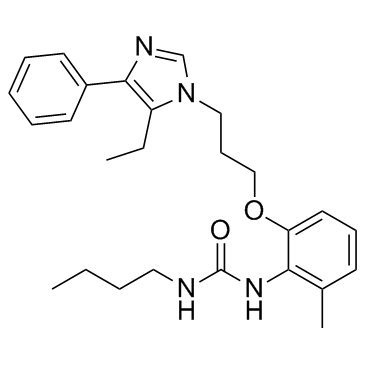
Cas No.: 141799-76-0
Sample solution is provided at 25 µL, 10mM.
_1-3.$$$39978408@51.jpg');)
_1-9.$$$38538795@65.jpg');)
_1-9.$$$39112701@51.jpg');)
_1-7.$$$37316672@70.jpg');)
_366-372.$$$36198801@70.jpg');)
.$$$38565142@65.jpg');)
_1867-1883.$$$33248023@67.jpg');)
_eads6055.$$$39977546@45.jpg');)
_eadm9805.$$$40080571@45.jpg');)
_eadj3020.$$$39666821@45.jpg');)
_1-20.$$$39757301@28.jpg');)
_1-24.$$$38898113@28.jpg');)
_273-287.$$$36806353@46.jpg');)
_1-16.$$$37156877@44.jpg');)
_1-19.$$$37460805@44.jpg');)
_1291-1307.$$$34518654@46.jpg');)
E-5324 is potent inhibitor of acyl-CoA:cholesterol acyltransferase (ACAT) with IC50s of 44 to 190 nM.
E-5324 is a potent ACAT inhibitor with IC50s of 44 to 190 nM in microsomes. E-5324 shows no effect on triglyceride synthesis up to 10 μM. E-5324 also has no effect on bovine pancreatic cholesterol esterase or lecithin: cholesterol acyltransferase (LCAT) up to 10 μM. E-5324 inhibits the incorporation of [3H]oleate into cholesteryl [3H]oleate in a concentration-dependent manner with an IC50 of 0.44 μM. E-5324 also inhibits [3H]cholesteryl ester synthesis with an IC50 of 0.41 μM[1].
The areas under the cholesterol-time curves for duration of this study (AUC) for control, E-5324 0.02% and E-5324 0.1% are 104985±4411, 106096±4476 and 105231±4 348 mg×day/dL, respectively. The high dose of E-5324 (0.1%) significantly reduces the surface involvement by 34% and 54% in the aortic arch and thoracic aorta, respectively. E-5324 treatment significantly reduces the wet weight and protein content. In the aortic arch, the high dose of E-5324 (0.1%) significantly reduces both cholesteryl ester and total cholesterol by 60% and 59%, respectively. The high dose of E-5324 (0.1%) markedly reduces the ACAT activities in the aortic arch and thoracic aorta by 35% and 44%, respectively[2].
[1]. Kogushi M, et al. Effect of E5324, a novel inhibitor of acyl-CoA:cholesterol acyltransferase, on cholesteryl ester synthesis and accumulation in macrophages. Jpn J Pharmacol. 1995 Jun;68(2):191-9. [2]. Kogushi M, et al. Anti-atherosclerotic effect of E5324, an inhibitor of acyl-CoA:cholesterol acyltransferase, in Watanabe heritable hyperlipidemic rabbits. Atherosclerosis. 1996 Aug 2;124(2):203-10.
Cell experiment: | In the study of the inhibitory effect of E-5324, PMA-treated THP-1 cells are incubated in LPDS/RPMI containing 50 μg protein/mL βVLDL for 5 hr. Then, 100 μL of each concentration of E-5324 solution or vehicle (LPDS/RPMI) is added to the cultured cells. After incubation with E-5324 for 30 min, 20 μL of [3H]oleate-BSA complex is added, and the mixture is incubated for 2 hr. The lipids are extracted from the cells with hexane: 2-propanol (3:2, v/v) and then separated by TLC. The remaining cellular protein is dissolved in 0.1 N NaOH[1]. |
Animal experiment: | Forty male WHHL rabbits weighing approximately 1.7 kg at the age of 3 months are used in the experiment. All animals are individually caged and receive 100 g/day of food throughout the experiment. The rabbits are divided into 4 groups so as to make their plasma total cholesterol levels similar. The rabbits are fed a standard rabbit chow, ORC-4, or ORC-4 containing E5324 (0.02% or 0.1% (w/w)), or ORC-4 containing probucol (1% (w/w)) for 16 weeks[2]. |
References: [1]. Kogushi M, et al. Effect of E5324, a novel inhibitor of acyl-CoA:cholesterol acyltransferase, on cholesteryl ester synthesis and accumulation in macrophages. Jpn J Pharmacol. 1995 Jun;68(2):191-9. | |
| Cas No. | 141799-76-0 | SDF | |
| Canonical SMILES | O=C(NC1=C(C)C=CC=C1OCCCN2C(CC)=C(C3=CC=CC=C3)N=C2)NCCCC | ||
| Formula | C26H34N4O2 | M.Wt | 434.57 |
| Solubility | Soluble in DMSO | Storage | Store at -20°C |
| General tips | Please select the appropriate solvent to prepare the stock solution according to the
solubility of the product in different solvents; once the solution is prepared, please store it in
separate packages to avoid product failure caused by repeated freezing and thawing.Storage method
and period of the stock solution: When stored at -80°C, please use it within 6 months; when stored
at -20°C, please use it within 1 month. To increase solubility, heat the tube to 37°C and then oscillate in an ultrasonic bath for some time. |
||
| Shipping Condition | Evaluation sample solution: shipped with blue ice. All other sizes available: with RT, or with Blue Ice upon request. | ||
| Prepare stock solution | |||

|
1 mg | 5 mg | 10 mg |
| 1 mM | 2.3011 mL | 11.5056 mL | 23.0113 mL |
| 5 mM | 460.2 μL | 2.3011 mL | 4.6023 mL |
| 10 mM | 230.1 μL | 1.1506 mL | 2.3011 mL |
Step 1: Enter information below (Recommended: An additional animal making an allowance for loss during the experiment)
 g
μL
g
μL
Step 2: Enter the in vivo formulation (This is only the calculator, not formulation. Please contact us first if there is no in vivo formulation at the solubility Section.)
Calculation results:
Working concentration: mg/ml;
Method for preparing DMSO master liquid: mg drug pre-dissolved in μL DMSO ( Master liquid concentration mg/mL, Please contact us first if the concentration exceeds the DMSO solubility of the batch of drug. )
Method for preparing in vivo formulation: Take μL DMSO master liquid, next addμL PEG300, mix and clarify, next addμL Tween 80, mix and clarify, next add μL saline, mix and clarify.
Method for preparing in vivo formulation: Take μL DMSO master liquid, next add μL Corn oil, mix and clarify.
Note: 1. Please make sure the liquid is clear before adding the next solvent.
2. Be sure to add the solvent(s) in order. You must ensure that the solution obtained, in the previous addition, is a clear solution before proceeding to add the next solvent. Physical methods such as vortex, ultrasound or hot water bath can be used to aid dissolving.
3. All of the above co-solvents are available for purchase on the GlpBio website.
Quality Control & SDS
- View current batch:
- Purity: >98.00% Appearance: A solid
- COA (Certificate of Analysis)
- SDS (Safety Data Sheet)
- Datasheet
Average Rating: 5 (Based on Reviews and 4 reference(s) in Google Scholar.)