

Gibberellic acid (Synonyms: GA3, Gibberellin A3, (+)-Gibberellic Acid) |
Catalog No.GC38309
 One-Click Copy Product Info
|

Gibberellic acid es una hormona vegetal que pertenece a las giberelinas, que están ampliamente presentes en las plantas y pueden promover el crecimiento y desarrollo de las plantas. Gibberellic acid también puede inducir disfunción hepática y renal en ratas y generar estrés oxidativo.
Products are for research use only. Not for human use. We do not sell to patients.
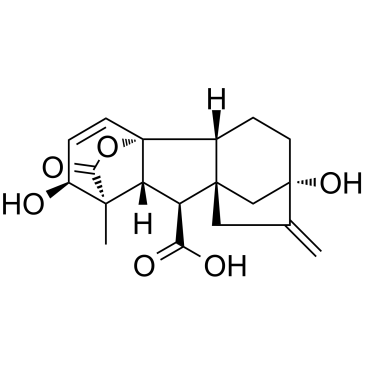
Cas No.: 77-06-5
Sample solution is provided at 25 µL, 10mM.
_1-3.$$$39978408@51.jpg');)
_1-9.$$$38538795@65.jpg');)
_1-9.$$$39112701@51.jpg');)
_1-7.$$$37316672@70.jpg');)
_366-372.$$$36198801@70.jpg');)
.$$$38565142@65.jpg');)
_1867-1883.$$$33248023@67.jpg');)
_eads6055.$$$39977546@45.jpg');)
_eadm9805.$$$40080571@45.jpg');)
_eadj3020.$$$39666821@45.jpg');)
_1-20.$$$39757301@28.jpg');)
_1-24.$$$38898113@28.jpg');)
_273-287.$$$36806353@46.jpg');)
_1-16.$$$37156877@44.jpg');)
_1-19.$$$37460805@44.jpg');)
_1291-1307.$$$34518654@46.jpg');)
Gibberellic acid es una hormona vegetal que pertenece a las giberelinas, que están ampliamente presentes en las plantas y pueden promover el crecimiento y desarrollo de las plantas[1]. Gibberellic acid también puede inducir disfunción hepática y renal en ratas y generar estrés oxidativo.
La aplicación de diferentes niveles de nitrógeno solo y en combinación con el Gibberellic acid (60g/ha) y el inhibidor de la ureasa (NBPT) aumentó significativamente el rendimiento del maíz[2]. Gibberellic acid (0.05µM) alivia la toxicidad del cadmio en el arroz al regular la acumulación de NO y la capacidad de fijación de la pared celular del cadmio[3]. Gibberellic acid (0 y 0.05μM; 14 días) mitiga el estrés del níquel en la soja mediante la fijación de la pared celular y la regulación del metabolismo del estrés oxidativo y el sistema de gluoxalasa[4]. La genración de sulfuro de hidrógeno inducida por el Gibberellic acid (100mg/L; 14 días) alivia la toxicidad del boro en las plantas de tomate (Solanum lycopersicum L.) [5]. El pretratamiento con Gibberellic acid (600μM; 1h) mejoró la viabilidad de las células microgliales BV2 estimuladas por LPS[6].
En experimentos con animales, Gibberellic acid (5mg/kg; 10 días; i.g.) redujo significativamente la expresión de múltiples factores inflamatorios en el hipocampo de ratones con sepsis [6]. Gibberellic acid (55mg/kg; i.g.) induce disfunción del hígado y el riñón y estrés oxidativo en ratas albinas macho[7].
References:
[1] Huang YP, Chen IH, Kao YS, et al. The gibberellic acid derived from the plastidial MEP pathway is involved in the accumulation of Bamboo mosaic virus. New Phytol. 2022 Aug;235(4):1543-1557.
[2] Ullah I, Dawar K, Tariq M, et al. Gibberellic acid and urease inhibitor optimize nitrogen uptake and yield of maize at varying nitrogen levels under changing climate. Environ Sci Pollut Res Int. 2022 Jan;29(5):6568-6577.
[3] Liu YS, Tao Y, Yang XZ, et al. Gibberellic acid alleviates cadmium toxicity in rice by regulating NO accumulation and cell wall fixation capacity of cadmium. J Hazard Mater. 2022 Oct 5;439:129597.
[4] Bhat JA, Basit F, Alyemeni MN, et al. Gibberellic acid mitigates nickel stress in soybean by cell wall fixation and regulating oxidative stress metabolism and glyoxalase system. Plant Physiol Biochem. 2023 May;198:107678.
[5] Kaya C, Sarıoğlu A, Ashraf M, et al. Gibberellic acid-induced generation of hydrogen sulfide alleviates boron toxicity in tomato (Solanum lycopersicum L.) plants. Plant Physiol Biochem. 2020 Aug;153:53-63.
[6] Xu HJ, Lin YY, Yu JJ, et al. Gibberellic acid targeting ZBTB16 reduces NF-κB dependent inflammatory stress in sepsis-induced neuroinflammation. Eur J Pharmacol. 2024 Aug 5;976:176665.
[7] Soliman MM, Gaber A, Alsanie WF, et al. Gibberellic acid-induced hepatorenal dysfunction and oxidative stress: Mitigation by quercetin through modulation of antioxidant, anti-inflammatory, and antiapoptotic activities. J Food Biochem. 2022 Feb;46(2):e14069.
| Experimentos celulares [1]: | |
Líneas celulares | OxABF1–6 y OxABF1–9 (líneas de sobreexpresión de OsABF1) |
Método de preparación | Primero, las semillas se empaparon en una solución de hipoclorito de sodio al 2% (NaClO, v/v) para su desinfección. Después de 20 minutos, las semillas se enjuagaron con agua desionizada y luego germinaron en la oscuridad a 30 °C. Posteriormente, las plántulas se transfirieron a 1/2 solución nutritiva de Kimura B durante otros 6 días. Finalmente, se seleccionaron las plántulas uniformes y se transfirieron a las siguientes soluciones: solución nutritiva completa sin cadmio (-Cd), solución -Cd suplementada con 0,05 µM de Gibberellic acid (GA) (-Cd+Gibberellic acid), solución que contiene 1 µM de cadmio (+Cd), solución +Cd con Gibberellic acid a 0,05 µM (+Cd+Gibberellic acid), +Cd solución con 10 µM eliminador de óxido nítrico cPTIO (+Cd+cPTIO), y +Cd+solución de Gibberellic acid con 10µM cPTIO (+Cd+Gibberellic acid+cPTIO). Las líneas deficientes en Gibberellic acid y sus plántulas de tipo salvaje (WT, Nip) fueron sometidas a soluciones -Cd y +Cd durante 5 días, después de lo cual las plántulas fueron cosechadas para su análisis. Las soluciones de tratamiento se cambiaron cada dos días. |
Condiciones de reacción | 0,05 µM |
Áreas de aplicación | Gibberellic acid alivia la toxicidad del cadmio en el arroz al regular la acumulación de NO y la capacidad de fijación de la pared celular del cadmio. |
| Experimentos con animales [2]: | |
Modelos animales | Ratones macho C57BL/6J |
Método de preparación | Los ratones se dividieron aleatoriamente en cuatro grupos (6-8 ratones por grupo) y se les administró lipopolisacárico (LPS) a través de inyección intraperitoneal o ácido giberílico (GA3, disuelto en una solución de etanol al 1%) a través de gavage, junto con diferentes reactivos de la siguiente manera: grupo de control, solución salina (8µl/g); grupo de Gibberellic acid, Gibberellic acid (5 mg/kg); grupo LPS, LPS (10 mg/kg); grupo de Gibberellic acid, Gibberellic acid (5 mg/kg) + LPS (10 mg/kg) disuelto en solución salina, con LPS inyectado 60 minutos después de la administración de Gibberellic acid. La supervivencia del ratón fue monitoreada durante 10 días (n = 20). En un experimento paralelo, los ratones recibieron los mismos tratamientos, y su sangre y cerebro se recogieron en varios momentos después de la inyección de LPS o solución salina. Las muestras de suero y tejido cerebral se almacenaron a -80 °C o se fijaron con formalina para su uso futuro. Los ratones fueron sacrificados por dislocación cervical después de la inyección intraperitoneal de una sobredosis de pentobarbital al 2% de sodio (50 mg/kg). |
Forma de dosificación | 5 mg/kg; 10 días; i.g. |
Áreas de aplicación | Gibberellic acid redujo significativamente la expresión de múltiples factores inflamatorios en el hipocampo de ratones con sepsis. |
References: | |
| Cas No. | 77-06-5 | SDF | |
| Sinónimos | GA3, Gibberellin A3, (+)-Gibberellic Acid | ||
| Canonical SMILES | OC([C@H]1[C@@]([C@]23C)([H])[C@@](OC2=O)(C=C[C@@H]3O)[C@@](CC4)([H])[C@]1(C5)C[C@]4(O)C5=C)=O | ||
| Formula | C19H22O6 | M.Wt | 346.37 |
| Solubility | DMSO: 250 mg/mL (721.77 mM) | Storage | Store at 2-8°C |
| General tips | Please select the appropriate solvent to prepare the stock solution according to the
solubility of the product in different solvents; once the solution is prepared, please store it in
separate packages to avoid product failure caused by repeated freezing and thawing.Storage method
and period of the stock solution: When stored at -80°C, please use it within 6 months; when stored
at -20°C, please use it within 1 month. To increase solubility, heat the tube to 37°C and then oscillate in an ultrasonic bath for some time. |
||
| Shipping Condition | Evaluation sample solution: shipped with blue ice. All other sizes available: with RT, or with Blue Ice upon request. | ||
| Prepare stock solution | |||

|
1 mg | 5 mg | 10 mg |
| 1 mM | 2.8871 mL | 14.4354 mL | 28.8709 mL |
| 5 mM | 577.4 μL | 2.8871 mL | 5.7742 mL |
| 10 mM | 288.7 μL | 1.4435 mL | 2.8871 mL |
Step 1: Enter information below (Recommended: An additional animal making an allowance for loss during the experiment)
 g
μL
g
μL
Step 2: Enter the in vivo formulation (This is only the calculator, not formulation. Please contact us first if there is no in vivo formulation at the solubility Section.)
Calculation results:
Working concentration: mg/ml;
Method for preparing DMSO master liquid: mg drug pre-dissolved in μL DMSO ( Master liquid concentration mg/mL, Please contact us first if the concentration exceeds the DMSO solubility of the batch of drug. )
Method for preparing in vivo formulation: Take μL DMSO master liquid, next addμL PEG300, mix and clarify, next addμL Tween 80, mix and clarify, next add μL saline, mix and clarify.
Method for preparing in vivo formulation: Take μL DMSO master liquid, next add μL Corn oil, mix and clarify.
Note: 1. Please make sure the liquid is clear before adding the next solvent.
2. Be sure to add the solvent(s) in order. You must ensure that the solution obtained, in the previous addition, is a clear solution before proceeding to add the next solvent. Physical methods such as vortex, ultrasound or hot water bath can be used to aid dissolving.
3. All of the above co-solvents are available for purchase on the GlpBio website.
Quality Control & SDS
- View current batch:
- Purity: >98.00% Appearance: A solid
- COA (Certificate of Analysis)
- SDS (Safety Data Sheet)
- Datasheet
Average Rating: 5 (Based on Reviews and 14 reference(s) in Google Scholar.)