

Gibberellic acid (Synonyms: GA3, Gibberellin A3, (+)-Gibberellic Acid) |
Katalog-Nr.GC38309
 One-Click Copy Product Info
|

GibberellinsÄure ist nach einem Pilz namens Gibberella fujikuroi benannt.
Products are for research use only. Not for human use. We do not sell to patients.
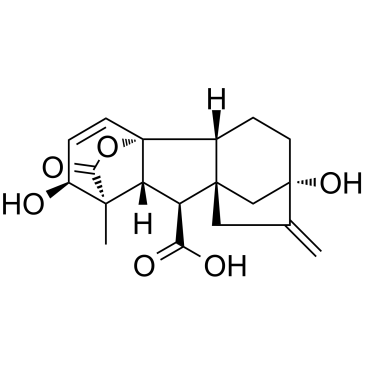
Cas No.: 77-06-5
Sample solution is provided at 25 µL, 10mM.
_1-3.$$$39978408@51.jpg');)
_1-9.$$$38538795@65.jpg');)
_1-9.$$$39112701@51.jpg');)
_1-7.$$$37316672@70.jpg');)
_366-372.$$$36198801@70.jpg');)
.$$$38565142@65.jpg');)
_1867-1883.$$$33248023@67.jpg');)
_eads6055.$$$39977546@45.jpg');)
_eadm9805.$$$40080571@45.jpg');)
_eadj3020.$$$39666821@45.jpg');)
_1-20.$$$39757301@28.jpg');)
_1-24.$$$38898113@28.jpg');)
_273-287.$$$36806353@46.jpg');)
_1-16.$$$37156877@44.jpg');)
_1-19.$$$37460805@44.jpg');)
_1291-1307.$$$34518654@46.jpg');)
Gibberellic acid is a plant hormone belonging to the gibberellins, which are widely present in plants and can promote plant growth and development[1]. Gibberellic acid can also induce liver and kidney dysfunction in rats and generate oxidative stress.
The application of different levels of nitrogen alone and in combination with Gibberellic acid (60g/ha) and the urease inhibitor (NBPT) significantly increased the yield of corn[2]. Gibberellic acid (0.05µM) alleviates cadmium toxicity in rice by regulating NO accumulation and cell wall fixation capacity of cadmium[3]. Gibberellic acid (0 and 0.05μM; 14 days) mitigates nickel stress in soybean by cell wall fixation and regulating oxidative stress metabolism and glyoxalase system[4]. Gibberellic acid (100mg/L; 14 days)-induced generation of hydrogen sulfide alleviates boron toxicity in tomato (Solanum lycopersicum L.) plants[5]. Pre-treatment with Gibberellic acid (600μM; 1h) improved the viability of LPS-stimulated BV2 microglial cells[6].
In animal experiments, Gibberellic acid (5mg/kg; 10 days; i.g.) significantly reduced the expression of multiple inflammatory factors in the hippocampus of sepsis mice[6]. Gibberellic acid (55mg/kg; i.g.) induces dysfunction of liver and kidney and oxidative stress in male albino rats[7].
References:
[1] Huang YP, Chen IH, Kao YS, et al. The gibberellic acid derived from the plastidial MEP pathway is involved in the accumulation of Bamboo mosaic virus. New Phytol. 2022 Aug;235(4):1543-1557.
[2] Ullah I, Dawar K, Tariq M, et al. Gibberellic acid and urease inhibitor optimize nitrogen uptake and yield of maize at varying nitrogen levels under changing climate. Environ Sci Pollut Res Int. 2022 Jan;29(5):6568-6577.
[3] Liu YS, Tao Y, Yang XZ, et al. Gibberellic acid alleviates cadmium toxicity in rice by regulating NO accumulation and cell wall fixation capacity of cadmium. J Hazard Mater. 2022 Oct 5;439:129597.
[4] Bhat JA, Basit F, Alyemeni MN, et al. Gibberellic acid mitigates nickel stress in soybean by cell wall fixation and regulating oxidative stress metabolism and glyoxalase system. Plant Physiol Biochem. 2023 May;198:107678.
[5] Kaya C, Sarıoğlu A, Ashraf M, et al. Gibberellic acid-induced generation of hydrogen sulfide alleviates boron toxicity in tomato (Solanum lycopersicum L.) plants. Plant Physiol Biochem. 2020 Aug;153:53-63.
[6] Xu HJ, Lin YY, Yu JJ, et al. Gibberellic acid targeting ZBTB16 reduces NF-κB dependent inflammatory stress in sepsis-induced neuroinflammation. Eur J Pharmacol. 2024 Aug 5;976:176665.
[7] Soliman MM, Gaber A, Alsanie WF, et al. Gibberellic acid-induced hepatorenal dysfunction and oxidative stress: Mitigation by quercetin through modulation of antioxidant, anti-inflammatory, and antiapoptotic activities. J Food Biochem. 2022 Feb;46(2):e14069.
| Plant experiment [1]: | |
Plant lines | OxABF1–6 and OxABF1–9 (OsABF1 overexpression lines) |
Preparation Method | First, seeds were soaked in a 2% sodium hypochlorite (NaClO, v/v) solution for disinfection. After 20min, the seeds were rinsed with deionized water and then germinated in darkness at 30°C. Subsequently, the seedlings were transferred to 1/2 Kimura B nutrient solution for another 6 days. Finally, uniform seedlings were selected and transferred into the following solutions: complete nutrient solution without cadmium (-Cd), -Cd solution supplemented with 0.05µM Gibberellic acid (GA) (-Cd+Gibberellic acid), solution containing 1µM cadmium (+Cd), +Cd solution with 0.05µM Gibberellic acid (+Cd+Gibberellic acid), +Cd solution with 10µM nitric oxide scavenger cPTIO (+Cd+cPTIO), and +Cd+Gibberellic acid solution with 10µM cPTIO (+Cd+Gibberellic acid+cPTIO). The Gibberellic acid-deficient lines and their wild-type (WT, Nip) seedlings were subjected to -Cd and +Cd solutions for 5 days, after which the seedlings were harvested for analysis. The treatment solutions were changed every two days. |
Reaction Conditions | 0.05µM |
Applications | Gibberellic acid alleviates cadmium toxicity in rice by regulating NO accumulation and cell wall fixation capacity of cadmium. |
| Animal experiment [2]: | |
Animal models | male C57BL/6J mice |
Preparation Method | Mice were randomly divided into four groups (6-8 mice per group) and were administered lipopolysaccharide (LPS) via intraperitoneal injection or Gibberellic acid (GA₃, dissolved in a 1% ethanol solution) via gavage, along with different reagents as follows: control group, saline (8µl/g); Gibberellic acid group, Gibberellic acid (5mg/kg); LPS group, LPS (10mg/kg); LPS + Gibberellic acid group, Gibberellic acid (5mg/kg) + LPS (10mg/kg) dissolved in saline, with LPS injected 60min after Gibberellic acid administration. Mouse survival was monitored for 10 days (n = 20). In a parallel experiment, mice received the same treatments, and their blood and brains were collected at various time points after injection of LPS or saline. Serum and brain tissue samples were stored at −80°C or fixed with formalin for future use. Mice were euthanized by cervical dislocation after intraperitoneal injection of an overdose of 2% pentobarbital sodium (50mg/kg). |
Dosage form | 5mg/kg; 10 days; i.g. |
Applications | Gibberellic acid significantly reduced the expression of multiple inflammatory factors in the hippocampus of sepsis mice. |
References: | |
| Cas No. | 77-06-5 | SDF | |
| Überlieferungen | GA3, Gibberellin A3, (+)-Gibberellic Acid | ||
| Canonical SMILES | OC([C@H]1[C@@]([C@]23C)([H])[C@@](OC2=O)(C=C[C@@H]3O)[C@@](CC4)([H])[C@]1(C5)C[C@]4(O)C5=C)=O | ||
| Formula | C19H22O6 | M.Wt | 346.37 |
| Löslichkeit | DMSO: 250 mg/mL (721.77 mM) | Storage | Store at 2-8°C |
| General tips | Please select the appropriate solvent to prepare the stock solution according to the
solubility of the product in different solvents; once the solution is prepared, please store it in
separate packages to avoid product failure caused by repeated freezing and thawing.Storage method
and period of the stock solution: When stored at -80°C, please use it within 6 months; when stored
at -20°C, please use it within 1 month. To increase solubility, heat the tube to 37°C and then oscillate in an ultrasonic bath for some time. |
||
| Shipping Condition | Evaluation sample solution: shipped with blue ice. All other sizes available: with RT, or with Blue Ice upon request. | ||
| Prepare stock solution | |||

|
1 mg | 5 mg | 10 mg |
| 1 mM | 2.8871 mL | 14.4354 mL | 28.8709 mL |
| 5 mM | 577.4 μL | 2.8871 mL | 5.7742 mL |
| 10 mM | 288.7 μL | 1.4435 mL | 2.8871 mL |
Step 1: Enter information below (Recommended: An additional animal making an allowance for loss during the experiment)
 g
μL
g
μL
Step 2: Enter the in vivo formulation (This is only the calculator, not formulation. Please contact us first if there is no in vivo formulation at the solubility Section.)
Calculation results:
Working concentration: mg/ml;
Method for preparing DMSO master liquid: mg drug pre-dissolved in μL DMSO ( Master liquid concentration mg/mL, Please contact us first if the concentration exceeds the DMSO solubility of the batch of drug. )
Method for preparing in vivo formulation: Take μL DMSO master liquid, next addμL PEG300, mix and clarify, next addμL Tween 80, mix and clarify, next add μL saline, mix and clarify.
Method for preparing in vivo formulation: Take μL DMSO master liquid, next add μL Corn oil, mix and clarify.
Note: 1. Please make sure the liquid is clear before adding the next solvent.
2. Be sure to add the solvent(s) in order. You must ensure that the solution obtained, in the previous addition, is a clear solution before proceeding to add the next solvent. Physical methods such as vortex, ultrasound or hot water bath can be used to aid dissolving.
3. All of the above co-solvents are available for purchase on the GlpBio website.
Quality Control & SDS
- View current batch:
- Purity: >98.00% Appearance: A solid
- COA (Certificate of Analysis)
- SDS (Safety Data Sheet)
- Datasheet
Average Rating: 5 (Based on Reviews and 14 reference(s) in Google Scholar.)