

Thymol (Synonyms: IPMP, p-Cymen-3-ol, 2-isopropyl-5-Methylphenol, NSC 11215, NSC 47821, NSC 49142) |
Catalog No.GC38667
 One-Click Copy Product Info
|

Thymol es un compuesto fenólico con múltiples actividades farmacológicas, como actividades antibacterianas, anticancerosas,antidiabéticas, antineurodegenerativas y antirreumáticas
Products are for research use only. Not for human use. We do not sell to patients.
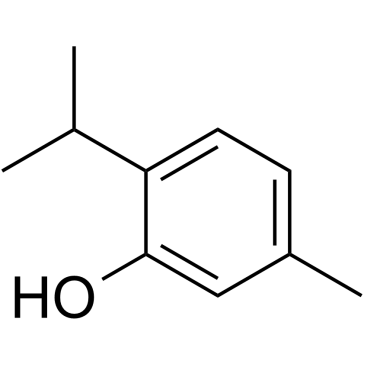
Cas No.: 89-83-8
Sample solution is provided at 25 µL, 10mM.
_1-3.$$$39978408@51.jpg');)
_1-9.$$$38538795@65.jpg');)
_1-9.$$$39112701@51.jpg');)
_1-7.$$$37316672@70.jpg');)
_366-372.$$$36198801@70.jpg');)
.$$$38565142@65.jpg');)
_1867-1883.$$$33248023@67.jpg');)
_eads6055.$$$39977546@45.jpg');)
_eadm9805.$$$40080571@45.jpg');)
_eadj3020.$$$39666821@45.jpg');)
_1-20.$$$39757301@28.jpg');)
_1-24.$$$38898113@28.jpg');)
_273-287.$$$36806353@46.jpg');)
_1-16.$$$37156877@44.jpg');)
_1-19.$$$37460805@44.jpg');)
_1291-1307.$$$34518654@46.jpg');)
Thymol es un compuesto fenólico con múltiples actividades farmacológicas, como actividades antibacterianas, anticancerosas,antidiabéticas, antineurodegenerativas y antirreumáticas [1]. Thymol es un agonista del subtipo 1 del canal de anquirina del subtipo 1 del receptor transitorio[2]. Thymol puede mostrar una actividad sigbificativa contra bacterias, hongos y parásitos al destruir las membranas celulares microbianas, inhibir la actividad enzimática e interferir con el metabolismo energético [3].
In vitro, el tratamiento con Thymol (0-150μM) de células de cáncer de vejiga (T24, SW780, células J82) y células uroteliales no malignas (células SV-HUC-1) durante 0-36h inhibió la viabilidad celular de una manera dependiente del tiempo y la dosis e indujo la detennción del ciclo celular en la fase G2/M [4]. El tratamiento con Thymol (5μM) de las células A549 durante 48h inhibió la transición epithelial-mesenchymal y la motilidad de las células[5].
In vivo, la administración oral de Thymol (400mg/kg) para tratar a ratas modelo de pleuresía inhibió significativamente el edema inflamatorio y redujo la cantidad de exudado pleurítico en un 34.2%[6]. Thymol (5mg/kg) se trató mediante inyección intraperitoneal en ratones albinos machos y redujo el índice mitótico (MI) de las células de la médula ósea del ratón[7].
References:
[1] Aljelehawy Q H A, Mohammadi S, Mohamadian E, et al. Antimicrobial, anticancer, antidiabetic, antineurodegenerative, and antirheumatic activities of thymol: clarification of mechanisms[J]. Micro Nano Bio Aspects, 2023, 2(1): 1-7.
[2] De La Chapa J J, Singha P K, Lee D R, et al. Thymol inhibits oral squamous cell carcinoma growth via mitochondria‐mediated apoptosis[J]. Journal of Oral Pathology & Medicine, 2018, 47(7): 674-682.
[3] Nourbakhsh F, Lotfalizadeh M, Badpeyma M, et al. From plants to antimicrobials: Natural products against bacterial membranes[J]. Phytotherapy Research, 2022, 36(1): 33-52.
[4] Li Y, Wen J, Du C, et al. Thymol inhibits bladder cancer cell proliferation via inducing cell cycle arrest and apoptosis[J]. Biochemical and biophysical research communications, 2017, 491(2): 530-536.
[5] Li T, Shi J, Wang L, et al. Thymol targeting interleukin 4 induced 1 expression reshapes the immune microenvironment to sensitize the immunotherapy in lung adenocarcinoma[J]. MedComm, 2023, 4(5): e355.
[6] Fachini-Queiroz F C, Kummer R, Estevao-Silva C F, et al. Effects of thymol and carvacrol, constituents of Thymus vulgaris L. essential oil, on the inflammatory response[J]. Evidence‐Based Complementary and Alternative Medicine, 2012, 2012(1): 657026.
[7] Abed R M. Cytotoxic, cytogenetics and immunomodulatory effects of thymol from Thymus vulgaris on cancer and normal cell lines in vitro and in vivo[J]. Al-Mustansiriyah J Sci, 2011, 22(4): 41-53.
| Experimentos celulares [1]: | |
Líneas celulares | Células T24, SW780, J82, SV-HUC-1 |
Método de preparación | Las células de cáncer de vejiga T24, SW780, J82 y las células uroteliales no malignas SV-HUC-1 se trataron con diferentes concentraciones de Thymol (0, 25, 50, 100, 150μM) durante 24h o una cierta dosis (100μM) de Thymol durante diferentes momentos (0, 6, 12, 24, 36h). Los cambios en la viabilidad celular se midieron mediante el ensayo MTT. |
Condiciones de reacción | 0, 25, 50, 100, 150μM; 0, 6, 12, 24, 36h |
Áreas de aplicación | Thymol inhibió la proliferación de células del cáncer de vejiga de una manera dependiente de la dosis y el tiempo. |
| Experimentos con animales [2]: | |
Modelos animales | Ratas Wistar macho |
Método de preparación | Los animales fueron pretratados por vía oral con aceite esencial de Thymus vulgaris(TEO) (250, 500, o 750mg/kg), Carvacrol (100, 200, o 400mg/kg), y Thymol (100, 200, o 400mg/kg). Indomethacin (5mg/kg) y Celecoxib (10mg/kg) se utilizaron como medicamentos estándar. Los de control solo recibieron agua. Una hora después, todos los animales, con la excepción del grupo normal, recibieron una inyección intrapleural de carragenina (200μg/animal). Cuatro horas después, los animales fueron sacrificados y se recogió el exudado pleural. |
Forma de dosificación | 100, 200, 400mg/kg; p.o. |
Áreas de aplicación | Thymol redujo significativamente el volumen de exudados inflamatorios pleurales en un 34.2%, a una dosis de 400 mg/kg. |
References: | |
| Cas No. | 89-83-8 | SDF | |
| Sinónimos | IPMP, p-Cymen-3-ol, 2-isopropyl-5-Methylphenol, NSC 11215, NSC 47821, NSC 49142 | ||
| Canonical SMILES | OC1=CC(C)=CC=C1C(C)C | ||
| Formula | C10H14O | M.Wt | 150.22 |
| Solubility | DMSO: 125 mg/mL (832.11 mM) | Storage | Store at -20°C |
| General tips | Please select the appropriate solvent to prepare the stock solution according to the
solubility of the product in different solvents; once the solution is prepared, please store it in
separate packages to avoid product failure caused by repeated freezing and thawing.Storage method
and period of the stock solution: When stored at -80°C, please use it within 6 months; when stored
at -20°C, please use it within 1 month. To increase solubility, heat the tube to 37°C and then oscillate in an ultrasonic bath for some time. |
||
| Shipping Condition | Evaluation sample solution: shipped with blue ice. All other sizes available: with RT, or with Blue Ice upon request. | ||
| Prepare stock solution | |||

|
1 mg | 5 mg | 10 mg |
| 1 mM | 6.6569 mL | 33.2845 mL | 66.569 mL |
| 5 mM | 1.3314 mL | 6.6569 mL | 13.3138 mL |
| 10 mM | 665.7 μL | 3.3285 mL | 6.6569 mL |
Step 1: Enter information below (Recommended: An additional animal making an allowance for loss during the experiment)
 g
μL
g
μL
Step 2: Enter the in vivo formulation (This is only the calculator, not formulation. Please contact us first if there is no in vivo formulation at the solubility Section.)
Calculation results:
Working concentration: mg/ml;
Method for preparing DMSO master liquid: mg drug pre-dissolved in μL DMSO ( Master liquid concentration mg/mL, Please contact us first if the concentration exceeds the DMSO solubility of the batch of drug. )
Method for preparing in vivo formulation: Take μL DMSO master liquid, next addμL PEG300, mix and clarify, next addμL Tween 80, mix and clarify, next add μL saline, mix and clarify.
Method for preparing in vivo formulation: Take μL DMSO master liquid, next add μL Corn oil, mix and clarify.
Note: 1. Please make sure the liquid is clear before adding the next solvent.
2. Be sure to add the solvent(s) in order. You must ensure that the solution obtained, in the previous addition, is a clear solution before proceeding to add the next solvent. Physical methods such as vortex, ultrasound or hot water bath can be used to aid dissolving.
3. All of the above co-solvents are available for purchase on the GlpBio website.
Quality Control & SDS
- View current batch:
- Purity: >99.50% Appearance: A solid
- COA (Certificate of Analysis)
- SDS (Safety Data Sheet)
- Datasheet
Average Rating: 5 (Based on Reviews and 25 reference(s) in Google Scholar.)