

GLPG0974 |
Catalog No.GC31614
 One-Click Copy Product Info
|

GLPG0974 es un antagonista oral del receptor de ácidos grasos libres 2(FFA2, GPR43, IC50 = 9nM) oral,de alta afinidad,potente y selectivo .
Products are for research use only. Not for human use. We do not sell to patients.
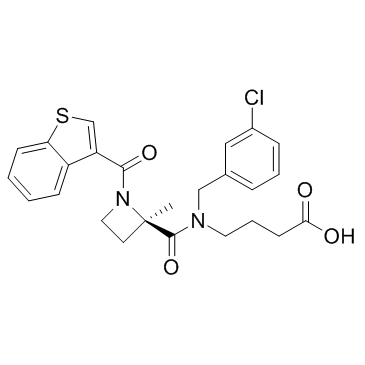
Cas No.: 1391076-61-1
Sample solution is provided at 25 µL, 10mM.
_1-3.$$$39978408@51.jpg');)
_1-9.$$$38538795@65.jpg');)
_1-9.$$$39112701@51.jpg');)
_1-7.$$$37316672@70.jpg');)
_366-372.$$$36198801@70.jpg');)
.$$$38565142@65.jpg');)
_1867-1883.$$$33248023@67.jpg');)
_eads6055.$$$39977546@45.jpg');)
_eadm9805.$$$40080571@45.jpg');)
_eadj3020.$$$39666821@45.jpg');)
_1-20.$$$39757301@28.jpg');)
_1-24.$$$38898113@28.jpg');)
_273-287.$$$36806353@46.jpg');)
_1-16.$$$37156877@44.jpg');)
_1-19.$$$37460805@44.jpg');)
_1291-1307.$$$34518654@46.jpg');)
GLPG0974 es un antagonista oral del receptor de ácidos grasos libres 2(FFA2, GPR43, IC50 = 9nM) oral,de alta afinidad,potente y selectivo [1]. GLPG0974 inhibe la activación y migración de neutrófilos al bloquear el efecto agonista de los ácidos grasos de cadena corta(AGCC) sobre los AGF2,ejerciendo así efectos anti-inflamatorios [2-3]. GLPG0974 se usa comúnmente en enfermedades inflamatorias[4].
En las células SH-SY5Y,el tratamiento con GLPG0974 (100μM; 24h) abolió significativamente el efecto neuroprotector de un agonista GPR43 específico[5].En las células miocárdicas,el GLPG0974(10μM; 5 minutos)previene la inhibición de la contracción miocárdica inducida por acetato [6]. En las células IPEC-J2, GLPG0974 (500nM; 24h) puede restaurar la replicación de PEDV en las células IPEC-J2 pretratadas con butirato [7].
En los ratonesC57BL/6,tratados con GLPG0974(1mg/kg; ig; 5 semanas)mostraron hobilidades motoras mejoradas,mayor número de gránulos fecales y una mejora significativa en los síntomas de estreñimiento [8].En el modelo del ratón de encefalopatía asociada a sepsis(SAE) establecido por cirugía de ligadura y punción cecal(CLP),GLPG0974 (1mg/kg; po; 24d) puede revertir los efectos protectores cognitivos y antineuroinflamatorios de los ácidos grasos de cadena corta[9]. En el modelo de los ratones alimentados con dieta alta en grasas (HFD),la frasa abdominal en los ratones aumentó significativamente después de la administración intragástrica de GLPG0974 (1mg/kg; ig; 24d) [10].
References:
[1]. Namour F, Galien R, Van Kaem T, et al. Safety, pharmacokinetics and pharmacodynamics of GLPG0974, a potent and selective FFA2 antagonist, in healthy male subjects. British journal of clinical pharmacology. 2016 Jul; 82(1): 139-148.
[2]. Pizzonero M, Dupont S, Babel M, et al. Discovery and optimization of an azetidine chemical series as a free fatty acid receptor 2 (FFA2) antagonist: from hit to clinic. Journal of medicinal chemistry. 2014 Dec 11; 57(23): 10044-10057.
[3]. Wenzel TJ, Gates EJ, Ranger AL, et al. Short-chain fatty acids (SCFAs) alone or in combination regulate select immune functions of microglia-like cells. Molecular and Cellular Neuroscience. 2020 Jun 1; 105: 103493.
[4]. Vermeire S, Kojecky V, Knoflícek V, et al. GLPG0974, an FFA2 antagonist, in ulcerative colitis: efficacy and safety in a multicenter proof-of-concept study. J. Crohn’s Colitis. 2015 Feb 1; 9(Suppl 1): S39.
[5]. Saikachain N, Sungkaworn T, Muanprasat C, et al. Neuroprotective effect of short‐chain fatty acids against oxidative stress‐induced SH‐SY5Y injury via GPR43‐dependent pathway. Journal of Neurochemistry. 2023 Jul; 166(2): 201-214.
[6]. Jiang X, Zhang Y, Zhang H, et al. Acetate suppresses myocardial contraction via the short-chain fatty acid receptor GPR43. Frontiers in Physiology. 2022 Dec 16; 13: 1111156.
[7]. He H, Fan X, Shen H, et al. Butyrate limits the replication of porcine epidemic diarrhea virus in intestine epithelial cells by enhancing GPR43-mediated IFN-III production. Frontiers in microbiology. 2023 Jan 20; 14: 1091807.
[8]. Qu Y, An K, Wang D, et al. Short-Chain Fatty Acid Aggregates Alpha-Synuclein Accumulation and Neuroinflammation via GPR43-NLRP3 Signaling Pathway in a Model Parkinson’s Disease. Molecular Neurobiology. 2025 Feb 4: 1-4.
[9]. Li H, Bao H, Jiang L, et al. Short chain fatty acids protect the cognitive function of sepsis associated encephalopathy mice via GPR43. Frontiers in Neurology 13: 909436 [Internet]. 2022
[10]. Pham MT, Tran TD, Zayabaatar E. Leuconostoc mesenteroides utilizes glucose fermentation to produce electricity and ameliorates high-fat diet-induced abdominal fat mass. Archives of Microbiology. 2022 Nov; 204(11): 670.
| Experimentos celulares [1]: | |
Líneas celulares | Las células SH-SY5Y |
Método de preparación | Las células SH-SY5Y se sembraron en una placa de cultivo de 96 pocillos a una densidad de siembra de 2.5 × 10⁴ células /pocillo.Todas las células se incubaron aleatoriamente con diversas condiciones de mezcla de ácido grasos de cadena corta (AGCC),propionato y butirato,agonista GPR43 10nM(butanamida),y algunos experimentos se combinaron con antagonista GPR43 100μM (GLPG0974) o 5μM PLC inhibidor (U73122) en medio de cultivo durante 24h. |
Condiciones de reacción | 100μM; 24h |
Áreas de aplicación | El pretratamiento con un antagonistas de GPR43(GLPG0974) significativamente el efecto neuroprotector de un agonista específico de GPR43. |
| Experimentos con animales [2]: | |
Modelos animales | Los ratones C57BL/6 |
Método de preparación | Se utilizaron cuarenta los ratones para exminar más a fondo la activación del inflamasoma NLRP3 inducida por ácido grasos de cadena corta(AGCC) en cuatro condiciones experimentales: control, 1-methyl-4-phenyl-1,2,3,6-tetrahydropyridine (MPTP), MPTP + SCFA, y MPTP + SCFA con un inhibidor de GPR43 (GLPG0974). (1) El grupo de control recibió solución salina al 0.9% y agua potable regular;(2) el grupo MPTP recibió 18mg/kg de MPTP en dosis divididas cada dos semanas durante 5 semanas; (3) el grupo MPTP + SCFAs recibió el mismo tratamiento MPTP más agua suplementada con SCFA; (5) el grupo MPTP + SCFAs + GLPG0974 , GLPG0974 a una dosis de 1mg/kg, 3 veces a la semana durnate 5 semanas. |
Forma de dosificación | 1mg/kg; ig; 3 veces a la semana durante 5 semanas |
Áreas de aplicación | Los ratones tratados con GLPG0974 mostraron habilidades motoras mejoradas,mayor número de gránulos fecales y una mejora siginificativa en los síntomas de estreñimiento. |
References: | |
| Cas No. | 1391076-61-1 | SDF | |
| Chemical Name | 4-[[[(2R)-1-(benzo[b]thien-3-ylcarbonyl)-2-methyl-2-azetidinyl]carbonyl][(3-chlorophenyl)methyl]amino]-butanoic acid | ||
| Canonical SMILES | O=C(O)CCCN(C([C@]1(C)N(C(C2=CSC3=CC=CC=C32)=O)CC1)=O)CC4=CC=CC(Cl)=C4 | ||
| Formula | C25H25ClN2O4S | M.Wt | 485 |
| Solubility | DMSO : 200 mg/mL (412.37 mM; Need ultrasonic) | Storage | Store at -20°C |
| General tips | Please select the appropriate solvent to prepare the stock solution according to the
solubility of the product in different solvents; once the solution is prepared, please store it in
separate packages to avoid product failure caused by repeated freezing and thawing.Storage method
and period of the stock solution: When stored at -80°C, please use it within 6 months; when stored
at -20°C, please use it within 1 month. To increase solubility, heat the tube to 37°C and then oscillate in an ultrasonic bath for some time. |
||
| Shipping Condition | Evaluation sample solution: shipped with blue ice. All other sizes available: with RT, or with Blue Ice upon request. | ||
| Prepare stock solution | |||

|
1 mg | 5 mg | 10 mg |
| 1 mM | 2.0619 mL | 10.3093 mL | 20.6186 mL |
| 5 mM | 412.4 μL | 2.0619 mL | 4.1237 mL |
| 10 mM | 206.2 μL | 1.0309 mL | 2.0619 mL |
Step 1: Enter information below (Recommended: An additional animal making an allowance for loss during the experiment)
 g
μL
g
μL
Step 2: Enter the in vivo formulation (This is only the calculator, not formulation. Please contact us first if there is no in vivo formulation at the solubility Section.)
Calculation results:
Working concentration: mg/ml;
Method for preparing DMSO master liquid: mg drug pre-dissolved in μL DMSO ( Master liquid concentration mg/mL, Please contact us first if the concentration exceeds the DMSO solubility of the batch of drug. )
Method for preparing in vivo formulation: Take μL DMSO master liquid, next addμL PEG300, mix and clarify, next addμL Tween 80, mix and clarify, next add μL saline, mix and clarify.
Method for preparing in vivo formulation: Take μL DMSO master liquid, next add μL Corn oil, mix and clarify.
Note: 1. Please make sure the liquid is clear before adding the next solvent.
2. Be sure to add the solvent(s) in order. You must ensure that the solution obtained, in the previous addition, is a clear solution before proceeding to add the next solvent. Physical methods such as vortex, ultrasound or hot water bath can be used to aid dissolving.
3. All of the above co-solvents are available for purchase on the GlpBio website.
Quality Control & SDS
- View current batch:
- Purity: >98.00% Appearance: A solid
- COA (Certificate of Analysis)
- SDS (Safety Data Sheet)
- Datasheet
Average Rating: 5 (Based on Reviews and 9 reference(s) in Google Scholar.)