

Hypaphorine (Synonyms: L-Hypaphorine, (+)-Tryptophan, Tryptophan Betaine) |
Catalog No.GC38797
 One-Click Copy Product Info
|

Hypaphorine, un alcaloide indol extraído de plantas leguminosas, ejerce efectos antiinflamatorios, antioxidantes y neuroprotectores al modular múltiples vías de señalización, incluyendo PI3K/Akt/mTOR y p38/JNK. Hypaphorine se investiga con frecuencia en estudios relacionados con enfermedades neurodegenrativas y trastornos metabólicos
Products are for research use only. Not for human use. We do not sell to patients.
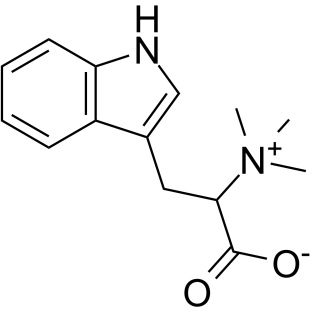
Cas No.: 487-58-1
Sample solution is provided at 25 µL, 10mM.
_1-3.$$$39978408@51.jpg');)
_1-9.$$$38538795@65.jpg');)
_1-9.$$$39112701@51.jpg');)
_1-7.$$$37316672@70.jpg');)
_366-372.$$$36198801@70.jpg');)
.$$$38565142@65.jpg');)
_1867-1883.$$$33248023@67.jpg');)
_eads6055.$$$39977546@45.jpg');)
_eadm9805.$$$40080571@45.jpg');)
_eadj3020.$$$39666821@45.jpg');)
_1-20.$$$39757301@28.jpg');)
_1-24.$$$38898113@28.jpg');)
_273-287.$$$36806353@46.jpg');)
_1-16.$$$37156877@44.jpg');)
_1-19.$$$37460805@44.jpg');)
_1291-1307.$$$34518654@46.jpg');)
Hypaphorine, un alcaloide indol extraído de plantas leguminosas, ejerce efectos antiinflamatorios, antioxidantes y neuroprotectores al modular múltiples vías de señalización, incluyendo PI3K/Akt/mTOR y p38/JNK. Hypaphorine se investiga con frecuencia en estudios relacionados con enfermedades neurodegenrativas y trastornos metabólicos[1-2]. Además, se ha demostrado que Hypaphorine previene eficazmente la osteoporosis [3] y exhibe actividad antiviral contra el virus del dengue [4].
In vitro, el pretratamiento de células endoteliales microvasculares humanas (HMEC-1) con Hypaphorine (0–100μM) durante 6 horas, seguido de estimulación de lipopolysaccharide (LPS, 500ng/mL) durante 48 hours, suprimió significativamente la expresión inducida por LPS de citoquinas proinflamatorias (TNF-α, IL-1β, MCP-1, VCAM-1). Hypaphorine también revirtió la regulación ascendente inducida por LPS de los niveles de proteína TLR4 yd mRNA y la regulación a la baja de PPAR-γ. Ademas, bloqueó la señalización PI3K/Akt/mTOR activada por LPS[5]. En los macrófagos RAW 264.7, el pretratamiento con Hypaphorine (12.5–50μM) durante 1 hora, seguido de la estimulación LPS (1μg/mL) durante 24 horas, inhibió notablemente la expresión de citocinas proinflamatorias inducidas por LPS (TNF-α, IL-1β, IL-6, IL-10, MCP-1) y la liberación de NO/PGE₂, mientras regulaba a la baja la expresión de proteínas COX-2 e iNOS. Hypaphorine también suprimió la fosforilación inducida por LPS de ERK, IκBα, IKKβ y NF-κB, e inhibió la translocación nuclear NF-κB[6].
In vivo, Hypaphorine (10mg/kg; inyección intraperitoneal) administrada 2 horas después de lar LPS (20mg/kg) atenuó significativamente la lesión pulmonar aguda (ALI) inducida por LPS en ratas macho de Sprague-Dawley (SD). Hypaphorine redujo el daño histopathologico pulmonar, disminuyó el recuento total de células y las proporciones de neutrófilos en en líquido de lavado broncoalveolar (BALF) y redujo la relación de peso húmedo/seco pulmonar, la permeabilidad microvascular y la actividad lactate dehydrogenase (LDH)/myeloperoxidase (MPO). Mechanisticalmente, Hypaphorine reguló la expresión de DUSP1 e inhibió la activación de p38/JNK, suprimiendo así las citoquinas proinflamatorias (TNF-α, IL-6, IL-1β, IL-18) [7]. Hypaphorine (10mg/kg; inyección intraperitoneal) inhibe selectivamente la actividad de la acetilcolinesterasa (AChE) en todas las regiones del cerebro (cortex, cerebellum, striatum, hippocampus) en rata normal después de 24 horas, con el enantiómero D demostrando una potente inhibición en áreas clave del cerebro[8].
References:
[1] Qin P, Li Y, Su Y, et al. Bifidobacterium adolescentis-derived hypaphorine alleviates acetaminophen hepatotoxicity by promoting hepatic Cry1 expression. J Transl Med. 2024 May 31;22(1):525.
[2] Chen H, Guo T, Wang D, et al. Vaccaria hypaphorine impairs RANKL-induced osteoclastogenesis by inhibition of ERK, p38, JNK and NF-κB pathway and prevents inflammatory bone loss in mice. Biomed Pharmacother. 2018 Jan;97:1155-1163.
[3] Zhang T, Yan Y, Xue Y, et al. Pharmacokinetic Study of Hypaphorine, a Potential Agent for Treating Osteoclast-based Bone Loss, on Rats Using LC-MS/MS. Comb Chem High Throughput Screen. 2022;25(11):1889-1896.
[4] Bai S, Liang H, Jiang W, et al. Identifying hypaphorine as a novel antiviral compound against dengue virus. Antiviral Res. 2025 Jun 24;240:106220.
[5] Sun H, Zhu X, Cai W, et al. Hypaphorine Attenuates Lipopolysaccharide-Induced Endothelial Inflammation via Regulation of TLR4 and PPAR-γ Dependent on PI3K/Akt/mTOR Signal Pathway. Int J Mol Sci. 2017 Apr 17;18(4):844.
[6] Sun H, Cai W, Wang X, et al. Vaccaria hypaphorine alleviates lipopolysaccharide-induced inflammation via inactivation of NFκB and ERK pathways in Raw 264.7 cells. BMC Complement Altern Med. 2017 Feb 20;17(1):120.
[7] Ding YH, Miao RX, Zhang Q. Hypaphorine exerts anti-inflammatory effects in sepsis induced acute lung injury via modulating DUSP1/p38/JNK pathway. Kaohsiung J Med Sci. 2021 Oct;37(10):883-893.
[8] Yonekawa MKA, Penteado BB, Dal'Ongaro Rodrigues A, et al. l-Hypaphorine and d-hypaphorine: Specific antiacetylcholinesterase activity in rat brain tissue. Bioorg Med Chem Lett. 2021 Sep 1;47:128206.
| Experimentos celulares [1]: | |
Líneas celulares | Células endoteliales microvasculares humanas (HMEC-1) |
Método de preparación | Las células HMEC-1 se sembraron en placas de 6 pozos a una densidad de 5×10⁴ células por pozo y se cultivaron hasta la confluencia del 80%. Las células se pretrataron con Hypaphorine (0, 25, 50 o 100μM) durante 6 horas, seguidas de estimulación lipopolisacárido (LPS, 500ng/mL) durante 48 horas adicionales para establecer el modelo de inflamación endotelial. |
Condiciones de reacción | Hypaphorine (0-100μM); pretratamiento de 6 horas + estimulación LPS de 48 horas. |
Áreas de aplicación | Hypaphorine reguló hacia abajo las citoquinas proinflamatorias (TNF-α, IL-1β, MCP-1, VCAM-1) tanto a nivel de ARNm como de proteínas, inhibió la activación de la vía PI3K/Akt/mTOR y bloqueó la translocación nuclear de NF-κB y la fosforilación de ERK. |
| Experimentos con animales [2]: | |
Modelos animales | Ratas Sprague-Dawley |
Método de preparación | El lipopolisacárido (LPS, 20 mg/kg) se administró por vía intratraqueal para inducir una lesión pulmonar aguda asociada a la sepsis (ALI). Hypaphorine (10 mg/kg) se inyectó por vía intraperitoneal 2 horas después del LPS. Los grupos de control recibieron solución salina o LPS solo. Las ratas fueron sacrificadas después de 24 horas para la recolección de tejido y líquido. |
Forma de dosificación | 10 mg/kg; i.p. |
Áreas de aplicación | Hypaphorine ejerció efectos antiinflamatorios y antiapoptóticos al regular hacia arriba DUSP1 para inactivar la vía p38/JNK, mitigando así la IA inducida por LPS en ratas. |
References: | |
| Cas No. | 487-58-1 | SDF | |
| Sinónimos | L-Hypaphorine, (+)-Tryptophan, Tryptophan Betaine | ||
| Canonical SMILES | C[N+](C)(C(C([O-])=O)CC1=CNC2=C1C=CC=C2)C | ||
| Formula | C14H18N2O2 | M.Wt | 246.3 |
| Solubility | H2O : 100 mg/mL (406.01 mM; Need ultrasonic); DMSO : < 1 mg/mL (insoluble or slightly soluble) | Storage | Store at -20°C,protect from light |
| General tips | Please select the appropriate solvent to prepare the stock solution according to the
solubility of the product in different solvents; once the solution is prepared, please store it in
separate packages to avoid product failure caused by repeated freezing and thawing.Storage method
and period of the stock solution: When stored at -80°C, please use it within 6 months; when stored
at -20°C, please use it within 1 month. To increase solubility, heat the tube to 37°C and then oscillate in an ultrasonic bath for some time. |
||
| Shipping Condition | Evaluation sample solution: shipped with blue ice. All other sizes available: with RT, or with Blue Ice upon request. | ||
| Prepare stock solution | |||

|
1 mg | 5 mg | 10 mg |
| 1 mM | 4.0601 mL | 20.3004 mL | 40.6009 mL |
| 5 mM | 812 μL | 4.0601 mL | 8.1202 mL |
| 10 mM | 406 μL | 2.03 mL | 4.0601 mL |
Step 1: Enter information below (Recommended: An additional animal making an allowance for loss during the experiment)
 g
μL
g
μL
Step 2: Enter the in vivo formulation (This is only the calculator, not formulation. Please contact us first if there is no in vivo formulation at the solubility Section.)
Calculation results:
Working concentration: mg/ml;
Method for preparing DMSO master liquid: mg drug pre-dissolved in μL DMSO ( Master liquid concentration mg/mL, Please contact us first if the concentration exceeds the DMSO solubility of the batch of drug. )
Method for preparing in vivo formulation: Take μL DMSO master liquid, next addμL PEG300, mix and clarify, next addμL Tween 80, mix and clarify, next add μL saline, mix and clarify.
Method for preparing in vivo formulation: Take μL DMSO master liquid, next add μL Corn oil, mix and clarify.
Note: 1. Please make sure the liquid is clear before adding the next solvent.
2. Be sure to add the solvent(s) in order. You must ensure that the solution obtained, in the previous addition, is a clear solution before proceeding to add the next solvent. Physical methods such as vortex, ultrasound or hot water bath can be used to aid dissolving.
3. All of the above co-solvents are available for purchase on the GlpBio website.
Quality Control & SDS
- View current batch:
- Purity: >99.50% Appearance: A solid
- COA (Certificate of Analysis)
- SDS (Safety Data Sheet)
- Datasheet
Average Rating: 5 (Based on Reviews and 23 reference(s) in Google Scholar.)