

Ilginatinib (NS-018) (Synonyms: NS-018) |
Catalog No.GC32809
 One-Click Copy Product Info
|

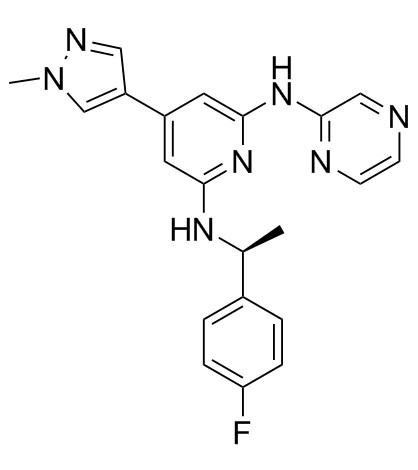
Ilginatinib (NS-018) (NS-018) es un inhibidor de JAK2 altamente activo y biodisponible por vÍa oral, con una IC50 de 0,72 nM, una selectividad de 46, 54 y 31 veces para JAK2 sobre JAK1 (IC50, 33 nM), JAK3 (IC50, 39 nM) y Tyk2 (IC50, 22 nM).
Products are for research use only. Not for human use. We do not sell to patients.
Cas No.: 1239358-86-1
Sample solution is provided at 25 µL, 10mM.
_1-3.$$$39978408@51.jpg');)
_1-9.$$$38538795@65.jpg');)
_1-9.$$$39112701@51.jpg');)
_1-7.$$$37316672@70.jpg');)
_366-372.$$$36198801@70.jpg');)
.$$$38565142@65.jpg');)
_1867-1883.$$$33248023@67.jpg');)
_eads6055.$$$39977546@45.jpg');)
_eadm9805.$$$40080571@45.jpg');)
_eadj3020.$$$39666821@45.jpg');)
_1-20.$$$39757301@28.jpg');)
_1-24.$$$38898113@28.jpg');)
_273-287.$$$36806353@46.jpg');)
_1-16.$$$37156877@44.jpg');)
_1-19.$$$37460805@44.jpg');)
_1291-1307.$$$34518654@46.jpg');)
Ilginatinib (NS-018) is a highly active and orally bioavailable JAK2 inhibitor, with an IC50 of 0.72 nM, 46-, 54-, and 31-fold selectivity for JAK2 over JAK1 (IC50, 33 nM), JAK3 (IC50, 39 nM), and Tyk2 (IC50, 22 nM).
Ilginatinib (NS-018) is a highly active JAK2 inhibitor, with an IC50 of 0.72 nM, 46-, 54-, and 31-fold selectivity for JAK2 over JAK1 (IC50, 33 nM), JAK3 (IC50, 39 nM), and Tyk2 (IC50, 22 nM). Ilginatinib (NS-018) also inhibits Src-family kinases, especially SRC and FYN, and weakly inhibits ABL and FLT3 with 45- and 90-fold selectivity for JAK2, respectively. NS-018 shows potent inhibitory activity against cell lines JAK2V617F or MPLW515L mutations or the TEL-JAK2 fusion gene (expressing a constitutively activated JAK2) with IC50 of 11-120 nM, but has only minimal cytotoxicity against most other hematopoietic cell lines that have no constitutively activated JAK2[1]. Ilginatinib (NS-018) (0.5 μM) preferentially suppresses colony-forming unitgranulocyte/macrophage (CFU-GM) formation from myelodysplastic syndrome (MDS)-derived bone marrow mononuclear cells (BMMNCs). Ilginatinib (NS-018) (1 μM) suppresses the phosphorylation of STAT3 (the downstream kinase of JAK2) in CFU-GM-forming cells from MDS patients[2].
Ilginatinib (NS-018) (12.5, 25, 50, 100 mg/kg, p.o.) potently prolongs the survival of mice and reduces splenomegaly in a mouse Ba/F3-JAK2V617F disease model. Ilginatinib (NS-018) (25, 50 mg/kg, p.o.) significantly reduces leukocytosis, hepatosplenomegaly and extramedullary hematopoiesis, improves nutritional status, and prolongs survival in JAK2V617F transgenic mice[1].
[1]. Nakaya Y, et al. Efficacy of NS-018, a potent and selective JAK2/Src inhibitor, in primary cells and mouse models of myeloproliferative neoplasms. Blood Cancer J. 2011 Jul;1(7):e29. [2]. Kuroda J, et al. NS-018, a selective JAK2 inhibitor, preferentially inhibits CFU-GM colony formation by bone marrow mononuclear cells from high-risk myelodysplastic syndrome patients. Leuk Res. 2014 May;38(5):619-24.
Cell experiment: | Bone marrow mononuclear cells (BMMNCs) from healthy volunteers and myelodysplastic syndrome (MDS) patients are incubated in MethoCult GF H4434 methylcellulose medium containing various hematopoietic cytokines at 1.0 × 10⁵ cells/mL with or without Ilginatinib (NS-018) at 37°C in a humidified atmosphere of 5% CO2. Commercially available purified normal human CD34-positive (CD34+) BM cells are used as a control. Burst-forming unit-erythroid (BFU-E) and colonyforming unit-granulocyte/macrophage (CFU-GM) colonies are counted under an inverted microscope on day 14 of culture[2]. |
Animal experiment: | Mice[1]Female BALB/c nude mice are placed in blanket cages in an environment maintained at 21-25°C and 45-65% relative humidity, with artificial illumination for 12 h and a ventilation frequency of at least 15 times/h. They are allowed free access to food pellets and tap water. Ba/F3-JAK2V617F cells (106 per mouse) are inoculated intravenously into 7-week-old mice. Administration of vehicle (0.5% methylcellulose) or Ilginatinib (NS-018) twice daily by oral gavage begins the day after cell inoculation. Survival is monitored daily, and moribund mice are humanely killed and their time of death is recorded for purposes of survival analysis. In a parallel study, all mice are humanely killed after 8 days of administration, and their spleens are removed and weighed[1]. |
References: [1]. Nakaya Y, et al. Efficacy of NS-018, a potent and selective JAK2/Src inhibitor, in primary cells and mouse models of myeloproliferative neoplasms. Blood Cancer J. 2011 Jul;1(7):e29. | |
| Cas No. | 1239358-86-1 | SDF | |
| Sinónimos | NS-018 | ||
| Canonical SMILES | CN1N=CC(C2=CC(N[C@H](C3=CC=C(F)C=C3)C)=NC(NC4=NC=CN=C4)=C2)=C1 | ||
| Formula | C21H20FN7 | M.Wt | 389.43 |
| Solubility | DMSO : ≥ 34 mg/mL (87.31 mM) | Storage | Store at -20°C |
| General tips | Please select the appropriate solvent to prepare the stock solution according to the
solubility of the product in different solvents; once the solution is prepared, please store it in
separate packages to avoid product failure caused by repeated freezing and thawing.Storage method
and period of the stock solution: When stored at -80°C, please use it within 6 months; when stored
at -20°C, please use it within 1 month. To increase solubility, heat the tube to 37°C and then oscillate in an ultrasonic bath for some time. |
||
| Shipping Condition | Evaluation sample solution: shipped with blue ice. All other sizes available: with RT, or with Blue Ice upon request. | ||
| Prepare stock solution | |||

|
1 mg | 5 mg | 10 mg |
| 1 mM | 2.5679 mL | 12.8393 mL | 25.6786 mL |
| 5 mM | 513.6 μL | 2.5679 mL | 5.1357 mL |
| 10 mM | 256.8 μL | 1.2839 mL | 2.5679 mL |
Step 1: Enter information below (Recommended: An additional animal making an allowance for loss during the experiment)
 g
μL
g
μL
Step 2: Enter the in vivo formulation (This is only the calculator, not formulation. Please contact us first if there is no in vivo formulation at the solubility Section.)
Calculation results:
Working concentration: mg/ml;
Method for preparing DMSO master liquid: mg drug pre-dissolved in μL DMSO ( Master liquid concentration mg/mL, Please contact us first if the concentration exceeds the DMSO solubility of the batch of drug. )
Method for preparing in vivo formulation: Take μL DMSO master liquid, next addμL PEG300, mix and clarify, next addμL Tween 80, mix and clarify, next add μL saline, mix and clarify.
Method for preparing in vivo formulation: Take μL DMSO master liquid, next add μL Corn oil, mix and clarify.
Note: 1. Please make sure the liquid is clear before adding the next solvent.
2. Be sure to add the solvent(s) in order. You must ensure that the solution obtained, in the previous addition, is a clear solution before proceeding to add the next solvent. Physical methods such as vortex, ultrasound or hot water bath can be used to aid dissolving.
3. All of the above co-solvents are available for purchase on the GlpBio website.
Quality Control & SDS
- View current batch:
- Purity: >99.00% Appearance: A solid
- COA (Certificate of Analysis)
- SDS (Safety Data Sheet)
- Datasheet
Average Rating: 5 (Based on Reviews and 6 reference(s) in Google Scholar.)