

L-Theanine (Synonyms: L-Glutamic Acid γ-ethyl amide, γ-ethylamino-L-Glutamic Acid, 5-N-ethyl-Glutamine, NSC 21308) |
Catalog No.GN10456
 One-Click Copy Product Info
|

L-Theanine is a natural non-protein amino acid with neuroprotective and anti-inflammatory effects.
Products are for research use only. Not for human use. We do not sell to patients.
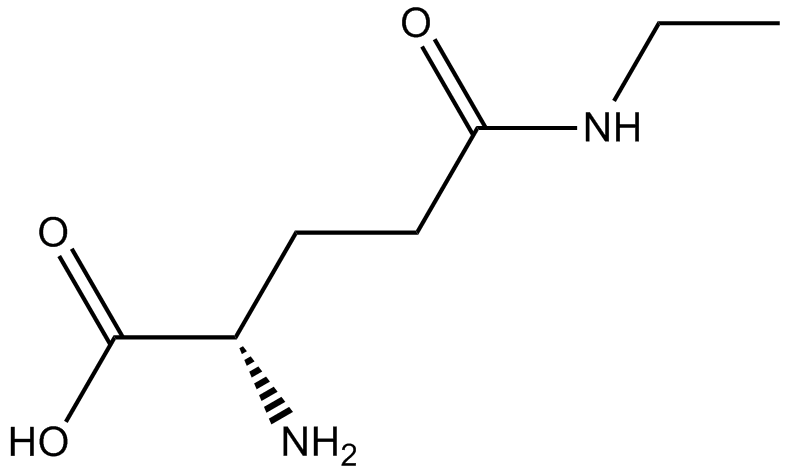
Cas No.: 3081-61-6
Sample solution is provided at 25 µL, 10mM.
_1-3.$$$39978408@51.jpg');)
_1-9.$$$38538795@65.jpg');)
_1-9.$$$39112701@51.jpg');)
_1-7.$$$37316672@70.jpg');)
_366-372.$$$36198801@70.jpg');)
.$$$38565142@65.jpg');)
_1867-1883.$$$33248023@67.jpg');)
_eads6055.$$$39977546@45.jpg');)
_eadm9805.$$$40080571@45.jpg');)
_eadj3020.$$$39666821@45.jpg');)
_1-20.$$$39757301@28.jpg');)
_1-24.$$$38898113@28.jpg');)
_273-287.$$$36806353@46.jpg');)
_1-16.$$$37156877@44.jpg');)
_1-19.$$$37460805@44.jpg');)
_1291-1307.$$$34518654@46.jpg');)
L-Theanine is a natural non-protein amino acid with neuroprotective and anti-inflammatory effects. L-Theanine can cross the blood-brain barrier, regulate glutamate and GABA neurotransmission, affect dopamine and serotonin levels, and increase alpha brain wave activity, helping to reduce anxiety, promote relaxation, and improve cognition. L-Theanine can be used in research related to anxiety disorders, sleep disturbances, cognitive impairment, and neurodegenerative diseases[1-4].
In vitro, treatment of hydrogen peroxide-induced H9C2 cells with 4-16mM L-Theanine for 24 hours upregulated pro-Caspase-3, reduced the apoptosis ratio, and decreased reactive oxygen species, nitric oxide, and oxidized glutathione levels[5]. After pre-treating with 250-1250μM L-Theanine for 1 hour and then treating with 200mM ethanol for 24 hours, L-Theanine can prevent the decrease in L02 cell viability and the release of LDH and AST caused by ethanol, inhibited the loss of mitochondrial membrane potential and the release of cytochrome c, and reduced the production of ROS and MDA[6]. Treatment of low-density lipoprotein-induced RAW264.7 cells and macrophages with 200-800μM L-Theanine for 1 hour inhibited intracellular lipid droplet and cholesteryl ester accumulation and reduced total cholesterol, free cholesterol, and cholesteryl ester levels[7].
In vivo, intragastric administration of 6.25-25mg/kg L-Theanine to a sleep-deprived C57BL/6 mouse model for 9 consecutive days alleviated tachycardia, restored myocardial and mitochondrial integrity, and reduced myocardial injury markers and oxidative stress indicators[8]. Intragastric administration of 50mg/kg L-Theanine to a multiple sclerosis C57BL/6 mouse model for 5 consecutive weeks improved walking scores, hindlimb foot angle, surface righting reflex, negative geotaxis response, and increased forelimb suspension, hindlimb suspension, grip strength, open field crossing numbers, and rotarod retention time[9]. A single subcutaneous injection of 3-24mg/kg L-Theanine to a nicotine withdrawal ICR mouse model dose-dependently reduced nicotine withdrawal somatic signs, decreased hyperalgesia, and reduced anxiety-like behavior in the light-dark box test[10].
References:
[1] Nobre AC, Rao A, Owen GN. L-theanine, a natural constituent in tea, and its effect on mental state. Asia Pac J Clin Nutr. 2008;17 Suppl 1:167-8.
[2] Chen S, Kang J, Zhu H, et al. L-Theanine and Immunity: A Review. Molecules. 2023 May 1;28(9):3846.
[3] Kimura K, Ozeki M, Juneja LR, et al. L-Theanine reduces psychological and physiological stress responses. Biol Psychol. 2007 Jan;74(1):39-45.
[4] Jin W, Su L, You H, et al. L-Theanine inhibits chemoresistance of lung cancer cells to cisplatin by regulating STAT3/NOTCH1-BMAL1 signaling. Front Biosci (Landmark Ed). 2024 Jun;29(6):2261.
[5] Li C, Yan Q, Tang S, et al. L-theanine protects H9C2 cells from hydrogen peroxide-induced apoptosis via improving antioxidant capacity. Med Sci Monit. 2018 Apr;24:2109-18.
[6] Li G, Ye Y, Kang J, et al. L-Theanine prevents alcoholic liver injury through enhancing the antioxidant capability of hepatocytes. Food Chem Toxicol. 2012 Feb;50(2):363-72.
[7] Lei J, Ye J, She R, et al. L-theanine inhibits foam cell formation via promoting the scavenger receptor A degradation. Eur J Pharmacol. 2021 Aug;904:174181.
[8] Huang X, Lu X, Wu Y, et al. L-theanine prevents myocardial injury in sleep-deprived mice by suppressing ferroptosis through SIRT1. Naunyn-Schmiedeberg's Archives of Pharmacology. 2025;398(8):15443-57.
[9] Khosravi-Nezhad S, Hassanpour S, Hesaraki S. L-Theanine improves locomotor function in a model of multiple sclerosis mice. Archives of Razi Institute. 2023;78(1):195-203.
[10] Alkhlaif Y, El-Halawany M, Toma W, et al. L-theanine attenuates nicotine reward and withdrawal signs in mice. Neurosci Lett. 2023 Jun 11;807:137279.
| Cell experiment [1]: | |
|
Cell lines |
H9C2 cells (rat cardiomyocyte cell line) |
|
Preparation Method |
H9C2 cells were maintained in HG-DMEM supplemented with 10% FBS at 37°C, 5% CO2. H9C2 cells were pretreated with L-Theanine at 4-16mM for 24 hours, followed by 160μM H2O2 for 4 hours. After treatment, cell viability, antioxidant indices (TBARS, ROS, NO, GSH, GSSG, SOD, GSH-Px), nuclear morphology (DAPI staining), apoptosis, and expression of pro-Caspase-3, PARP, cleaved-PARP, JNK, p38 and their phosphorylated forms (Western blot) were assessed. |
|
Reaction Conditions |
4-16mM; 24 hours |
|
Applications |
L-Theanine increased cell viability, GSH content, and activities of GSH-Px and SOD. L-Theanine decreased contents of TBARS, ROS, NO, and GSSG. L-Theanine attenuated H2O2-induced nuclear condensation and fragmentation. L-Theanine decreased the apoptosis ratio. L-Theanine upregulated pro-Caspase-3 expression and inhibited cleaved-PARP expression. L-Theanine did not affect phosphorylation of JNK and p38. |
| Animal experiment [2]: | |
|
Animal models |
C57BL/6 mice |
|
Preparation Method |
Mice were gavaged with distilled water (0.1mL/10g body weight) as control or with L-Theanine at 6.25-25mg/kg once daily for 9 days, while the sleep deprivation model was induced by a modified multiple-platform water environment method for 48h. Cardiac ultrasound, H&E staining, TEM, biochemical assays (ANP, CK, LDH, SOD, GSH, MDA, Fe2+), ROS immunofluorescence and Western blot of SIRT1/TFRC/Nrf2/Keap1/SLC7A11/NQO1/HO-1/GPX4 were performed after treatment. |
|
Dosage form |
6.25-25mg/kg; p.o.; 9 days |
|
Applications |
L-Theanine alleviated sleep deprivation-induced tachycardia and echocardiographic changes. L-Theanine reversed sleep deprivation-induced myocardial tissue disruption, nuclear condensation and fiber breakage. L-Theanine reduced serum and myocardial LDH, CK, MDA, ANP and Fe2+ levels and increased SOD and GSH levels. L-Theanine restored mitochondrial cristae integrity and reduced mitochondrial vacuolation and membrane rupture. L-Theanine reversed sleep deprivation-induced downregulation of SIRT1, Nrf2, SLC7A11, NQO1, HO-1 and GPX4 and upregulation of TFRC and Keap1 in cardiac tissue. L-Theanine reduced ROS accumulation in myocardium. |
References: [1] Li C, Yan Q, Tang S, et al. L-theanine protects H9C2 cells from hydrogen peroxide-induced apoptosis via improving antioxidant capacity. Med Sci Monit. 2018 Apr;24:2109-18. [2] Huang X, Lu X, Wu Y, et al. L-theanine prevents myocardial injury in sleep-deprived mice by suppressing ferroptosis through SIRT1. Naunyn-Schmiedeberg's Archives of Pharmacology. 2025;398(8):15443-15457. | |
| Cas No. | 3081-61-6 | SDF | |
| Sinónimos | L-Glutamic Acid γ-ethyl amide, γ-ethylamino-L-Glutamic Acid, 5-N-ethyl-Glutamine, NSC 21308 | ||
| Chemical Name | (2S)-2-amino-5-(ethylamino)-5-oxopentanoic acid | ||
| Canonical SMILES | CCNC(=O)CCC(C(=O)O)N | ||
| Formula | C7H14N2O3 | M.Wt | 174.2 |
| Solubility | Water : 150 mg/mL (861.08 mM; Need ultrasonic) | Storage | Store at -20°C |
| Shipping Condition | Evaluation sample solution: shipped with blue ice. All other sizes available: with RT, or with Blue Ice upon request. | ||
| Prepare stock solution | |||

|
1 mg | 5 mg | 10 mg |
| 1 mM | 5.7405 mL | 28.7026 mL | 57.4053 mL |
| 5 mM | 1.1481 mL | 5.7405 mL | 11.4811 mL |
| 10 mM | 574.1 μL | 2.8703 mL | 5.7405 mL |
Step 1: Enter information below (Recommended: An additional animal making an allowance for loss during the experiment)
 g
μL
g
μL
Step 2: Enter the in vivo formulation (This is only the calculator, not formulation. Please contact us first if there is no in vivo formulation at the solubility Section.)
Calculation results:
Working concentration: mg/ml;
Method for preparing DMSO master liquid: mg drug pre-dissolved in μL DMSO ( Master liquid concentration mg/mL, Please contact us first if the concentration exceeds the DMSO solubility of the batch of drug. )
Method for preparing in vivo formulation: Take μL DMSO master liquid, next addμL PEG300, mix and clarify, next addμL Tween 80, mix and clarify, next add μL saline, mix and clarify.
Method for preparing in vivo formulation: Take μL DMSO master liquid, next add μL Corn oil, mix and clarify.
Note: 1. Please make sure the liquid is clear before adding the next solvent.
2. Be sure to add the solvent(s) in order. You must ensure that the solution obtained, in the previous addition, is a clear solution before proceeding to add the next solvent. Physical methods such as vortex, ultrasound or hot water bath can be used to aid dissolving.
3. All of the above co-solvents are available for purchase on the GlpBio website.
Quality Control & SDS
- View current batch:
- Purity: >99.50% Appearance: A solid
- COA (Certificate of Analysis)
- SDS (Safety Data Sheet)
- Datasheet
Average Rating: 5 (Based on Reviews and 30 reference(s) in Google Scholar.)