

LCL161 (Synonyms: LCL-161;LCL 161) |
Catalog No.GC14291
 One-Click Copy Product Info
|

A Smac mimetic and inhibitor of IAP family proteins
Products are for research use only. Not for human use. We do not sell to patients.
Cas No.: 1005342-46-0
Sample solution is provided at 25 µL, 10mM.
_1-3.$$$39978408@51.jpg');)
_1-9.$$$38538795@65.jpg');)
_1-9.$$$39112701@51.jpg');)
_1-7.$$$37316672@70.jpg');)
_366-372.$$$36198801@70.jpg');)
.$$$38565142@65.jpg');)
_1867-1883.$$$33248023@67.jpg');)
_eads6055.$$$39977546@45.jpg');)
_eadm9805.$$$40080571@45.jpg');)
_eadj3020.$$$39666821@45.jpg');)
_1-20.$$$39757301@28.jpg');)
_1-24.$$$38898113@28.jpg');)
_273-287.$$$36806353@46.jpg');)
_1-16.$$$37156877@44.jpg');)
_1-19.$$$37460805@44.jpg');)
_1291-1307.$$$34518654@46.jpg');)
LCL161 is a small molecular antagonist of the inhibitor of apoptosis (IAP) with IC50 value of 10.23 μM in Hep3B cells [1].
IAP is a family of proteins which are firstly found in virus and to inhibit the apoptosis of the infected hosts. It contains eight proteins in human. Since they were always found to overexpress in variety of malignant tumors, the IAP are thought to be appropriate targets in cancer therapy. SMAC (second mitochondria-derived activator of caspases) is the first-identified antagonist of IAP. It binds to XIAP within the BIR2/3 domain through its N-terminal segment. As a mimetic of SMAC, LCL161 is designed to be the inhibitor of both XIAP and cIAP1/2 [1].
LCL161 showed significant inhibition of cell proliferation and viability in two human hepatocellular carcinoma (HCC) cells, Hep3B and PLC5. The IC50 values were 10 and 19 μM, respectively. However, LCL161 had no effect in the two other HCC cell lines, Sk-Hep1 (IC50 value of 224 μM) and Huh-7 (IC50 value of 228 μM). The difference of the effects is found to dependent on the expression of Bcl-2 in cells. For the ALL cells, LCL161 exerted growth inhibition with IC50 values of 9.3 and 0.25 μM, respectively. LCL161 also showed effect on the ALCL cell line Karpas-299 with IC50 value of 1.6 μM [1, 2].
In vivo, LCL161 markedly affected the distribution of EFS in many solid tumor xenograft models. It also caused growth delay in some tumors such as osteosarcoma, neuroblastoma and glioblastoma at dose of 30 mg/kg orally. Besides that, LCL161 administration caused significant growth inhibition in EW-5 and BT-39 glioblastoma but not in BT-28. Moreover, the combination therapy of LCL161 and the adeno-associated virus bacteriophage-tumor necrosis factor-α (AAVP-TNF-α) has been reported to has synergistic anti-tumor effects and delayed treatment resistance in mice models of tumor xenografts [1, 2 and 3].
References:
1.Chen K F, Lin J P, Shiau C W, et al. Inhibition of Bcl-2 improves effect of LCL161, a SMAC mimetic, in hepatocellular carcinoma cells. Biochemical pharmacology, 2012, 84(3): 268-277.
2.Houghton P J, Kang M H, Reynolds C P, et al. Initial testing (stage 1) of LCL161, a SMAC mimetic, by the Pediatric Preclinical Testing Program. Pediatric blood & cancer, 2012, 58(4): 636-639.
3.Yuan Z, Syrkin G, Adem A, et al. Blockade of inhibitors of apoptosis (IAPs) in combination with tumor-targeted delivery of tumor necrosis factor-α leads to synergistic antitumor activity. Cancer gene therapy, 2012, 20(1): 46-56.
| Cell experiment [1]: | |
|
Cell lines |
Hep3B, PLC5, Sk-Hep1 and Huh-7 cells |
|
Preparation method |
The solubility of this compound in DMSO is >10 mM. General tips for obtaining a higher concentration: Please warm the tube at 37℃ for 10 minutes and/or shake it in the ultrasonic bath for a while. Stock solution can be stored below -20℃ for several months. |
|
Reaction Conditions |
0, 0.01, 0.05, 0.1, 0.5, 1, 5 and 10 μM; 24, 48 or 72 hrs |
|
Applications |
LCL161 showed significant inhibition of cell proliferation and viability in 2 human hepatocellular carcinoma (HCC) cells, Hep3B and PLC5. The IC50 values were 10 and 19 μM, respectively. However, LCL161 had no effect in 2 other HCC cell lines, Sk-Hep1 (IC50 value of 224 μM) and Huh-7 (IC50 value of 228 μM). |
| Animal experiment [1]: | |
|
Animal models |
Huh-7 xeonograft nude mice |
|
Dosage form |
50 mg/kg; p.o.; q.d., for 20 days |
|
Applications |
Co-treatment with LCL161 and SC-2001 showed significant anti-tumor effect on Huh-7 tumors, without affecting body weight significantly. |
|
Other notes |
Please test the solubility of all compounds indoor, and the actual solubility may slightly differ with the theoretical value. This is caused by an experimental system error and it is normal. |
|
References: [1]. Chen K F, Lin J P, Shiau C W, et al. Inhibition of Bcl-2 improves effect of LCL161, a SMAC mimetic, in hepatocellular carcinoma cells. Biochemical pharmacology, 2012, 84(3): 268-277. | |
| Cas No. | 1005342-46-0 | SDF | |
| Sinónimos | LCL-161;LCL 161 | ||
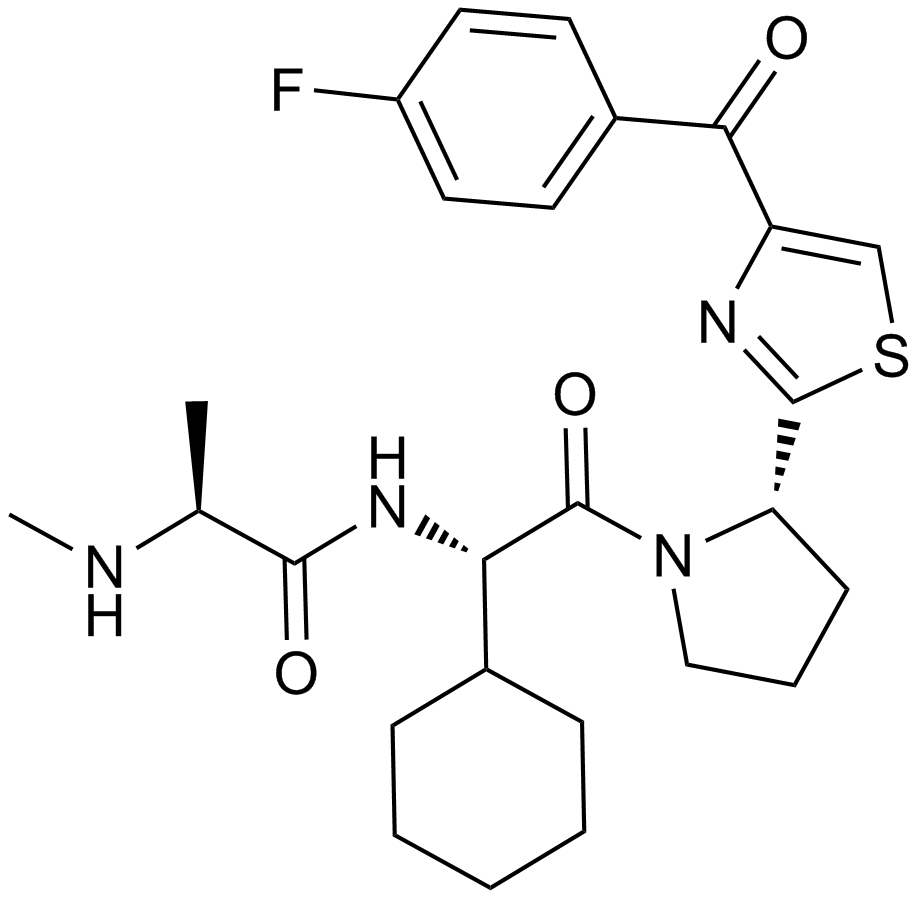
| Chemical Name | (2S)-N-[(1S)-1-cyclohexyl-2-[(2S)-2-[4-(4-fluorobenzoyl)-1,3-thiazol-2-yl]pyrrolidin-1-yl]-2-oxoethyl]-2-(methylamino)propanamide | ||
| Canonical SMILES | CC(C(=O)NC(C1CCCCC1)C(=O)N2CCCC2C3=NC(=CS3)C(=O)C4=CC=C(C=C4)F)NC | ||
| Formula | C26H33FN4O3S | M.Wt | 500.63 |
| Solubility | ≥ 25.05 mg/mL in DMSO | Storage | Store at -20°C |
| General tips | Please select the appropriate solvent to prepare the stock solution according to the
solubility of the product in different solvents; once the solution is prepared, please store it in
separate packages to avoid product failure caused by repeated freezing and thawing.Storage method
and period of the stock solution: When stored at -80°C, please use it within 6 months; when stored
at -20°C, please use it within 1 month. To increase solubility, heat the tube to 37°C and then oscillate in an ultrasonic bath for some time. |
||
| Shipping Condition | Evaluation sample solution: shipped with blue ice. All other sizes available: with RT, or with Blue Ice upon request. | ||
| Prepare stock solution | |||

|
1 mg | 5 mg | 10 mg |
| 1 mM | 1.9975 mL | 9.9874 mL | 19.9748 mL |
| 5 mM | 399.5 μL | 1.9975 mL | 3.995 mL |
| 10 mM | 199.7 μL | 998.7 μL | 1.9975 mL |
Step 1: Enter information below (Recommended: An additional animal making an allowance for loss during the experiment)
 g
μL
g
μL
Step 2: Enter the in vivo formulation (This is only the calculator, not formulation. Please contact us first if there is no in vivo formulation at the solubility Section.)
Calculation results:
Working concentration: mg/ml;
Method for preparing DMSO master liquid: mg drug pre-dissolved in μL DMSO ( Master liquid concentration mg/mL, Please contact us first if the concentration exceeds the DMSO solubility of the batch of drug. )
Method for preparing in vivo formulation: Take μL DMSO master liquid, next addμL PEG300, mix and clarify, next addμL Tween 80, mix and clarify, next add μL saline, mix and clarify.
Method for preparing in vivo formulation: Take μL DMSO master liquid, next add μL Corn oil, mix and clarify.
Note: 1. Please make sure the liquid is clear before adding the next solvent.
2. Be sure to add the solvent(s) in order. You must ensure that the solution obtained, in the previous addition, is a clear solution before proceeding to add the next solvent. Physical methods such as vortex, ultrasound or hot water bath can be used to aid dissolving.
3. All of the above co-solvents are available for purchase on the GlpBio website.
Quality Control & SDS
- View current batch:
- Purity: >99.50% Appearance: A solid
- COA (Certificate of Analysis)
- SDS (Safety Data Sheet)
- Datasheet
Average Rating: 5 (Based on Reviews and 30 reference(s) in Google Scholar.)