

LP-211 |
Catalog No.GC30880
 One-Click Copy Product Info
|

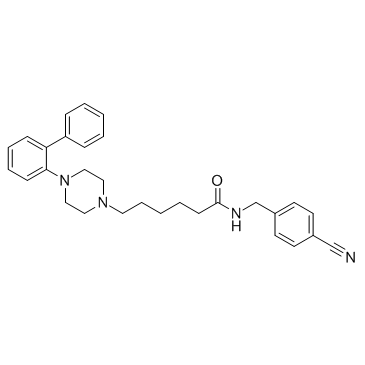
LP-211 es un agonista del receptor 5-HT7 selectivo y penetrante de la barrera hematoencefÁlica, con una Ki de 0,58 nM, con alta selectividad sobre el receptor 5-HT1A (Ki, 188 nM) y el receptor D2 (Ki, 142 nM).
Products are for research use only. Not for human use. We do not sell to patients.
Cas No.: 1052147-86-0
Sample solution is provided at 25 µL, 10mM.
LP-211 is a selective, blood-brain barrier-permeable 5-HT7 receptor agonist (Ki=0.58nM) with higher selectivity over the 5-HT1A receptor (Ki=188nM) and the D2 receptor (Ki=142nM)[1-2]. LP-211 can modulate histone H3 acetylation levels and influence the association of the MeCP2 co-repressor protein by activating the 5-HT7 receptor. LP-211 can be used in research related to neurodevelopmental disorders such as Rett syndrome and Fragile X syndrome, as well as neuropathic pain and memory impairment[3-4].
In vitro, LP-211 (10µM) stimulated THP-1-derived macrophages for 48 hours. LP-211 significantly reduced the phagocytic and migratory capacity of pro-inflammatory M1-like macrophages, while also altering the cytokine and chemokine secretion profiles of all macrophage types (M0, M1, M2a, M2c)[5]. LP-211 (1µM) was incubated with mitochondria purified from human SH-SY5Y neuroblastoma cells for 3 minutes. LP-211 did not significantly affect the activity of mitochondrial respiratory chain cytochrome c oxidas[6].
In vivo, a single intraperitoneal injection of LP-211 (3mg/kg) was administered to male Fmr1-KO (B6.129P2-Fmr1tm1Cgr/J) mice, 30 minutes prior to behavioral testing. LP-211 significantly reduced the duration of their self-grooming behavior[7]. Single intraperitoneal injection of LP-211 (10mg/kg) was administered to adult male C57BL/6 mice 7-10 days after chronic constriction injury (CCI) surgery. The effects began 30 minutes post-injection and peaked between 90-150 minutes. LP-211 significantly increased the mechanical withdrawal threshold of the injured hind paw and completely blocked the place preference shift induced by noxious stimulation in the place escape/avoidance paradigm[8].
References:
[1] Leopoldo M, Lacivita E, De Giorgio P, et al. Structural modifications of N-(1,2,3,4-tetrahydronaphthalen-1-yl)-4-aryl-1-piperazinehexanamides: influence on lipophilicity and 5-HT7 receptor activity. Part III. J Med Chem. 2008 Sep 25;51(18):5813-22.
[2] Beaudet G, Paizanis E, Zoratto F, et al. LP-211, a selective 5-HT7 receptor agonist, increases novelty-preference and promotes risk-prone behavior in rats. Synapse. 2017 Dec;71(12).
[3] Norouzi-Javidan A, Javanbakht J, Barati F, et al. Effect of 5-HT7 receptor agonist, LP-211, on micturition following spinal cord injury in male rats. Am J Transl Res. 2016 Jun 15;8(6):2525-33.
[4] Rahdar M, Davoudi S, Dehghan S, et al. Reversal of electrophysiological and behavioral deficits mediated by 5-HT7 receptor upregulation following LP-211 treatment in an autistic-like rat model induced by prenatal valproic acid exposure. Neuropharmacology. 2024 Oct 1;257:110057.
[5] Bahr FS, Müller FE, Kasten M, et al. Serotonin receptor 5-HT7 modulates inflammatory-associated functions of macrophages. Cell Mol Life Sci. 2025 Jan 21;82(1):51.
[6] Tempio A, Niso M, Laera L, et al. Mitochondrial Membranes of Human SH-SY5Y Neuroblastoma Cells Express Serotonin 5-HT7 Receptor. Int J Mol Sci. 2020 Dec 17;21(24):9629.
[7] Sharghi S, Flunkert S, Daurer M, et al. Evaluating the effect of R-Baclofen and LP-211 on autistic behavior of the BTBR and Fmr1-KO mouse models. Front Neurosci. 2023 Mar 30;17:1087788.
[8] Santello M, Bisco A, Nevian NE, et al. The brain-penetrant 5-HT7 receptor agonist LP-211 reduces the sensory and affective components of neuropathic pain. Neurobiol Dis. 2017 Oct;106:214-221.
| Cell experiment [1]: | |
Cell lines | THP-1-derived macrophages and human CD14+ cell-derived macrophages |
Preparation Method | THP-1 monocytes were differentiated into macrophages (M0, M1-like, M2a-like, M2c-like) using PMA and specific polarizing agents. Human CD14+ cells from PBMCs were differentiated into M1-like and M2-like macrophages using GM-CSF and M-CSF, respectively. Macrophages were stimulated with LP-211 (10μM) starting on day 3 or day 5 after seeding. |
Reaction Conditions | 10μM; 48 hours. |
Applications | LP-211 significantly reduced the phagocytic and migratory ability of pro-inflammatory M1-like macrophages. LP-211 treatment led to changes in the secretory properties (cytokine and chemokine profiles) of all macrophage types (M0, M1, M2a, M2c), with the highest effects observed for M0- and M2c-like macrophages. The importance of 5-HT7R for regulating phagocytosis was confirmed in human primary CD14+ cell-derived M2-like macrophages. |
| Animal experiment [2]: | |
Animal models | Male BTBR T+ Itpr3tf/J mice and male B6.129P2-Fmr1tm1Cgr/J (Fmr1-KO) mice |
Preparation Method | Animals received an acute intraperitoneal injection of LP-211 30 minutes prior to a series of behavioral tests performed starting at 5 weeks of age. Tests included the open field test, elevated plus maze (EPM), and self-grooming test. |
Dosage form | 3mg/kg; i.p.; single injection per test session. |
Applications | Acute LP-211 administration did not affect the behavioral abnormalities (anxiety, repetitive behavior) observed in BTBR mice. In Fmr1-KO mice, acute LP-211 treatment significantly improved repetitive behavior by reducing self-grooming duration and showed a trend to change anxiety levels, as evidenced by a decreased frequency of entries into the open arms of the EPM. |
References: | |
| Cas No. | 1052147-86-0 | SDF | |
| Canonical SMILES | O=C(NCC1=CC=C(C#N)C=C1)CCCCCN2CCN(C3=CC=CC=C3C4=CC=CC=C4)CC2 | ||
| Formula | C30H34N4O | M.Wt | 466.62 |
| Solubility | DMSO : ≥ 106.6 mg/mL (228.45 mM) | Storage | Store at -20°C |
| General tips | Please select the appropriate solvent to prepare the stock solution according to the
solubility of the product in different solvents; once the solution is prepared, please store it in
separate packages to avoid product failure caused by repeated freezing and thawing.Storage method
and period of the stock solution: When stored at -80°C, please use it within 6 months; when stored
at -20°C, please use it within 1 month. To increase solubility, heat the tube to 37°C and then oscillate in an ultrasonic bath for some time. |
||
| Shipping Condition | Evaluation sample solution: shipped with blue ice. All other sizes available: with RT, or with Blue Ice upon request. | ||
| Prepare stock solution | |||

|
1 mg | 5 mg | 10 mg |
| 1 mM | 2.1431 mL | 10.7154 mL | 21.4307 mL |
| 5 mM | 428.6 μL | 2.1431 mL | 4.2861 mL |
| 10 mM | 214.3 μL | 1.0715 mL | 2.1431 mL |
Step 1: Enter information below (Recommended: An additional animal making an allowance for loss during the experiment)
 g
μL
g
μL
Step 2: Enter the in vivo formulation (This is only the calculator, not formulation. Please contact us first if there is no in vivo formulation at the solubility Section.)
Calculation results:
Working concentration: mg/ml;
Method for preparing DMSO master liquid: mg drug pre-dissolved in μL DMSO ( Master liquid concentration mg/mL, Please contact us first if the concentration exceeds the DMSO solubility of the batch of drug. )
Method for preparing in vivo formulation: Take μL DMSO master liquid, next addμL PEG300, mix and clarify, next addμL Tween 80, mix and clarify, next add μL saline, mix and clarify.
Method for preparing in vivo formulation: Take μL DMSO master liquid, next add μL Corn oil, mix and clarify.
Note: 1. Please make sure the liquid is clear before adding the next solvent.
2. Be sure to add the solvent(s) in order. You must ensure that the solution obtained, in the previous addition, is a clear solution before proceeding to add the next solvent. Physical methods such as vortex, ultrasound or hot water bath can be used to aid dissolving.
3. All of the above co-solvents are available for purchase on the GlpBio website.
Quality Control & SDS
- View current batch:
- Purity: >99.50% Appearance: A solid
- COA (Certificate of Analysis)
- SDS (Safety Data Sheet)
- Datasheet
Average Rating: 5 (Based on Reviews and 12 reference(s) in Google Scholar.)