
LP-211 |
| Catalog No.GC30880 |
LP-211 est un agoniste sélectif et pénétrant de la barrière hémato-encéphalique des récepteurs 5-HT7, avec un Ki de 0,58 nM, avec une sélectivité élevée sur le récepteur 5-HT1A (Ki, 188 nM) et le récepteur D2 (Ki, 142 nM).
Products are for research use only. Not for human use. We do not sell to patients.
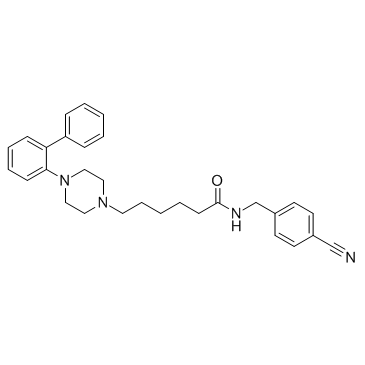
Cas No.: 1052147-86-0
Sample solution is provided at 25 µL, 10mM.
LP-211 is a selective and blood-brain barrier penetrant 5-HT7 receptor agonist, with a Ki of 0.58 nM, with high selectivity over 5-HT1A receptor (Ki, 188 nM) and D2 receptor (Ki, 142 nM).
LP-211 is a selective 5-HT7 receptor agonist, with a Ki of 0.58 nM, 324- and 245-fold selectivity over 5-HT1A receptor (Ki, 188 nM) and D2 receptor (Ki, 142 nM). LP-211 shows agonist properties with an EC50 of 0.6 μM[1].
LP-211 (10 mg/kg, i.p.) rapidly reaches the systemic circulation in the mouse, with mean Cmax of 0.76 ± 0.32 μg/mL at 30 min[1]. LP-211 (0.003-0.3 mg/kg, i.p.) significantly increases the micturition volume in a dose-dependent manner, and causes significant increases in voiding efficiency in spinal cord-injured (SCI) rats, and such effects can be completely reversed by SB-269970[2]. LP-211 (0.25 and 0.50 mg/kg i.p.) improves consolidation of chamber-shape memory in rats, resulting in significant novelty-induced hyperactivity and recognition[3].
[1]. Leopoldo M, et al. Structural modifications of N-(1,2,3,4-tetrahydronaphthalen-1-yl)-4-aryl-1-piperazinehexanamides: influence on lipophilicity and 5-HT7 receptor activity. Part III. J Med Chem. 2008 Sep 25;51(18):5813-22. [2]. Norouzi-Javidan A, et al. Effect of 5-HT7 receptor agonist, LP-211, on micturition following spinal cord injury in male rats. Am J Transl Res. 2016 Jun 15;8(6):2525-33. eCollection 2016. [3]. Beaudet G, et al. LP-211, a selective 5-HT7 receptor agonist, increases novelty-preference and promotes risk-prone behavior in rats. Synapse. 2017 Dec;71(12).

Kinase experiment: | Binding of [3H]-LSD at rat cloned 5-HT7 receptor is performed in the assay. In 1 mL of incubation buffer (50 mM Tris, 10 mM MgCl2 and 0.5 mM EDTA, pH 7.4) are suspended 30 μg of membranes, 2.5 nM [3H]-LSD, LP-211 (6−9 concentrations). The samples are incubated for 60 min at 37°C. The incubation is stopped by rapid filtration on GF/A glass fiber filters (presoaked in 0.5% polyethylenimine for 30 min). The filters are washed with 3 × 53 mL of ice-cold buffer (50 mM Tris, pH 7.4). Nonspecific binding is determined in the presence of 10 μM 5-CT. Approximately 90% of specific binding is determined under these conditions[1]. |
Animal experiment: | Rats[3]Thirty male adult Wistar rats (300-450 g) are assessed for novelty preference behavior after acute treatment (administered immediately after the training session and 24 h before the test session). After a 4 weeks' wash out, the rPDT is conducted to evaluate attraction from a greater/uncertain reward, with a sub-chronic treatment (five injections, immediately after sessions which follow the indifferent point). Food restriction, imposed by the experimenter through a limited quantity of food given at the end of each rPDT session, is applied to increase motivation to work for food delivery. All behavioral tests take place between 9:30 am and 4:00 pm. Rats are randomly assigned to treatment (LP-211 at 0.25 or 0.50 mg/kg i.p.) and control groups (injection volume 10 mL/kg; n = 10 per group). The brain penetrant 5-HT7R agonist LP-211 is dissolved in a vehicle solution of 1% dimethyl sulfoxide (DMSO) in saline (0.9% NaCl). Control group receives the vehicle strictly in the same conditions[3]. |
References: [1]. Leopoldo M, et al. Structural modifications of N-(1,2,3,4-tetrahydronaphthalen-1-yl)-4-aryl-1-piperazinehexanamides: influence on lipophilicity and 5-HT7 receptor activity. Part III. J Med Chem. 2008 Sep 25;51(18):5813-22. | |
| Cas No. | 1052147-86-0 | SDF | |
| Canonical SMILES | O=C(NCC1=CC=C(C#N)C=C1)CCCCCN2CCN(C3=CC=CC=C3C4=CC=CC=C4)CC2 | ||
| Formula | C30H34N4O | M.Wt | 466.62 |
| Solubility | DMSO : ≥ 106.6 mg/mL (228.45 mM) | Storage | Store at -20°C |
| General tips | Please select the appropriate solvent to prepare the stock solution according to the
solubility of the product in different solvents; once the solution is prepared, please store it in
separate packages to avoid product failure caused by repeated freezing and thawing.Storage method
and period of the stock solution: When stored at -80°C, please use it within 6 months; when stored
at -20°C, please use it within 1 month. To increase solubility, heat the tube to 37°C and then oscillate in an ultrasonic bath for some time. |
||
| Shipping Condition | Evaluation sample solution: shipped with blue ice. All other sizes available: with RT, or with Blue Ice upon request. | ||
| Prepare stock solution | |||
|
1 mg | 5 mg | 10 mg |
| 1 mM | 2.1431 mL | 10.7154 mL | 21.4307 mL |
| 5 mM | 428.6 μL | 2.1431 mL | 4.2861 mL |
| 10 mM | 214.3 μL | 1.0715 mL | 2.1431 mL |
Step 1: Enter information below (Recommended: An additional animal making an allowance for loss during the experiment)
Step 2: Enter the in vivo formulation (This is only the calculator, not formulation. Please contact us first if there is no in vivo formulation at the solubility Section.)
Calculation results:
Working concentration: mg/ml;
Method for preparing DMSO master liquid: mg drug pre-dissolved in μL DMSO ( Master liquid concentration mg/mL, Please contact us first if the concentration exceeds the DMSO solubility of the batch of drug. )
Method for preparing in vivo formulation: Take μL DMSO master liquid, next addμL PEG300, mix and clarify, next addμL Tween 80, mix and clarify, next add μL ddH2O, mix and clarify.
Method for preparing in vivo formulation: Take μL DMSO master liquid, next add μL Corn oil, mix and clarify.
Note: 1. Please make sure the liquid is clear before adding the next solvent.
2. Be sure to add the solvent(s) in order. You must ensure that the solution obtained, in the previous addition, is a clear solution before proceeding to add the next solvent. Physical methods such as vortex, ultrasound or hot water bath can be used to aid dissolving.
3. All of the above co-solvents are available for purchase on the GlpBio website.
Quality Control & SDS
- View current batch:
- Purity: >99.50%
- COA (Certificate Of Analysis)
- SDS (Safety Data Sheet)
- Datasheet
Average Rating: 5 (Based on Reviews and 12 reference(s) in Google Scholar.)
GLPBIO products are for RESEARCH USE ONLY. Please make sure your review or question is research based.
Required fields are marked with *