

TCEP hydrochloride (Synonyms: Tris(2-carboxyethyl) phosphine hydrochloride) |
Catalog No.GC10529
 One-Click Copy Product Info
|

TCEP hydrochloride es un agente reductor no tiol que no se une a Hg(2+).
Products are for research use only. Not for human use. We do not sell to patients.
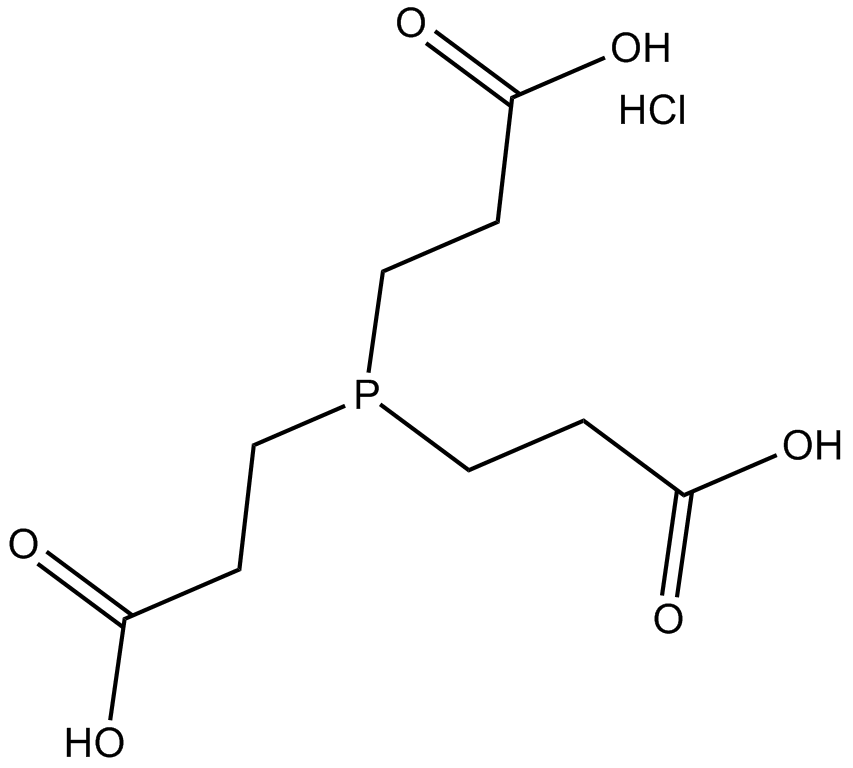
Cas No.: 51805-45-9
Sample solution is provided at 25 µL, 10mM.
TCEP hydrochloride es un agente reductor no tiol que no se une a Hg(2+). TCEP hydrochloride aumentó la formación de monómeros de SOD1, evitando así el aumento de la actividad dismutasa inducida por NO y la disminución de ROS.
En pruebas de eficacia in vitro, se mostró que TCEP hydrochloride promovió la unión de NF-kappaB al ADN de manera dependiente de la dosis en concentraciones de 0.25 a 6 mM. Con 6 mM de TCEP hydrochloride, Hg(2+) previno la unión de NF-kappaB al ADN en concentraciones tan bajas como 20 microM en reacciones de unión.
En experimentos in vitro, se indicó que el tratamiento con 100 μM de TCEP hydrochloride-HCL puede mejorar la calidad y la capacidad de desarrollo de embriones fertilizados in vitro al disminuir el estrés oxidativo en ovocitos porcinos. En la línea celular neuronal humana SHSY-5Y, 1 mM de TCEP hydrochloride protegió al máximo contra la inhibición de BoNT/B de la liberación de [(3)H]-NA, y no fue tóxico. TCEP hydrochloride (0.01 mM) no elimina Fe(3+) de Tf y es capaz de proteger los grupos tiol para el acoplamiento a maleimida. Además, TCEP hydrochloride no interfiere con el propio acoplamiento a maleimida. In vitro, células hepáticas humanas (HepG2) tratadas con 100, 200 y 400 μM de TCEP hydrochloride durante 3 días mostraron un aumento en el nivel de estrés oxidativo, esterasas, afluencia de Ca2+ y disfunción de ΔΨm. Y hubo un pico apoptótico subG1 del 65.96% en células tratadas con 400 μM.
In vivo, el tratamiento con 20 mg/kg y 60 mg/kg de TCEP hydrochloride por vía oral en ratones ICR adultos durante 9 semanas, mejoró la ganancia de peso corporal, la hipertrigliceridemia y la esteatosis hepática, consistente con la regulación positiva de la expresión de genes relacionados con la lipogénesis hepática. TCEP también alteró los niveles de varios metabolitos hepáticos.
References:
[1].Dieguez-Acuña FJ, et al. Inhibition of NF-kappaB-DNA binding by mercuric ion: utility of the non-thiol reductant, tris(2-carboxyethyl)phosphine hydrochloride (TCEP hydrochloride), on detection of impaired NF-kappaB-DNA binding by thiol-directed agents. Toxicol In Vitro. 2000 Feb;14(1):7-16.
[2]Zeng Y, et al. Effects of tris (2-carboxyethyl) phosphine hydrochloride treatment on porcine oocyte in vitro maturation and subsequent in vitro fertilized embryo developmental capacity. Theriogenology. 2021 Mar 1;162:32-41.
[3]Shi X, et al. TCEP hydrochloride treatment reduces proteolytic activity of BoNT/B in human neuronal SHSY-5Y cells. J Cell Biochem. 2009 Aug 1;107(5):1021-30.
[4]Visser CC, et al. Coupling of metal containing homing devices to liposomes via a maleimide linker: use of TCEP to stabilize thiol-groups without scavenging metals. J Drug Target. 2004;12(9-10):569-73.
[5]Peng H, et al. Nitric oxide inhibits endothelial cell apoptosis by inhibiting cysteine-dependent SOD1 monomerization. FEBS Open Bio. 2022 Feb;12(2):538-548.
[6]M Al-Salem A, et al. Tris(2-chloroethyl) Phosphate (TCEP) Elicits Hepatotoxicity by Activating Human Cancer Pathway Genes in HepG2 Cells. Toxics. 2020 Nov 20;8(4):109.
[7]Yang D, et al. Tris (2-chloroethyl) phosphate (TCEP) induces obesity and hepatic steatosis via FXR-mediated lipid accumulation in mice: Long-term exposure as a potential risk for metabolic diseases. Chem Biol Interact. 2022 Aug 25;363:110027.
| Experimentos celulares [1]: | |
Líneas celulares | Células HUVEC |
Método de preparación | Se utilizaron SNP como donante de NO (100 µm), L-NAME como inhibidor de NOS (500 µm), y TCEP hidrocloruro como agente reductor de tioles de cisteína (2 mm) en células HUVEC. |
Condiciones de reacción | 2 mm; 2h |
Áreas de aplicación | El TCEP hidrocloruro abolió con éxito la inhibición inducida por NO de la monomerización de SOD1 en células HUVEC, lo que indica que el NO inhibió la SOD1 monomérica al actuar sobre los tioles de cisteína. |
| Experimentos con animales [2]: | |
Modelos animales | Ratones Kunming adultos |
Método de preparación | Un total de 30 ratones Kunming adultos fueron divididos aleatoriamente en grupo de control normal (0 mg/kg·d), grupo de baja dosis de TCEP hidrocloruro (10 mg/kg·d) y grupo de alta dosis de TCEP hidrocloruro (100 mg/kg·d), administrados continuamente por gavage durante 30 días. |
Forma de dosificación | 0, 10, 100 mg/kg·d; p.o. |
Áreas de aplicación | En comparación con el grupo de control, la ingesta de agua del grupo de alta dosis de TCEP hidrocloruro disminuyó significativamente, y el índice de órganos del hígado y el bazo aumentó significativamente. Además, la latencia de escape de los ratones expuestos al TCEP hidrocloruro fue más prolongada que en el grupo de control en la prueba del laberinto acuático, mientras que el recorrido total de natación del grupo de alta dosis de TCEP hidrocloruro fue elevado y el tiempo de natación en el cuadrante objetivo se acortó notablemente en comparación con el grupo de control. |
Referencias: [1]. Peng H, et al. Nitric oxide inhibits endothelial cell apoptosis by inhibiting cysteine-dependent SOD1 monomerization. FEBS Open Bio. 2022 Feb;12(2):538-548. [2]. Wang C, et al. Neurotoxicity and related mechanisms of flame retardant TCEP hydrochloride exposure in mice. Toxicol Mech Methods. 2020 Sep;30(7):490-496. | |
| Cas No. | 51805-45-9 | SDF | |
| Sinónimos | Tris(2-carboxyethyl) phosphine hydrochloride | ||
| Chemical Name | 3,3',3''-phosphinetriyltripropanoic acid hydrochloride | ||
| Canonical SMILES | O=C(O)CCP(CCC(O)=O)CCC(O)=O.Cl | ||
| Formula | C9H16ClO6P | M.Wt | 286.65 |
| Solubility | ≥ 28.7mg/mL in Water ; ≥ 50mg/mL in DMSO | Storage | Store at 2-8°C , protect from light, stored under nitrogen |
| General tips | Please select the appropriate solvent to prepare the stock solution according to the
solubility of the product in different solvents; once the solution is prepared, please store it in
separate packages to avoid product failure caused by repeated freezing and thawing.Storage method
and period of the stock solution: When stored at -80°C, please use it within 6 months; when stored
at -20°C, please use it within 1 month. To increase solubility, heat the tube to 37°C and then oscillate in an ultrasonic bath for some time. |
||
| Shipping Condition | Evaluation sample solution: shipped with blue ice. All other sizes available: with RT, or with Blue Ice upon request. | ||
| Prepare stock solution | |||

|
1 mg | 5 mg | 10 mg |
| 1 mM | 3.4886 mL | 17.4429 mL | 34.8857 mL |
| 5 mM | 697.7 μL | 3.4886 mL | 6.9771 mL |
| 10 mM | 348.9 μL | 1.7443 mL | 3.4886 mL |
Step 1: Enter information below (Recommended: An additional animal making an allowance for loss during the experiment)
 g
μL
g
μL
Step 2: Enter the in vivo formulation (This is only the calculator, not formulation. Please contact us first if there is no in vivo formulation at the solubility Section.)
Calculation results:
Working concentration: mg/ml;
Method for preparing DMSO master liquid: mg drug pre-dissolved in μL DMSO ( Master liquid concentration mg/mL, Please contact us first if the concentration exceeds the DMSO solubility of the batch of drug. )
Method for preparing in vivo formulation: Take μL DMSO master liquid, next addμL PEG300, mix and clarify, next addμL Tween 80, mix and clarify, next add μL saline, mix and clarify.
Method for preparing in vivo formulation: Take μL DMSO master liquid, next add μL Corn oil, mix and clarify.
Note: 1. Please make sure the liquid is clear before adding the next solvent.
2. Be sure to add the solvent(s) in order. You must ensure that the solution obtained, in the previous addition, is a clear solution before proceeding to add the next solvent. Physical methods such as vortex, ultrasound or hot water bath can be used to aid dissolving.
3. All of the above co-solvents are available for purchase on the GlpBio website.
Quality Control & SDS
- View current batch:
- Purity: >98.00% Appearance: A solid
- COA (Certificate of Analysis)
- SDS (Safety Data Sheet)
- Datasheet
Average Rating: 5 (Based on Reviews and 6 reference(s) in Google Scholar.)