

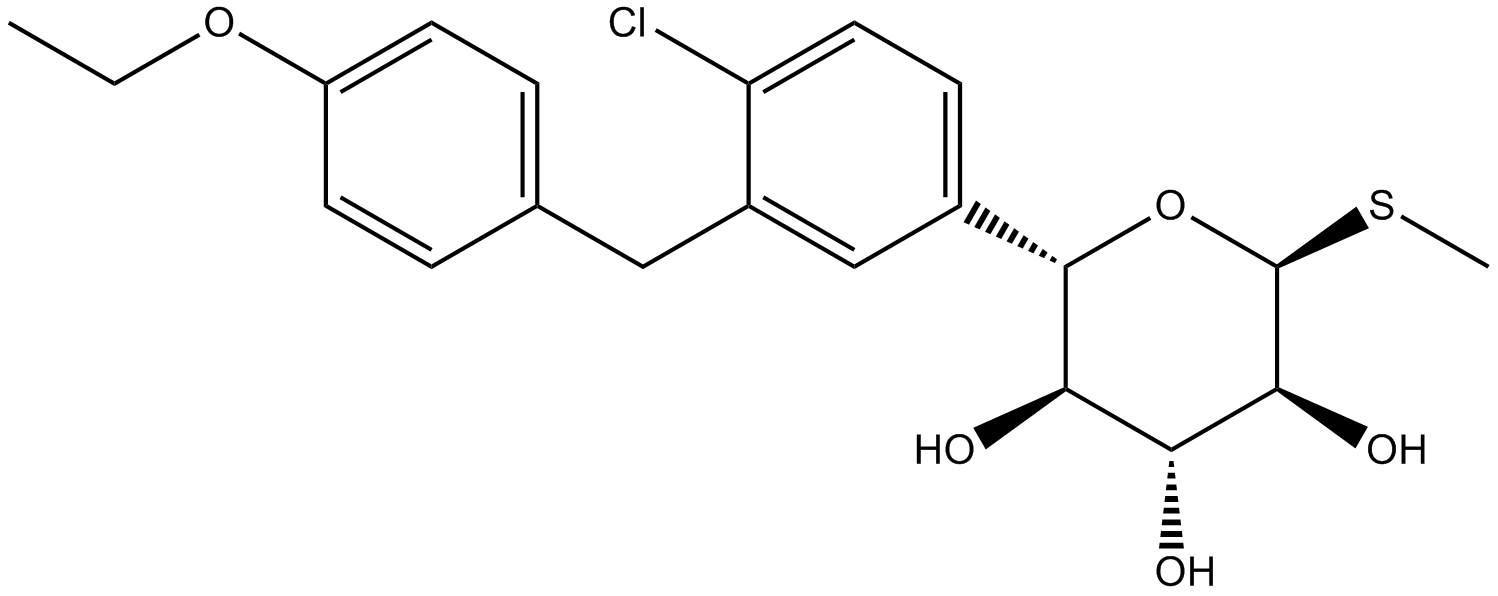
LX-4211 (Synonyms: LP 802034, LX4211) |
Catalog No.GC15088
 One-Click Copy Product Info
|

LX-4211 es un inhibidor dual oral y potente de SGLT2/1, con valores IC50 de 36nM y 1.8nM para SGLT1 y SGLT2, respectivamente
Products are for research use only. Not for human use. We do not sell to patients.
Cas No.: 1018899-04-1
Sample solution is provided at 25 µL, 10mM.
_1-3.$$$39978408@51.jpg');)
_1-9.$$$38538795@65.jpg');)
_1-9.$$$39112701@51.jpg');)
_1-7.$$$37316672@70.jpg');)
_366-372.$$$36198801@70.jpg');)
.$$$38565142@65.jpg');)
_1867-1883.$$$33248023@67.jpg');)
_eads6055.$$$39977546@45.jpg');)
_eadm9805.$$$40080571@45.jpg');)
_eadj3020.$$$39666821@45.jpg');)
_1-20.$$$39757301@28.jpg');)
_1-24.$$$38898113@28.jpg');)
_273-287.$$$36806353@46.jpg');)
_1-16.$$$37156877@44.jpg');)
_1-19.$$$37460805@44.jpg');)
_1291-1307.$$$34518654@46.jpg');)
LX-4211 es un inhibidor dual oral y potente de SGLT2/1, con valores IC50 de 36nM y 1.8nM para SGLT1 y SGLT2, respectivamente[1][2]. LX-4211 mejora la excreción urinaria de glucosa al inhibir el SGLT2 y reduce la absorción gastrointestinal de glucosa al inhibir el SGLT1, reduciendo así efectivamente los niveles de glucosa en sangre [3][4]. LX-4211 se utiliza comúnmente en la investigación relacionada con la diabetes[5][6].
In vitro, el tratamiento de células endoteliales cultivadas (ECs) de la arteria coronaria porcina con LX-4211 (10nM) durante 30 minutos antes de la posterior incubación en glucosa normo o glucosa alta (HG: 25mmol/L) durante 24 horas redujo la absorción de glucosa estimulada por HG, y disminuyó los marcadores de senescencia de ECs y el estrés oxidativo, reguló la expresión de eNOS y la formación de NO, y redujo la expresión de VCAM-1, factor tisular y el sistema local de angiotensina [7].
In vivo, el tratamiento oral de ratones no obesos y propensos a la diabetes con T1D inducida por ciclofosfamida con LX-4211(por vía oral;2/30mg/kg/día) durante 22 días disminuyó significativamente los niveles de glucosa en sangre y los niveles de A1c sin aumentar la tasa de mediciones de hipoglucemia [8]. La administración oral de LX-4211 (60mg/kg) en ratones reduce la absorción intestinal de glucosa al inhibir SGLT1, aumenta la liberación del péptido-1 similar al glucagón (GLP-1) y del péptido YY (PYY), al tiempo que reduce la liberación de polipéptido insulinotrópico dependiente de la glucosa (GIP) y las fluctuaciones en los niveles de glucosa en sangre durante las 6 horas osteriores a una comida que contiene glucosa[4].
References:
[1] Zambrowicz, B., Freiman, J., Brown, P. M., Frazier, K. S., Turnage, A., Bronner, J., Ruff, D., Shadoan, M., Banks, P., Mseeh, F., Rawlins, D. B., Goodwin, N. C., Mabon, R., Harrison, B. A., Wilson, A., Sands, A., & Powell, D. R. (2012). LX4211, a dual SGLT1/SGLT2 inhibitor, improved glycemic control in patients with type 2 diabetes in a randomized, placebo-controlled trial. Clinical pharmacology and therapeutics, 92(2), 158–169.
[2] Goodwin, N. C., Ding, Z. M., Harrison, B. A., Strobel, E. D., Harris, A. L., Smith, M., Thompson, A. Y., Xiong, W., Mseeh, F., Bruce, D. J., Diaz, D., Gopinathan, S., Li, L., O'Neill, E., Thiel, M., Wilson, A. G., Carson, K. G., Powell, D. R., & Rawlins, D. B. (2017). Discovery of LX2761, a Sodium-Dependent Glucose Cotransporter 1 (SGLT1) Inhibitor Restricted to the Intestinal Lumen, for the Treatment of Diabetes. Journal of medicinal chemistry, 60(2), 710–721.
[3] Goodwin, N. C., Mabon, R., Harrison, B. A., Shadoan, M. K., Almstead, Z. Y., Xie, Y., Healy, J., Buhring, L. M., DaCosta, C. M., Bardenhagen, J., Mseeh, F., Liu, Q., Nouraldeen, A., Wilson, A. G., Kimball, S. D., Powell, D. R., & Rawlins, D. B. (2009). Novel L-xylose derivatives as selective sodium-dependent glucose cotransporter 2 (SGLT2) inhibitors for the treatment of type 2 diabetes. Journal of medicinal chemistry, 52(20), 6201–6204.
[4] Powell, D. R., Smith, M., Greer, J., Harris, A., Zhao, S., DaCosta, C., Mseeh, F., Shadoan, M. K., Sands, A., Zambrowicz, B., & Ding, Z. M. (2013). LX4211 increases serum glucagon-like peptide 1 and peptide YY levels by reducing sodium/glucose cotransporter 1 (SGLT1)-mediated absorption of intestinal glucose. The Journal of pharmacology and experimental therapeutics, 345(2), 250–259.
[5] Herat, L. Y., Matthews, J. R., Hibbs, M., Rakoczy, E. P., Schlaich, M. P., & Matthews, V. B. (2023). SGLT1/2 inhibition improves glycemic control and multi-organ protection in type 1 diabetes. iScience, 26(8), 107260.
[6] Bhatt, D. L., Szarek, M., Steg, P. G., Cannon, C. P., Leiter, L. A., McGuire, D. K., Lewis, J. B., Riddle, M. C., Voors, A. A., Metra, M., Lund, L. H., Komajda, M., Testani, J. M., Wilcox, C. S., Ponikowski, P., Lopes, R. D., Verma, S., Lapuerta, P., Pitt, B., & SOLOIST-WHF Trial Investigators (2021). Sotagliflozin in Patients with Diabetes and Recent Worsening Heart Failure. The New England journal of medicine, 384(2), 117–128.
[7] Khemais-Benkhiat, S., Belcastro, E., Idris-Khodja, N., Park, S. H., Amoura, L., Abbas, M., Auger, C., Kessler, L., Mayoux, E., Toti, F., & Schini-Kerth, V. B. (2020). Angiotensin II-induced redox-sensitive SGLT1 and 2 expression promotes high glucose-induced endothelial cell senescence. Journal of cellular and molecular medicine, 24(3), 2109–2122.
[8] Powell, D. R., Doree, D., Jeter-Jones, S., Ding, Z. M., Zambrowicz, B., & Sands, A. (2015). Sotagliflozin improves glycemic control in nonobese diabetes-prone mice with type 1 diabetes. Diabetes, metabolic syndrome and obesity : targets and therapy, 8, 121–127.
| Experimentos celulares [1]: | |
Líneas celulares | Células endoteliales cultivadas de la arteria cornaria porcina (ECs) |
Método de preparación | Se recogieron corazones de cerdos del matadero local. Las arterias coronarias circunflejas izquierdas fueron extirpadas, limpiadas y enjuagadas con PBS sin calcio para eliminar la sangre resstante. Para la tinción de inmunofluorescencia, se incubaron segmentos de la arteria coronaria con endotelio en RPMI que contenía una concentración normal de glucosa (NG: 11.1mmol/L) suplementada con fungizona (2.5μg/mL), penicillin (100U/mL), streptomycin (100μg/mL), HEPES (100mmol/L), en ausencia o presencia de empagliflozina (100nmol/L) o LX-4211(10nM) durante 30 minutos antes de la posterior incubación en glucosa normal o glucosa alta (HG: 25mmol/L) durante 24 horas. A partir de entonces, los segmentos se lavaron con PBS antes de incrustarse en medio de sección congelado FSC22 y congelados en nitrógeno líquido. |
Condiciones de reacción | 10nM; 30min |
Áreas de aplicación | LX-4211 redujo notablemente el nivel de estrés oxidativo en los ECs. |
| Experimentos con animales [2]: | |
Modelos animales | Ratones hembra NOD/ShiLtJ |
Método de preparación | Los ratones diabéticos fueron asignados al azar por peso corporal y nivel de glucosa en sangre en cuatro grupos de tratamiento: insulina 0.2U/vehículo, 0.05U insulina/vehículo, 0.05U insulina/2mg/kg LX-4211 o 0.05U insulina/30mg/kg LX-4211. En el día –1, mientras estaban bajo anestesia de isoflurano, todos los ratones fueron implantados por vía subcutánea con una bomba microosmótica Alzet (modelo 1004, duración de 4 semanas) entregando insulina en forma de Humulin R en dosis de 0.05U/día o 0.2U/día. Al día siguiente día 1 del estudio), todos los ratones recibieron su primera dosis diaria dosis diaria de vehículo (0.1% Tween 80 en agua) solo o vehículo que contiene LX-4211, estructura química (2S,3R,4R,5S,6R)-2-(4-chloro-3-[4-ethoxybenzyl] phenyl)-6-(methylthio)tetrahydro-2H-pyran-3,4,5-triol. LX-4211 se administró una vez por la tarde por gavage oral a una dosis de 2 mg/kg o 30mg/kg en un volumen total de 10mL/kg; estas dosis se eligieron porque en estudios anteriores de ratones, 2mg/kg tuvieron un efecto medio máximo y 30mg/kg un efecto máximo en la excreción urinaria de glucosa. |
Forma de dosificación | 2, 30mg/kg/día durante 22 días; p.o. |
Áreas de aplicación | LX-4211(por vía oral; 2/30mg/kg/día) durante 22 días disminuyó significativamente los niveles de glucosa en sangre y los niveles de A1c sin aumentar la tasa de mediciones de hipoglucemia. |
References: | |
| Cas No. | 1018899-04-1 | SDF | |
| Sinónimos | LP 802034, LX4211 | ||
| Chemical Name | (2S,3R,4R,5S,6R)-2-[4-chloro-3-[(4-ethoxyphenyl)methyl]phenyl]-6-methylsulfanyloxane-3,4,5-trio | ||
| Canonical SMILES | CCOC1=CC=C(C=C1)CC2=C(C=CC(=C2)C3C(C(C(C(O3)SC)O)O)O)Cl | ||
| Formula | C21H25ClO5S | M.Wt | 424.94 |
| Solubility | DMF: 30 mg/ml,DMSO: 30 mg/ml,Ethanol: 30 mg/ml,Ethanol:PBS(pH 7.2) (1:1): 0.5 mg/ml | Storage | Store at -20°C |
| General tips | Please select the appropriate solvent to prepare the stock solution according to the
solubility of the product in different solvents; once the solution is prepared, please store it in
separate packages to avoid product failure caused by repeated freezing and thawing.Storage method
and period of the stock solution: When stored at -80°C, please use it within 6 months; when stored
at -20°C, please use it within 1 month. To increase solubility, heat the tube to 37°C and then oscillate in an ultrasonic bath for some time. |
||
| Shipping Condition | Evaluation sample solution: shipped with blue ice. All other sizes available: with RT, or with Blue Ice upon request. | ||
| Prepare stock solution | |||

|
1 mg | 5 mg | 10 mg |
| 1 mM | 2.3533 mL | 11.7664 mL | 23.5327 mL |
| 5 mM | 470.7 μL | 2.3533 mL | 4.7065 mL |
| 10 mM | 235.3 μL | 1.1766 mL | 2.3533 mL |
Step 1: Enter information below (Recommended: An additional animal making an allowance for loss during the experiment)
 g
μL
g
μL
Step 2: Enter the in vivo formulation (This is only the calculator, not formulation. Please contact us first if there is no in vivo formulation at the solubility Section.)
Calculation results:
Working concentration: mg/ml;
Method for preparing DMSO master liquid: mg drug pre-dissolved in μL DMSO ( Master liquid concentration mg/mL, Please contact us first if the concentration exceeds the DMSO solubility of the batch of drug. )
Method for preparing in vivo formulation: Take μL DMSO master liquid, next addμL PEG300, mix and clarify, next addμL Tween 80, mix and clarify, next add μL saline, mix and clarify.
Method for preparing in vivo formulation: Take μL DMSO master liquid, next add μL Corn oil, mix and clarify.
Note: 1. Please make sure the liquid is clear before adding the next solvent.
2. Be sure to add the solvent(s) in order. You must ensure that the solution obtained, in the previous addition, is a clear solution before proceeding to add the next solvent. Physical methods such as vortex, ultrasound or hot water bath can be used to aid dissolving.
3. All of the above co-solvents are available for purchase on the GlpBio website.
Quality Control & SDS
- View current batch:
- Purity: >98.50% Appearance: A solid
- COA (Certificate of Analysis)
- SDS (Safety Data Sheet)
- Datasheet
Average Rating: 5 (Based on Reviews and 30 reference(s) in Google Scholar.)