

MD-224 |
Catalog No.GC38812
 One-Click Copy Product Info
|

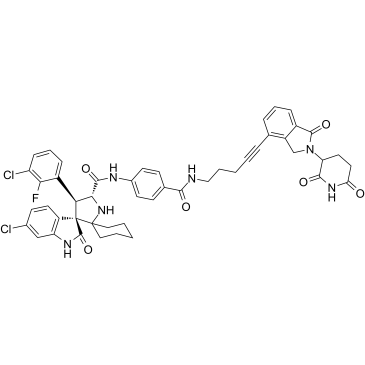
MD-224 es un degradador de doble minuto 2 (MDM2) murino humano de molécula pequeÑa altamente potente y primero en su clase basado en el concepto de quimera dirigida a la proteÓlisis (PROTAC). MD-224 consta de ligandos para Cereblon y MDM2. MD-224 induce una rÁpida degradaciÓn de MDM2 a concentraciones <1 nM en células de leucemia humana y logra un valor IC50 de 1,5 nM en la inhibiciÓn del crecimiento de células RS4;11. MD-224 tiene el potencial de ser una nueva clase de agente anticancerÍgeno.
Products are for research use only. Not for human use. We do not sell to patients.
Cas No.: 2136247-12-4
Sample solution is provided at 25 µL, 10mM.
_1-3.$$$39978408@51.jpg');)
_1-9.$$$38538795@65.jpg');)
_1-9.$$$39112701@51.jpg');)
_1-7.$$$37316672@70.jpg');)
_366-372.$$$36198801@70.jpg');)
.$$$38565142@65.jpg');)
_1867-1883.$$$33248023@67.jpg');)
_eads6055.$$$39977546@45.jpg');)
_eadm9805.$$$40080571@45.jpg');)
_eadj3020.$$$39666821@45.jpg');)
_1-20.$$$39757301@28.jpg');)
_1-24.$$$38898113@28.jpg');)
_273-287.$$$36806353@46.jpg');)
_1-16.$$$37156877@44.jpg');)
_1-19.$$$37460805@44.jpg');)
_1291-1307.$$$34518654@46.jpg');)
MD-224, a highly potent PROTAC degrader of MDM2 that is composed of Cereblon and MDM2 ligand, induces rapid degradation of the MDM2 protein [1]. MD-224 binds to the pregnane X receptor (PXR) outside the ligand-binding pocket at a structural motif and can induce the degradation of multiple nuclear receptors[2]. MD-224 has been widely used to inhibit the growth of tumor cells in a p53-independent manner and induce tumor regression in mouse xenograft models[3].
In vitro, MD-224 treatment for 4 days significantly inhibited the proliferation of RS4;11 cells, with an IC50 value of 1.5nM[4].
In vivo, MD-224 treatment via intravenous injection at a dose of 50mg/kg, once every other day for 3 weeks, significantly inhibited tumor growth in the RS4;11 xenograft mouse model without causing weight loss in the mice[4].
References:
[1] Yang J, Li Y, Aguilar A, et al. Simple structural modifications converting a bona fide MDM2 PROTAC degrader into a molecular glue molecule: a cautionary tale in the design of PROTAC degraders[J]. Journal of medicinal chemistry, 2019, 62(21): 9471-9487.
[2] Huber A D, Lin W, Jung Y H, et al. PROTAC repurposing uncovers a noncanonical binding surface that mediates chemical degradation of nuclear receptors[J]. Nature Communications, 2025, 16(1): 9805.
[3] Han X, Wei W, Sun Y. PROTAC degraders with ligands recruiting MDM2 E3 ubiquitin ligase: an updated perspective[J]. Acta materia medica, 2022, 1(2): 244.
[4] Li Y, Yang J, Aguilar A, et al. Discovery of MD-224 as a first-in-class, highly potent, and efficacious proteolysis targeting chimera murine double minute 2 degrader capable of achieving complete and durable tumor regression[J]. Journal of medicinal chemistry, 2018, 62(2): 448-466.
| Cell experiment [1]: | |
|
Cell lines |
RS4;11 cells |
|
Preparation Method |
RS4;11 cells were cultured in RPMI-1640 medium supplemented with 10% fetal bovine serum (FBS) and antibiotics (penicillin 100U/ml, streptomycin 0.1mg/ml) under normal conditions (5% CO2 with 95% humidified air). RS4;11 cells (1×10⁴ per ml) were seeded in 96-well cell culture plates in 100μl of culture medium. After addition of the different concentrations of MD-224 (0.1, 1, 10, and 100nM), the cells were incubated for 4 days at 37°C in an atmosphere of 5% CO2. Cell growth was evaluated. |
|
Reaction Conditions |
0.1, 1, 10, and 100nM; 4 days |
|
Applications |
MD-224 treatment reduced the cell viability of RS4;11 cells in a dose-dependent manner. |
| Animal experiment [1]: | |
|
Animal models |
SCID mice |
|
Preparation Method |
SCID mice (eight-week-old) were housed in a temperature/humidity-controlled room on a 12h/12h light/dark cycle with free access to food and water. 5×10⁶ RS4;11 cells with 50% Matrigel were injected subcutaneously on the dorsal side of SCID mice. When tumors reached 100mm3, mice were randomly assigned to treatment and vehicle control groups. MD-224 treatment (i.v.) at 50mg/kg, every other day for three weeks. Tumor size was measured 2-3 times per week by electronic calipers during the treatment period and at least weekly after the treatment was ended. |
|
Dosage form |
50mg/kg; every other day for three weeks; i.v. |
|
Applications |
MD-224 treatment significantly reduced tumor growth in the RS4;11 xenograft mouse model. |
|
References: |
|
| Cas No. | 2136247-12-4 | SDF | |
| Canonical SMILES | FC1=C(Cl)C=CC=C1[C@@H]2[C@@]3(C(C=CC(Cl)=C4)=C4NC3=O)C5(CCCCC5)N[C@H]2C(NC6=CC=C(C(NCCCC#CC7=C(CN(C8C(NC(CC8)=O)=O)C9=O)C9=CC=C7)=O)C=C6)=O | ||
| Formula | C48H43Cl2FN6O6 | M.Wt | 889.8 |
| Solubility | DMSO: 150 mg/mL (168.58 mM); Water: < 0.1 mg/mL (insoluble) | Storage | Store at -20°C |
| General tips | Please select the appropriate solvent to prepare the stock solution according to the
solubility of the product in different solvents; once the solution is prepared, please store it in
separate packages to avoid product failure caused by repeated freezing and thawing.Storage method
and period of the stock solution: When stored at -80°C, please use it within 6 months; when stored
at -20°C, please use it within 1 month. To increase solubility, heat the tube to 37°C and then oscillate in an ultrasonic bath for some time. |
||
| Shipping Condition | Evaluation sample solution: shipped with blue ice. All other sizes available: with RT, or with Blue Ice upon request. | ||
| Prepare stock solution | |||

|
1 mg | 5 mg | 10 mg |
| 1 mM | 1.1238 mL | 5.6192 mL | 11.2385 mL |
| 5 mM | 224.8 μL | 1.1238 mL | 2.2477 mL |
| 10 mM | 112.4 μL | 561.9 μL | 1.1238 mL |
Step 1: Enter information below (Recommended: An additional animal making an allowance for loss during the experiment)
 g
μL
g
μL
Step 2: Enter the in vivo formulation (This is only the calculator, not formulation. Please contact us first if there is no in vivo formulation at the solubility Section.)
Calculation results:
Working concentration: mg/ml;
Method for preparing DMSO master liquid: mg drug pre-dissolved in μL DMSO ( Master liquid concentration mg/mL, Please contact us first if the concentration exceeds the DMSO solubility of the batch of drug. )
Method for preparing in vivo formulation: Take μL DMSO master liquid, next addμL PEG300, mix and clarify, next addμL Tween 80, mix and clarify, next add μL saline, mix and clarify.
Method for preparing in vivo formulation: Take μL DMSO master liquid, next add μL Corn oil, mix and clarify.
Note: 1. Please make sure the liquid is clear before adding the next solvent.
2. Be sure to add the solvent(s) in order. You must ensure that the solution obtained, in the previous addition, is a clear solution before proceeding to add the next solvent. Physical methods such as vortex, ultrasound or hot water bath can be used to aid dissolving.
3. All of the above co-solvents are available for purchase on the GlpBio website.
Quality Control & SDS
- View current batch:
- Purity: >98.00% Appearance: A solid
- COA (Certificate of Analysis)
- SDS (Safety Data Sheet)
- Datasheet
Average Rating: 5 (Based on Reviews and 31 reference(s) in Google Scholar.)