

Mesalamine (Synonyms: 5-ASA) |
Catalog No.GC16607
 One-Click Copy Product Info
|

El Ácido 5-aminosalicÍlico (mesalamina) actÚa como un PPARγ especÍfico; agonista y también inhibe la quinasa 1 activada por p21 (PAK1) y NF-κB.
Products are for research use only. Not for human use. We do not sell to patients.
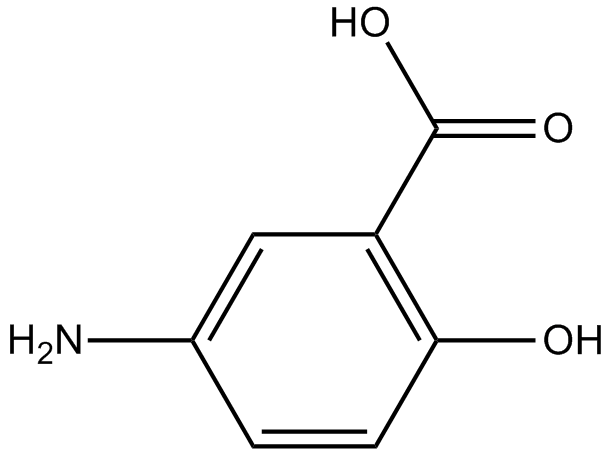
Cas No.: 89-57-6
Sample solution is provided at 25 µL, 10mM.
5-Aminosalicylic acid (Mesalamine) acts as a specific PPARγ agonist and also inhibits p21-activated kinase 1 (PAK1) and NF-κB.
5-Aminosalicylic acid (5-ASA) is a specific agonist for PPARγ, and only PPARγ but not PPARα or PPARδ induces p65 degradation. 5-Aminosalicylic acid induces degradation of p65 protein indicative of PPARγ's E3 ubiquitin ligase activity. 5-Aminosalicylic acid also inhibits PAK1 at the mRNA level which is suggestive of an additional mechanism independent of PPARγ ligand activation. 5-Aminosalicylic acid blocks NF-κB in intestinal epithelial cells (IECs) through inhibition of PAK1[1]. Pretreatment with 5-Aminosalicylic acid (5-ASA) or Nimesulide at different concentration (10-1000 μmol/L) for 12-96 h, inhibits the growth of HT-29 colon carcinoma cells in a dose and time-dependent manner. However, the suppression of 5-Aminosalicylic acid or Nimesulide has no statistical significance. The growth of HT-29 colon carcinoma cells is inhibited dose-dependently when pretreated with different doses of combined 5-Aminosalicylic acid and Nimesulide. Combined 5-Aminosalicylic acid (final concentration 100 μM) and Nimesulide (final concentration 10-1000 μM) inhibits the proliferation of HT-29 colon carcinoma cells in a dose-dependent manner, being more potent than corresponding dose of Nimesulide. Similarly, combined Nimesulide (final concentration 100 μM) and 5-Aminosalicylic acid (final concentration 10-1000 μM) also inhibits the proliferation of these cells dose-dependently, being more potent than corresponding dose of 5-Aminosalicylic acid[2].
5-Aminosalicylic acid (5-ASA) has an antineoplastic effect in a xenograft tumor model. To evaluate the in vivo antineoplasic effect of 5-Aminosalicylic acid, SCID mice engrafted with HT-29 colon cancer cells are treated daily for 21 consecutive days with 5-Aminosalicylic acid at 50 mM. At the end of the treatment, a reduction of 80-86% of tumor weight and volume is observed in SCID mice receiving 5-Aminosalicylic acid compared with control mice or mice treated with GW9662 alone. The antineoplastic effect of 5-Aminosalicylic acid is already detectable after 10 days of 5-Aminosalicylic acid treatment. Similar results are obtained with mice treated with 5-Aminosalicylic acid at 5 mM. Antitumorigenic effect of 5-Aminosalicylic acid is completely abolished at 21 days by simultaneous intraperitoneal administration of GW9662. Thus, the observed antineoplastic effect of 5-Aminosalicylic acid is at least partially dependent on PPARγ[3].
References:
[1]. Dammann K, et al. PAK1 modulates a PPARγ/NF-κB cascade in intestinal inflammation. Biochim Biophys Acta. 2015 Oct;1853(10 Pt A):2349-60.
[2]. Rousseaux C, et al. The 5-aminosalicylic acid antineoplastic effect in the intestine is mediated by PPARγ. Carcinogenesis. 2013 Nov;34(11):2580-6.
[3]. Fang HM, et al. 5-aminosalicylic acid in combination with Nimesulide inhibits proliferation of colon carcinoma cells in vitro. World J Gastroenterol. 2007 May 28;13(20):2872-7.
|
Cell experiment: |
Cytostatic effects are measured by MTT assay. HT-29 colon carcinoma cells are detached with a 0.25% trypsin solution for 5 min. Subsequently, the cells are seeded onto 96-well plates (1×10⁶ cells/well), supplemented with 10% FCS and allowed to attach for 24 h before the addition of test compounds (5-Aminosalicylic acid 10, 50, 100, 500, and 1000 μM; Nimesulide; and their combination). Test compounds are diluted in serum-free culture medium. Then the cells are incubated in a medium or at different concentrations of drugs for 48 h, 20 μL of MTT solution (5 g/L) in PBS is added. Four hours later, the medium in each well is removed, and 120 μL of 0.04 mM muriatic isopropanol is added, slightly concussed for 10 min. Dye uptake is measured at 490 nm with an ELISA reader. Five wells are used for each concentration or as a control group. On the other hand, the cells are seeded onto 96-well plates (1×10⁶ cells/well) and allowed to attach for 24 h, then treated with test compounds (5-Aminosalicylic acid, Nimesulide, and their combination). The final concentration is 100 μM. The same medium is added into the control group and dye uptake is then measured. Five wells are used for each test compound or control group[2]. |
|
Animal experiment: |
Mice[3]Six to seven weeks old pathogen-free BALB/c SCID mice are used. Human colon cancer cells (107 HT-29 cells) pretreated or not with GW9662 for 24 h are implanted subcutaneously in the flank of animals. Two days after cell inoculation, mice are treated with 5-Aminosalicylic acid (5 or 50 mM) administered daily by peritumoral injection for 10 or 21 days. The effect of PPARγ during 5-Aminosalicylic acid treatment is evaluated by daily intraperitoneal injection of GW9662 (1 mg/kg/day). The control group receives saline instead of 5-Aminosalicylic acid. Mice are checked three times a week for tumor development. After killing at 10 or 21 days, tumor size and volume are calculated. Tumors are weighted before paraffin embedding for histological examination. |
|
References: [1]. Dammann K, et al. PAK1 modulates a PPARγ/NF-κB cascade in intestinal inflammation. Biochim Biophys Acta. 2015 Oct;1853(10 Pt A):2349-60. |
|
| Cas No. | 89-57-6 | SDF | |
| Sinónimos | 5-ASA | ||
| Chemical Name | 5-amino-2-hydroxybenzoic acid | ||
| Canonical SMILES | C1=CC(=C(C=C1N)C(=O)O)O | ||
| Formula | C7H7NO3 | M.Wt | 153.14 |
| Solubility | DMSO: 25mg/ml;Water:1mg/ml;DMF: 1.6mg/ml | Storage | 4°C, protect from light, stored under nitrogen |
| General tips | Please select the appropriate solvent to prepare the stock solution according to the
solubility of the product in different solvents; once the solution is prepared, please store it in
separate packages to avoid product failure caused by repeated freezing and thawing.Storage method
and period of the stock solution: When stored at -80°C, please use it within 6 months; when stored
at -20°C, please use it within 1 month. To increase solubility, heat the tube to 37°C and then oscillate in an ultrasonic bath for some time. |
||
| Shipping Condition | Evaluation sample solution: shipped with blue ice. All other sizes available: with RT, or with Blue Ice upon request. | ||
| Prepare stock solution | |||

|
1 mg | 5 mg | 10 mg |
| 1 mM | 6.53 mL | 32.6499 mL | 65.2997 mL |
| 5 mM | 1.306 mL | 6.53 mL | 13.0599 mL |
| 10 mM | 653 μL | 3.265 mL | 6.53 mL |
Step 1: Enter information below (Recommended: An additional animal making an allowance for loss during the experiment)
 g
μL
g
μL
Step 2: Enter the in vivo formulation (This is only the calculator, not formulation. Please contact us first if there is no in vivo formulation at the solubility Section.)
Calculation results:
Working concentration: mg/ml;
Method for preparing DMSO master liquid: mg drug pre-dissolved in μL DMSO ( Master liquid concentration mg/mL, Please contact us first if the concentration exceeds the DMSO solubility of the batch of drug. )
Method for preparing in vivo formulation: Take μL DMSO master liquid, next addμL PEG300, mix and clarify, next addμL Tween 80, mix and clarify, next add μL saline, mix and clarify.
Method for preparing in vivo formulation: Take μL DMSO master liquid, next add μL Corn oil, mix and clarify.
Note: 1. Please make sure the liquid is clear before adding the next solvent.
2. Be sure to add the solvent(s) in order. You must ensure that the solution obtained, in the previous addition, is a clear solution before proceeding to add the next solvent. Physical methods such as vortex, ultrasound or hot water bath can be used to aid dissolving.
3. All of the above co-solvents are available for purchase on the GlpBio website.
Quality Control & SDS
- View current batch:
- Purity: >98.00% Appearance: A solid
- COA (Certificate of Analysis)
- SDS (Safety Data Sheet)
- Datasheet
Average Rating: 5 (Based on Reviews and 15 reference(s) in Google Scholar.)