

Moxifloxacin |
Catalog No.GC11992
 One-Click Copy Product Info
|

La moxifloxacina es un antimicrobiano de 8-metoxiquinolona activo por vÍa oral para su uso en el tratamiento de la sinusitis bacteriana aguda, las exacerbaciones bacterianas agudas de la bronquitis crÓnica y la neumonÍa adquirida en la comunidad.
Products are for research use only. Not for human use. We do not sell to patients.
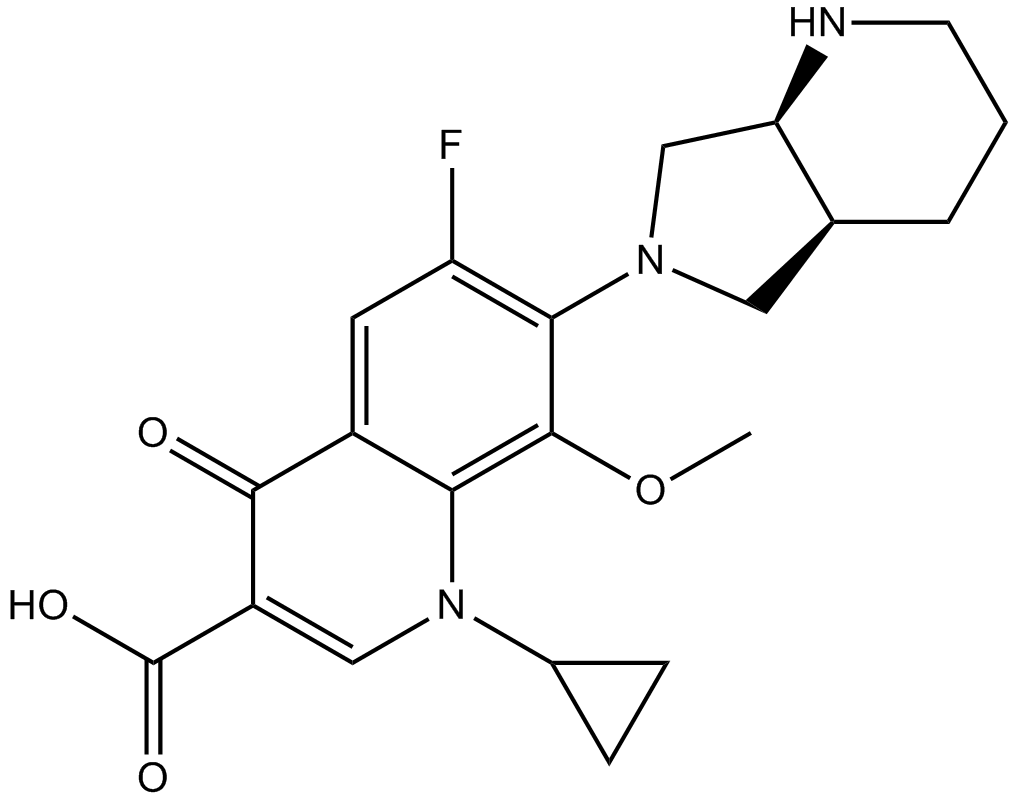
Cas No.: 151096-09-2
Sample solution is provided at 25 µL, 10mM.
_1-3.$$$39978408@51.jpg');)
_1-9.$$$38538795@65.jpg');)
_1-9.$$$39112701@51.jpg');)
_1-7.$$$37316672@70.jpg');)
_366-372.$$$36198801@70.jpg');)
.$$$38565142@65.jpg');)
_1867-1883.$$$33248023@67.jpg');)
_eads6055.$$$39977546@45.jpg');)
_eadm9805.$$$40080571@45.jpg');)
_eadj3020.$$$39666821@45.jpg');)
_1-20.$$$39757301@28.jpg');)
_1-24.$$$38898113@28.jpg');)
_273-287.$$$36806353@46.jpg');)
_1-16.$$$37156877@44.jpg');)
_1-19.$$$37460805@44.jpg');)
_1291-1307.$$$34518654@46.jpg');)
Moxifloxacin is a fourth-generation, broad-spectrum 8-methoxyfluoroquinolone antibacterial agent. Moxifloxacin inhibits the activity of bacterial DNA topoisomerase II (DNA gyrase) and topoisomerase IV, thereby blocking bacterial DNA replication and transcription processes, ultimately leading to bacterial death. Moxifloxacin can be used in research related to respiratory tract infections, skin and skin structure infections, intra-abdominal infections, and tuberculosis (especially drug-resistant tuberculosis)[1-4].
In vitro, Moxifloxacin (5-50μg/ml) was co-treated with TNF-α (50ng/ml) in cystic fibrosis bronchial epithelial cell lines IB3 and C38 cells for 48 hours. Moxifloxacin significantly inhibited the secretion of IL-8 and IL-6; Moxifloxacin (5-20μg/ml) was co-treated with TNF-α (50ng/ml) in IB3 and C38 cells for 15-60 minutes. Moxifloxacin significantly inhibited the activation of ERK1/2, JNK, and NF-κB[5]. Moxifloxacin (0.05-1mg/ml) was used to treat immortalized human corneal endothelial cells (B4G12 cells) for 24-72 hours. Moxifloxacin induced dose-dependent cytotoxicity, increased reactive oxygen species generation and autophagy, activated caspase 2, 3, 8 pathways and induced apoptosis[6].
In vivo, Moxifloxacin (12.5, 25, 50mg/kg; once daily) was orally administered to Wistar mice for 7 days. Moxifloxacin significantly increased serum creatinine, cholesterol, high-density lipoprotein cholesterol, low-density lipoprotein cholesterol, triglyceride, urea levels and aspartate transaminase, alanine transaminase, alkaline phosphatase activities, while decreasing total bilirubin levels in mice[7]. Moxifloxacin (100mg/kg; twice daily) was intraperitoneally injected into C57BL/6N mice for 2 days. Moxifloxacin significantly reduced the numbers and concentrations of total immune cells, neutrophils, and inflammatory mediators (KC, IL-1β, IL-17A) in the lungs after infection with live or heat-killed bacteria[8].
References:
[1] Balfour JA, Wiseman LR. Moxifloxacin. Drugs. 1999 Mar;57(3):363-73; discussion 374.
[2] Al Omari MM, Jaafari DS, Al-Sou'od KA, Badwan AA. Moxifloxacin hydrochloride. Profiles Drug Subst Excip Relat Methodol. 2014;39:299-431.
[3] Miravitlles M, Anzueto A. Moxifloxacin: a respiratory fluoroquinolone. Expert Opin Pharmacother. 2008 Jul;9(10):1755-72.
[4] Khan F, Ismail M, Khan Q, et al. Moxifloxacin-induced QT interval prolongation and torsades de pointes: a narrative review. Expert Opin Drug Saf. 2018 Oct;17(10):1029-1039.
[5] Blau H, Klein K, Shalit I, et al. Moxifloxacin but not ciprofloxacin or azithromycin selectively inhibits IL-8, IL-6, ERK1/2, JNK, and NF-kappaB activation in a cystic fibrosis epithelial cell line. Am J Physiol Lung Cell Mol Physiol. 2007 Jan;292(1):L343-52.
[6] Park JH, Kim M, Chuck RS, et al. Evaluation of moxifloxacin-induced cytotoxicity on human corneal endothelial cells. Sci Rep. 2021 Mar 18;11(1):6250.
[7] Ukpo GE, Ebuehi OA, Kareem AA. Evaluation of Moxifloxacin-induced Biochemical Changes in Mice. Indian J Pharm Sci. 2012 Sep;74(5):454-7.
[8] Beisswenger C, Honecker A, Kamyschnikow A, et al. Moxifloxacin modulates inflammation during murine pneumonia. Respir Res. 2014 Jul 17;15(1):82.
| Cell experiment [1]: | |
Cell lines | Immortalized human corneal endothelial cells (B4G12 cell line) |
Preparation Method | B4G12 cells were cultured in human endothelial serum-free medium supplemented with 10ng/ml fibroblast growth factor-2. The cells were treated with various concentrations of Moxifloxacin (0.05-1mg/ml) for 24, 48, and 72 hours. |
Reaction Conditions | 0.05-1mg/ml; 24-72h |
Applications | Moxifloxacin induced dose-dependent cytotoxicity in HCECs. Moxifloxacin exposure increased reactive oxygen species (ROS) generation and induced autophagy in HCECs. Moxifloxacin exposure resulted in significant dose-dependent increases of caspase 2, 3, and 8 activation and induced apoptosis in HCECs. |
| Animal experiment [2]: | |
Animal models | Wistar mice (weighing 17.5-19.0g) |
Preparation Method | Mice were divided into four groups. Group A served as the control and received 2ml of distilled water, while Groups B, C and D were orally administered Moxifloxacin at doses of 12.5, 25 and 50mg/kg body weight once daily for 7 days, respectively. |
Dosage form | 12.5, 25, 50mg/kg; p.o.; once daily for 7 days |
Applications | Moxifloxacin administration significantly increased serum creatinine, cholesterol, high-density lipoprotein cholesterol, low-density lipoprotein cholesterol, triglyceride, urea levels and aspartate transaminase, alanine transaminase, alkaline phosphatase activities, while decreasing total bilirubin levels in a dose-dependent manner. |
References: | |
| Cas No. | 151096-09-2 | SDF | |
| Chemical Name | 7-[(4aS,7aS)-1,2,3,4,4a,5,7,7a-octahydropyrrolo[3,4-b]pyridin-6-yl]-1-cyclopropyl-6-fluoro-8-methoxy-4-oxoquinoline-3-carboxylic acid | ||
| Canonical SMILES | COC1=C2C(=CC(=C1N3CC4CCCNC4C3)F)C(=O)C(=CN2C5CC5)C(=O)O | ||
| Formula | C21H24FN3O4 | M.Wt | 401.43 |
| Solubility | ≥ 50.8 mg/mL in DMSO with gentle warming, ≥ 11.62 mg/mL in EtOH with ultrasonic and warming, ≥ 25.6 mg/mL in Water with ultrasonic and warming | Storage | Store at -20°C |
| General tips | Please select the appropriate solvent to prepare the stock solution according to the
solubility of the product in different solvents; once the solution is prepared, please store it in
separate packages to avoid product failure caused by repeated freezing and thawing.Storage method
and period of the stock solution: When stored at -80°C, please use it within 6 months; when stored
at -20°C, please use it within 1 month. To increase solubility, heat the tube to 37°C and then oscillate in an ultrasonic bath for some time. |
||
| Shipping Condition | Evaluation sample solution: shipped with blue ice. All other sizes available: with RT, or with Blue Ice upon request. | ||
| Prepare stock solution | |||

|
1 mg | 5 mg | 10 mg |
| 1 mM | 2.4911 mL | 12.4555 mL | 24.9109 mL |
| 5 mM | 498.2 μL | 2.4911 mL | 4.9822 mL |
| 10 mM | 249.1 μL | 1.2455 mL | 2.4911 mL |
Step 1: Enter information below (Recommended: An additional animal making an allowance for loss during the experiment)
 g
μL
g
μL
Step 2: Enter the in vivo formulation (This is only the calculator, not formulation. Please contact us first if there is no in vivo formulation at the solubility Section.)
Calculation results:
Working concentration: mg/ml;
Method for preparing DMSO master liquid: mg drug pre-dissolved in μL DMSO ( Master liquid concentration mg/mL, Please contact us first if the concentration exceeds the DMSO solubility of the batch of drug. )
Method for preparing in vivo formulation: Take μL DMSO master liquid, next addμL PEG300, mix and clarify, next addμL Tween 80, mix and clarify, next add μL saline, mix and clarify.
Method for preparing in vivo formulation: Take μL DMSO master liquid, next add μL Corn oil, mix and clarify.
Note: 1. Please make sure the liquid is clear before adding the next solvent.
2. Be sure to add the solvent(s) in order. You must ensure that the solution obtained, in the previous addition, is a clear solution before proceeding to add the next solvent. Physical methods such as vortex, ultrasound or hot water bath can be used to aid dissolving.
3. All of the above co-solvents are available for purchase on the GlpBio website.
Quality Control & SDS
- View current batch:
- Purity: >99.00% Appearance: A solid
- COA (Certificate of Analysis)
- SDS (Safety Data Sheet)
- Datasheet
Average Rating: 5 (Based on Reviews and 4 reference(s) in Google Scholar.)