

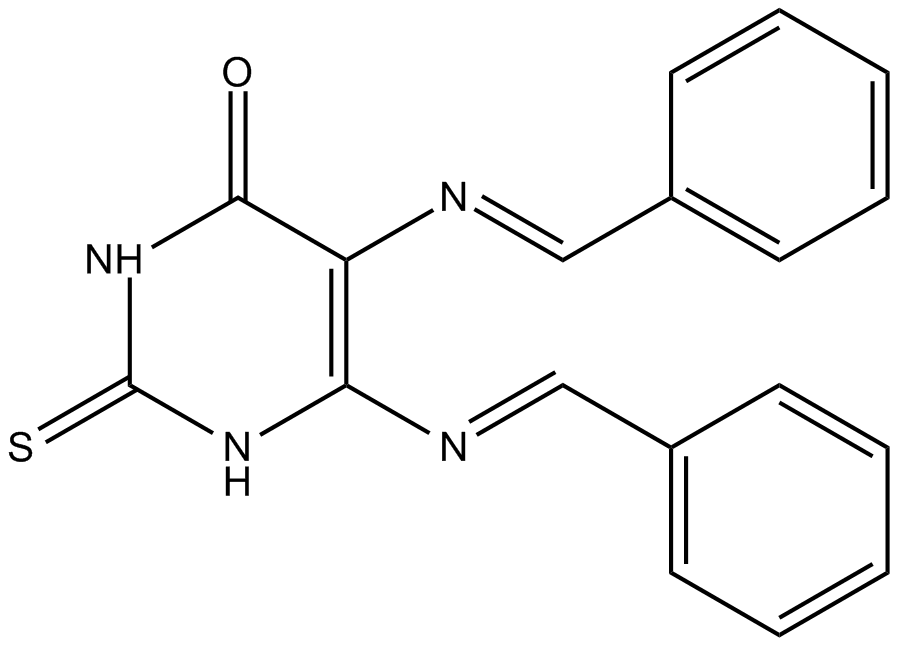
SCR7 |
Catalog No.GC12106
 One-Click Copy Product Info
|

SCR7 es un inhibidor de molécula pequeña de la ligasa IV del ADN,que inhibe la vía de unión final no homóloga (NHEJ) al unirse al dominio de unión al ADN(DBD) de la ligasa IV.
Products are for research use only. Not for human use. We do not sell to patients.
Cas No.: 1533426-72-0
Sample solution is provided at 25 µL, 10mM.
_1-3.$$$39978408@51.jpg');)
_1-9.$$$38538795@65.jpg');)
_1-9.$$$39112701@51.jpg');)
_1-7.$$$37316672@70.jpg');)
_366-372.$$$36198801@70.jpg');)
.$$$38565142@65.jpg');)
_1867-1883.$$$33248023@67.jpg');)
_eads6055.$$$39977546@45.jpg');)
_eadm9805.$$$40080571@45.jpg');)
_eadj3020.$$$39666821@45.jpg');)
_1-20.$$$39757301@28.jpg');)
_1-24.$$$38898113@28.jpg');)
_273-287.$$$36806353@46.jpg');)
_1-16.$$$37156877@44.jpg');)
_1-19.$$$37460805@44.jpg');)
_1291-1307.$$$34518654@46.jpg');)
SCR7 es un inhibidor de molécula pequeña de la ligasa IV del ADN[1] [2],que inhibe la vía de unión final no homóloga (NHEJ) al unirse al dominio de unión al ADN(DBD) de la ligasa IV[3]. SCR7 se utiliza comúnmente en la investigación terapéutica del cáncer[4] y sirve como una herramienta valiosa para mejorar la eficiencia de la edición genómica [5].
SCR7 presenta citotoxicidad dependiente de la concentración y del tiempo en las células DLBCL (SUDHL8)meidante las vías de apoptosis extrínsecas e intrínsecas.En las células SUDHL8,el tratamiento con SCR7 a 100 y 250µM durante 48 y 72 horas aumenta el potencial de la membrana mitocondrial,provoca la translocación de fosfatidilserina a la superficie celular y incrementa la expresión de proteínas de reparación de rupturas de doble cadena y marcadores apoptóticos[6].
El tratamiento con SCR7 (10mg/kg, cada dos días para seis dosis, i.p.) puede potenciar significativamente el efecto de la radiación en los ratones con tumores líquidos de linfoma de Dalton(DLA).La combinación de SCR7 y radiación ionizante (IR) puede reducir notablemente el crecimiento tumoral y mejorar la tasa de supervivencia de los ratones portadores de tumores[7].
References:
[1]. Srivastava M, Nambiar M, Sharma S, et al. An inhibitor of nonhomologous end-joining abrogates double-strand break repair and impedes cancer progression. Cell. 2012 Dec 21;151(7):1474-87. doi: 10.1016/j.cell.2012.11.054.
[2]. Gkotzamanidou M, Terpos E, Bamia C, et al. DNA repair of myeloma plasma cells correlates with clinical outcome: the effect of the nonhomologous end-joining inhibitor SCR7. Blood. 2016 Sep 1;128(9):1214-25. doi: 10.1182/blood-2016-01-691618. Epub 2016 Jul 21. PMID: 27443291; PMCID: PMC5524533.
[3]. Manjunath M, Choudhary B, Raghavan SC. SCR7, a potent cancer therapeutic agent and a biochemical inhibitor of nonhomologous DNA end-joining. Cancer Rep (Hoboken). 2021 Jun;4(3):e1341. doi: 10.1002/cnr2.1341. Epub 2021 Jan 26.
[4]. Vartak SV, Swarup HA, Gopalakrishnan V, et al. Autocyclized and oxidized forms of SCR7 induce cancer cell death by inhibiting nonhomologous DNA end joining in a Ligase IV dependent manner. FEBS J. 2018 Nov;285(21):3959-3976. doi: 10.1111/febs.14661. Epub 2018 Oct 8. PMID: 30230716.
[5]. Hu Z, Shi Z, Guo X, Jiang B, Wang G, Luo D, Chen Y, Zhu YS. Ligase IV inhibitor SCR7 enhances gene editing directed by CRISPR-Cas9 and ssODN in human cancer cells. Cell Biosci. 2018 Feb 19;8:12. doi: 10.1186/s13578-018-0200-z. PMID: 29468011; PMCID: PMC5819182.
[6]. Gopalakrishnan V, Radha G, Raghavan SC, et al. Inhibitor of nonhomologous end joining can inhibit proliferation of diffuse large B-Cell lymphoma cells and potentiate the effect of ionization radiation. J Radiat Cancer Res 2018;9:93-101. DOI: 10.4103/jrcr.jrcr_9_18
[7]. Gopalakrishnan V, Sharma S, Ray U, et al. SCR7, an inhibitor of NHEJ can sensitize tumor cells to ionization radiation. Mol Carcinog. 2021 Sep;60(9):627-643. doi: 10.1002/mc.23329. Epub 2021 Jun 30.
| Experimentos celulares [1]: | |
Líneas celulares | A549 |
Método de preparación | Las células A549 se trataron con una concentración creciente de SCR7(10, 50, 100, y 250µM) durante 48h.La proliferación celular fue evaluada pposteriormente mediante un ensayo MTT.El medio se cambió entonces por una solución de MTT (0.5mg/ml) en DMEM o RPMI sin fenol rojo ni FBS;las células se incubaron a 37°C durante 30 minutos y el precipitado cioleta se disolvió con isopropanol.La absorbancia a 550 nm se medía mediante un lector de placas. |
Condiciones de reacción | 10, 50, 100, y 250µM,48h |
Áreas de aplicación | SCR7 puede inducir citotoxicidad en las células A549. |
| Experimentos con animales [1]: | |
Modelos animales | Las ratones BALB/c portadores de tumores EAC |
Método de preparación | Los ratones con tumores de EAC fueron tratados con SCR7 (10mg/kg,seis dosis). Ki67 (un marcador de proliferación celular), p21 (regulador del ciclo celular) y marcadores apoptóticos como la BID y la Capasa 3 fueron medidos en las secciones tratadas mediante inmunohistoquímica. |
Forma de dosificación | 10mg/kg, cada dos días para seis dosis, i.p. |
Áreas de aplicación | La acumulación de DSBs tras el tratamiento con SCR7 activa la vía intrínseca de apoptosis mediada por p53 en los ratones BALB/c . |
References: | |
| Cas No. | 1533426-72-0 | SDF | |
| Chemical Name | 5,6-bis((E)-benzylideneamino)-2-thioxo-2,3-dihydropyrimidin-4(1H)-one | ||
| Canonical SMILES | S=C(NC(/N=C/C1=CC=CC=C1)=C2/N=C/C3=CC=CC=C3)NC2=O | ||
| Formula | C18H14N4OS | M.Wt | 334.39 |
| Solubility | ≥ 16.7195mg/mL in DMSO | Storage | Store at -20°C |
| General tips | Please select the appropriate solvent to prepare the stock solution according to the
solubility of the product in different solvents; once the solution is prepared, please store it in
separate packages to avoid product failure caused by repeated freezing and thawing.Storage method
and period of the stock solution: When stored at -80°C, please use it within 6 months; when stored
at -20°C, please use it within 1 month. To increase solubility, heat the tube to 37°C and then oscillate in an ultrasonic bath for some time. |
||
| Shipping Condition | Evaluation sample solution: shipped with blue ice. All other sizes available: with RT, or with Blue Ice upon request. | ||
| Prepare stock solution | |||

|
1 mg | 5 mg | 10 mg |
| 1 mM | 2.9905 mL | 14.9526 mL | 29.9052 mL |
| 5 mM | 598.1 μL | 2.9905 mL | 5.981 mL |
| 10 mM | 299.1 μL | 1.4953 mL | 2.9905 mL |
Step 1: Enter information below (Recommended: An additional animal making an allowance for loss during the experiment)
 g
μL
g
μL
Step 2: Enter the in vivo formulation (This is only the calculator, not formulation. Please contact us first if there is no in vivo formulation at the solubility Section.)
Calculation results:
Working concentration: mg/ml;
Method for preparing DMSO master liquid: mg drug pre-dissolved in μL DMSO ( Master liquid concentration mg/mL, Please contact us first if the concentration exceeds the DMSO solubility of the batch of drug. )
Method for preparing in vivo formulation: Take μL DMSO master liquid, next addμL PEG300, mix and clarify, next addμL Tween 80, mix and clarify, next add μL saline, mix and clarify.
Method for preparing in vivo formulation: Take μL DMSO master liquid, next add μL Corn oil, mix and clarify.
Note: 1. Please make sure the liquid is clear before adding the next solvent.
2. Be sure to add the solvent(s) in order. You must ensure that the solution obtained, in the previous addition, is a clear solution before proceeding to add the next solvent. Physical methods such as vortex, ultrasound or hot water bath can be used to aid dissolving.
3. All of the above co-solvents are available for purchase on the GlpBio website.
Quality Control & SDS
- View current batch:
- Purity: >97.50% Appearance: A solid
- COA (Certificate of Analysis)
- SDS (Safety Data Sheet)
- Datasheet
Average Rating: 5 (Based on Reviews and 9 reference(s) in Google Scholar.)