

TAK-778 |
Catalog No.GC34175
 One-Click Copy Product Info
|

TAK-778 es un derivado de la ipriflavona y se ha demostrado que induce el crecimiento Óseo en modelos in vitro e in vivo.
Products are for research use only. Not for human use. We do not sell to patients.
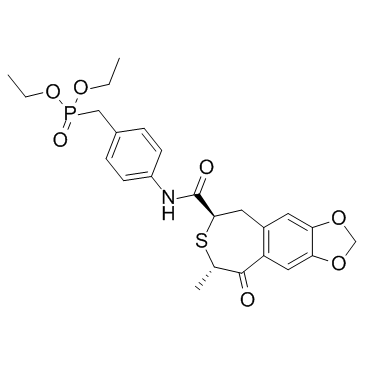
Cas No.: 180185-61-9
Sample solution is provided at 25 µL, 10mM.
_1-3.$$$39978408@51.jpg');)
_1-9.$$$38538795@65.jpg');)
_1-9.$$$39112701@51.jpg');)
_1-7.$$$37316672@70.jpg');)
_366-372.$$$36198801@70.jpg');)
.$$$38565142@65.jpg');)
_1867-1883.$$$33248023@67.jpg');)
_eads6055.$$$39977546@45.jpg');)
_eadm9805.$$$40080571@45.jpg');)
_eadj3020.$$$39666821@45.jpg');)
_1-20.$$$39757301@28.jpg');)
_1-24.$$$38898113@28.jpg');)
_273-287.$$$36806353@46.jpg');)
_1-16.$$$37156877@44.jpg');)
_1-19.$$$37460805@44.jpg');)
_1291-1307.$$$34518654@46.jpg');)
TAK-778 is a derivative of ipriflavone and has been shown to induce bone growth in in vitro and in vivo models.
TAK-778 is a derivative of ipriflavone and has been shown to induce bone growth in in vitro and in vivo models.Continuous treatment with TAK-778 (10 μM) for 1 to 21 days results in an increase in the area of mineralized nodules. TAK-778 at concentrations of 1 μM and higher significantly stimulates the activity of cellular Alkaline phosphatase (ALP). TAK-778 increases slightly but significantly the DNA content of the cells at the confluence stage. Treatment with TAK-778 also results in dose-dependent increases in the amount of soluble collagen and osteocalcin secreted into culture medium from days 5 to 7. TAK-778 enhances the secretion of both TGF-β and IGF-I at every time point during the 21 days of culture. Treatment of the cells with TAK-778 does not induce ALP activity, but does result in a dose-dependent increase in the saturated cell density. TAK-778 at a concentration of 10 μM significantly reduces the saturated cell density[2].
Treatment with a single local application of TAK-778/PLGA-MC (0.2 to 5 mg/site) results in a dose-dependent increase in the radio-opaque area formed in the defect. Histological studies show the defect area is occupied by a bony bridge and the newly-formed radio-opaque area corresponds to a calcified bone containing bone marrow cavities surrounded by thick osteoid seams with cuboidal osteoblasts. There is no significant difference in either of the indices between placebo- or TAK-778/PLGA-MC-treated skulls. Two months after the operation, the TAK-778/PLGA-MC pellets induce radiological osseous union across the defects[2]. Oral treatment of OVX rats with TAK-778 causes a more pronounced increase in bone mineral density (BMD) of the lumbar vertebrae compare to vehicle controls[3].
[1]. Rosa AL, et al. TAK-778 enhances osteoblast differentiation of human bone marrow cells via an estrogen-receptor-dependent pathway. J Cell Biochem. 2004 Mar 1;91(4):749-55. [2]. Notoya K, et al. Enhancement of osteogenesis in vitro and in vivo by a novel osteoblast differentiation promoting compound, TAK-778. J Pharmacol Exp Ther. 1999 Sep;290(3):1054-64. [3]. Cai M, et al. TAK-778 induces osteogenesis in ovariectomized rats via an estrogen receptor-dependent pathway. J Bone Miner Metab. 2011 Mar;29(2):168-73.
Cell experiment: | Human bone marrow cells are used and cultured in α-MEM supplemented with 10% fetal bovine serum, 50 mg/mL gentamicin, 0.3 mg/mL fungizone, 100 nM Mdexamethasone, 5 mg/L ascorbic acid, and 7 mM bglycerophosphate. Subconfluent cells in primary culture are harvested after treatment with 1 mM EDTA and 0.25% trypsin and the first passage is subcultured in 24-well culture plates at a cell density of 2×10⁴ cells/well in culture medium containing the same volume of TAK-778 (10 μM), Tamoxifen (10 μM), and TAK-778 (10 μM)+Tamoxifen (10 μM). Cells subcultured in medium supplemented with vehicle are used as a control. During the culture period, cells are incubated at 37°C in a humidified atmosphere of 5% CO2 and 95% air, and the medium is changed every 3 or 4 days[1]. |
Animal experiment: | Eight-week-old female Wistar-Imamichi rats are used in this study. Forty Wistar-Imamichi rats are divided into sham-operated, vehicle, TAK-778, tamoxifen, and combination (TAK-778 and tamoxifen) treatment groups. Two weeks after ovariectomy, animals are orally administered TAK-778 [100 mg/kg body weight (BW), three times per week] and/or tamoxifen (200 mg/kg BW, three times per week) for 3 months. Rats orally administered vehicle and sham operated rats serve as controls. On 13 and 3 days before killing, tetracycline (30 mg/kg BW) or calcein (5 mg/kg BW) is injected subcutaneously, and lumbar vertebrae (L2-L5) are removed for bone analysis[3]. |
References: [1]. Rosa AL, et al. TAK-778 enhances osteoblast differentiation of human bone marrow cells via an estrogen-receptor-dependent pathway. J Cell Biochem. 2004 Mar 1;91(4):749-55. | |
| Cas No. | 180185-61-9 | SDF | |
| Canonical SMILES | O=C(NC1=CC=C(CP(OCC)(OCC)=O)C=C1)[C@@H](C2)S[C@@H](C)C(C3=C2C=C4OCOC4=C3)=O | ||
| Formula | C24H28NO7PS | M.Wt | 505.52 |
| Solubility | Soluble in DMSO | Storage | Store at -20°C |
| General tips | Please select the appropriate solvent to prepare the stock solution according to the
solubility of the product in different solvents; once the solution is prepared, please store it in
separate packages to avoid product failure caused by repeated freezing and thawing.Storage method
and period of the stock solution: When stored at -80°C, please use it within 6 months; when stored
at -20°C, please use it within 1 month. To increase solubility, heat the tube to 37°C and then oscillate in an ultrasonic bath for some time. |
||
| Shipping Condition | Evaluation sample solution: shipped with blue ice. All other sizes available: with RT, or with Blue Ice upon request. | ||
| Prepare stock solution | |||

|
1 mg | 5 mg | 10 mg |
| 1 mM | 1.9782 mL | 9.8908 mL | 19.7816 mL |
| 5 mM | 395.6 μL | 1.9782 mL | 3.9563 mL |
| 10 mM | 197.8 μL | 989.1 μL | 1.9782 mL |
Step 1: Enter information below (Recommended: An additional animal making an allowance for loss during the experiment)
 g
μL
g
μL
Step 2: Enter the in vivo formulation (This is only the calculator, not formulation. Please contact us first if there is no in vivo formulation at the solubility Section.)
Calculation results:
Working concentration: mg/ml;
Method for preparing DMSO master liquid: mg drug pre-dissolved in μL DMSO ( Master liquid concentration mg/mL, Please contact us first if the concentration exceeds the DMSO solubility of the batch of drug. )
Method for preparing in vivo formulation: Take μL DMSO master liquid, next addμL PEG300, mix and clarify, next addμL Tween 80, mix and clarify, next add μL saline, mix and clarify.
Method for preparing in vivo formulation: Take μL DMSO master liquid, next add μL Corn oil, mix and clarify.
Note: 1. Please make sure the liquid is clear before adding the next solvent.
2. Be sure to add the solvent(s) in order. You must ensure that the solution obtained, in the previous addition, is a clear solution before proceeding to add the next solvent. Physical methods such as vortex, ultrasound or hot water bath can be used to aid dissolving.
3. All of the above co-solvents are available for purchase on the GlpBio website.
Quality Control & SDS
- View current batch:
- Purity: >98.00% Appearance: A solid
- COA (Certificate of Analysis)
- SDS (Safety Data Sheet)
- Datasheet
Average Rating: 5 (Based on Reviews and 20 reference(s) in Google Scholar.)