

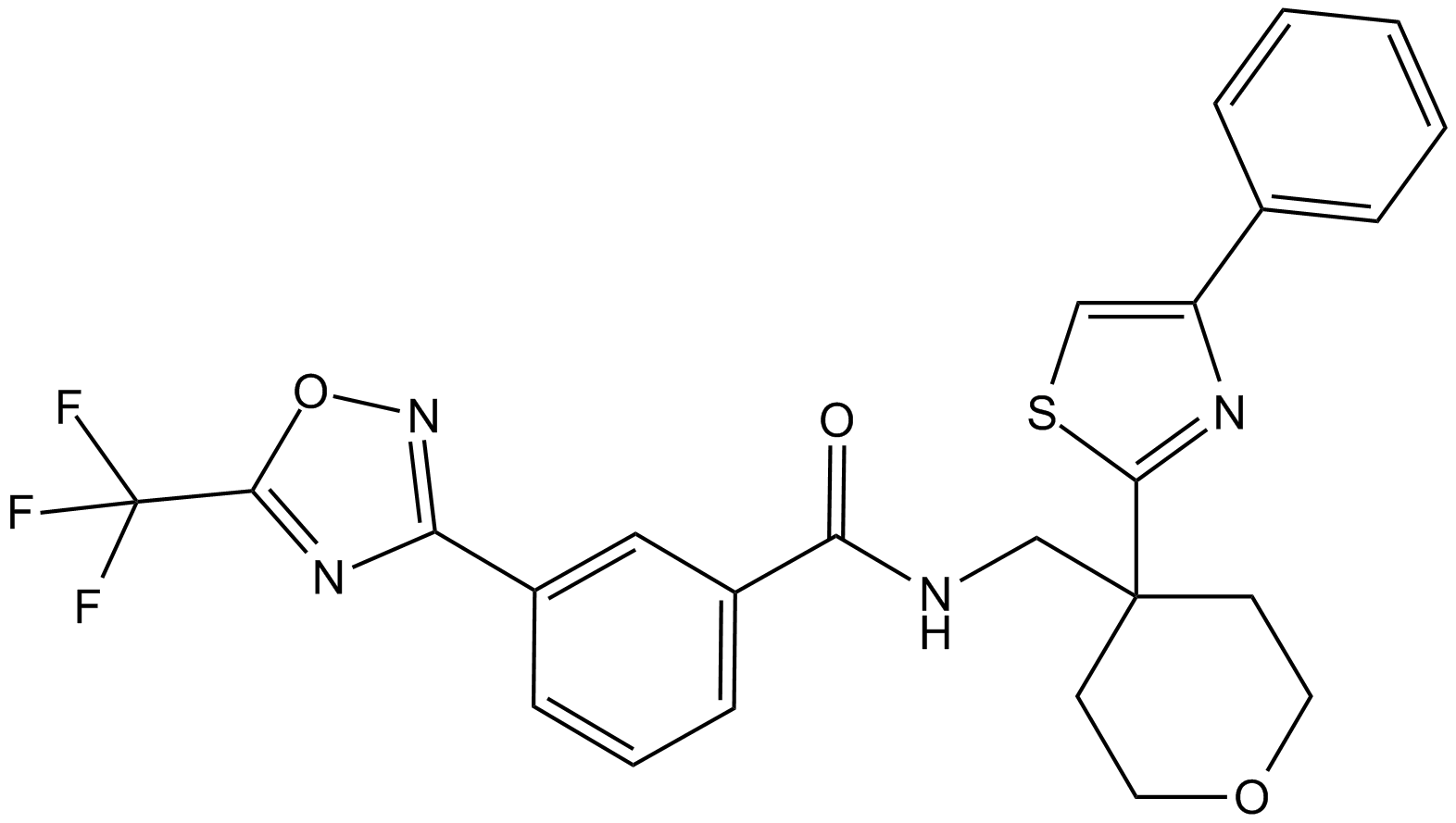
TMP269 (Synonyms: TMP 269;TMP-269) |
Catalog No.GC17703
 One-Click Copy Product Info
|

TMP269 es un nuevo y selectivo inhibidor de histona desacetilasa de clase IIa (HDAC) con IC50 de 157 nM, 97 nM, 43 nM y 23 nM para HDAC4, HDAC5, HDAC7 y HDAC9, respectivamente.
Products are for research use only. Not for human use. We do not sell to patients.
Cas No.: 1314890-29-3
Sample solution is provided at 25 µL, 10mM.
_1-3.$$$39978408@51.jpg');)
_1-9.$$$38538795@65.jpg');)
_1-9.$$$39112701@51.jpg');)
_1-7.$$$37316672@70.jpg');)
_366-372.$$$36198801@70.jpg');)
.$$$38565142@65.jpg');)
_1867-1883.$$$33248023@67.jpg');)
_eads6055.$$$39977546@45.jpg');)
_eadm9805.$$$40080571@45.jpg');)
_eadj3020.$$$39666821@45.jpg');)
_1-20.$$$39757301@28.jpg');)
_1-24.$$$38898113@28.jpg');)
_273-287.$$$36806353@46.jpg');)
_1-16.$$$37156877@44.jpg');)
_1-19.$$$37460805@44.jpg');)
_1291-1307.$$$34518654@46.jpg');)
TMP269 is a potent and selective inhibitor of Histone deacetylase (HDAC) with IC50 values of 157nM, 97nM, 43nM, 23nM for HDAC 4, 5, 7, 9, respectively[1]. TMP269 upregulates the expression of the neurotrophic factor BMP2 and the BMP-Smad transcriptional signaling pathway, thereby preventing neuronal degeneration and improving neurological function[2]. TMP269 suppresses Lumpy skin disease virus (LSDV) replication by regulating the host's lysophosphatidic acid metabolism and blocking the activation of the MEK/ERK signaling pathway[3]. TMP269 has been widely used in preclinical models to improve rehabilitation after ischemic stroke[4].
In vitro, TMP269 treatment for 72 hours significantly induced cell death in THP-1 cells, with an IC50 value of 13μM, accompanied by activation of Caspase 3/7[5]. Treatment with 12.5μM TMP269 for 48 hours inhibited the growth of MOLM-13 cells, downregulated the expression of ribosomal proteins, and promoted cell apoptosis[6]. Incubation with 50μM TMP269 for 48 hours increased the expression of FOXO3a and induced G1/S phase arrest in AsPC-1 cells[7].
In vivo, TMP269 treatment via intraperitoneal injection at a dose of 23mg/kg/day for 10 days improved the depressive-like behaviors, alleviated the stress-induced changes in hippocampal synaptic plasticity, and increased the expression of hippocampal synaptic proteins in learned helplessness mice[8]. Intraperitoneal injection of TMP269 (50mg/kg/day) for 2 days improved the renal function of the kidney injury mouse model and alleviated the pathological changes in the kidneys[9].
References:[1] Lobera M, Madauss K P, Pohlhaus D T, et al. Selective class IIa histone deacetylase inhibition via a nonchelating zinc-binding group[J]. Nature chemical biology, 2013, 9(5): 319-325.
[2] O'Mahony A G, Mazzocchi M, Morris A, et al. The class-IIa HDAC inhibitor TMP269 promotes BMP-Smad signalling and is neuroprotective in in vitro and in vivo 6-hydroxydopamine models of Parkinson's disease[J]. Neuropharmacology, 2025, 268: 110319.
[3] Cheng P, Wang X, Wang S, et al. Class IIa histone deacetylase (HDAC) inhibitor TMP269 suppresses lumpy skin disease virus replication by regulating host lysophosphatidic acid metabolism[J]. Journal of Virology, 2025, 99(2): e01827-24.
[4] Jiang Q, Ding Y, Li F, et al. Inhibition of class IIa HDACs reduces neuroinflammation via NEU1-LAMP1 regulation and promotes M2 macrophage polarization in ischemic stroke[J]. Brain Research, 2025, 1864: 149806.
[5] Asfaha Y, Bollmann L M, Skerhut A J, et al. 5-(Trifluoromethyl)-1, 2, 4-oxadiazole (TFMO)-based highly selective class IIa HDAC inhibitors exhibit synergistic anticancer activity in combination with bortezomib[J]. European Journal of Medicinal Chemistry, 2024, 263: 115907.
[6] Urwanisch L, Unger M S, Sieberer H, et al. The class IIA histone deacetylase (HDAC) inhibitor TMP269 downregulates ribosomal proteins and has anti-proliferative and pro-apoptotic effects on AML cells[J]. Cancers, 2023, 15(4): 1039.
[7] Usami M, Kikuchi S, Takada K, et al. FOXO3a activation by HDAC class IIa inhibition induces cell cycle arrest in pancreatic cancer cells[J]. Pancreas, 2020, 49(1): 135-142.
[8] Meng Y, Xiao L, Liu R, et al. Antidepressant effect and mechanism of TMP269 on stress-induced depressive-like behavior in mice[J]. Biochemical Pharmacology, 2024, 225: 116320.
[9] Li J, Yu C, Shen F, et al. Class IIa histone deacetylase inhibition ameliorates acute kidney injury by suppressing renal tubular cell apoptosis and enhancing autophagy and proliferation[J]. Frontiers in Pharmacology, 2022, 13: 946192.
| Cell experiment [1]: | |
|
Cell lines |
THP-1 cells |
|
Preparation Method |
THP-1 cells were cultivated in RPMI 1640 medium supplemented with 10% fetal bovine serum, 120IU/ml penicillin and 120μg/ml streptomycin at 37°C in an incubator with 5% CO2. THP-1 cells were plated in 96-well plates at 5000 cells/well for 24h, and were treated with different concentrations of TMP269 (0, 0.1, 1, 10, and 100μM) for 72h. Cell proliferation was measured. |
|
Reaction Conditions |
0, 0.1, 1, 10, and 100μM; 72h |
|
Applications |
TMP269 treatment reduced the cell proliferation of THP-1 cells in a dose-dependent manner. |
| Animal experiment [2]: | |
|
Animal models |
Male C57/BL mice |
|
Preparation Method |
Male C57/BL mice (8 weeks old; 20-25g) were housed in a specific pathogen-free (SPF) barrier environment and were continuously provided with sterilized food, water, and bedding. To establish folic acid-induced acute kidney injury (AKI), a single dose of folic acid (dissolved in 0.3M NaHCO3) at 200mg/kg was intraperitoneally administered. Control mice were injected with an equal volume of 0.3M NaHCO3. TMP269 at 50mg/kg/day was intraperitoneally administered immediately after folic acid injection for 2 days. At the end of experiments, mice were sacrificed by injecting an overdose of phenobarbital (100mg/kg) and kidneys were collected for analysis. |
|
Dosage form |
50mg/kg/day; 2 days; i.p. |
|
Applications |
TMP269 treatment attenuated renal tubule injury and inhibited renal tubular cell apoptosis in murine models of folic acid-induced AKI. |
| References: [1] Asfaha Y, Bollmann L M, Skerhut A J, et al. 5-(Trifluoromethyl)-1, 2, 4-oxadiazole (TFMO)-based highly selective class IIa HDAC inhibitors exhibit synergistic anticancer activity in combination with bortezomib[J]. European Journal of Medicinal Chemistry, 2024, 263: 115907. [2] Li J, Yu C, Shen F, et al. Class IIa histone deacetylase inhibition ameliorates acute kidney injury by suppressing renal tubular cell apoptosis and enhancing autophagy and proliferation[J]. Frontiers in Pharmacology, 2022, 13: 946192. | |
| Cas No. | 1314890-29-3 | SDF | |
| Sinónimos | TMP 269;TMP-269 | ||
| Chemical Name | (Z)-N-((4-(4-phenylthiazol-2-yl)tetrahydro-2H-pyran-4-yl)methyl)-3-(5-(trifluoromethyl)-1,2,4-oxadiazol-3-yl)benzimidic acid | ||
| Canonical SMILES | FC(F)(F)C1=NC(C2=CC(/C(O)=N/CC3(C4=NC(C5=CC=CC=C5)=CS4)CCOCC3)=CC=C2)=NO1 | ||
| Formula | C25H21F3N4O3S | M.Wt | 514.52 |
| Solubility | ≥ 23mg/mL in DMSO | Storage | Store at -20°C |
| General tips | Please select the appropriate solvent to prepare the stock solution according to the
solubility of the product in different solvents; once the solution is prepared, please store it in
separate packages to avoid product failure caused by repeated freezing and thawing.Storage method
and period of the stock solution: When stored at -80°C, please use it within 6 months; when stored
at -20°C, please use it within 1 month. To increase solubility, heat the tube to 37°C and then oscillate in an ultrasonic bath for some time. |
||
| Shipping Condition | Evaluation sample solution: shipped with blue ice. All other sizes available: with RT, or with Blue Ice upon request. | ||
| Prepare stock solution | |||

|
1 mg | 5 mg | 10 mg |
| 1 mM | 1.9436 mL | 9.7178 mL | 19.4356 mL |
| 5 mM | 388.7 μL | 1.9436 mL | 3.8871 mL |
| 10 mM | 194.4 μL | 971.8 μL | 1.9436 mL |
Step 1: Enter information below (Recommended: An additional animal making an allowance for loss during the experiment)
 g
μL
g
μL
Step 2: Enter the in vivo formulation (This is only the calculator, not formulation. Please contact us first if there is no in vivo formulation at the solubility Section.)
Calculation results:
Working concentration: mg/ml;
Method for preparing DMSO master liquid: mg drug pre-dissolved in μL DMSO ( Master liquid concentration mg/mL, Please contact us first if the concentration exceeds the DMSO solubility of the batch of drug. )
Method for preparing in vivo formulation: Take μL DMSO master liquid, next addμL PEG300, mix and clarify, next addμL Tween 80, mix and clarify, next add μL saline, mix and clarify.
Method for preparing in vivo formulation: Take μL DMSO master liquid, next add μL Corn oil, mix and clarify.
Note: 1. Please make sure the liquid is clear before adding the next solvent.
2. Be sure to add the solvent(s) in order. You must ensure that the solution obtained, in the previous addition, is a clear solution before proceeding to add the next solvent. Physical methods such as vortex, ultrasound or hot water bath can be used to aid dissolving.
3. All of the above co-solvents are available for purchase on the GlpBio website.
Quality Control & SDS
- View current batch:
- Purity: >98.00% Appearance: A solid
- COA (Certificate of Analysis)
- SDS (Safety Data Sheet)
- Datasheet
Average Rating: 5 (Based on Reviews and 16 reference(s) in Google Scholar.)