

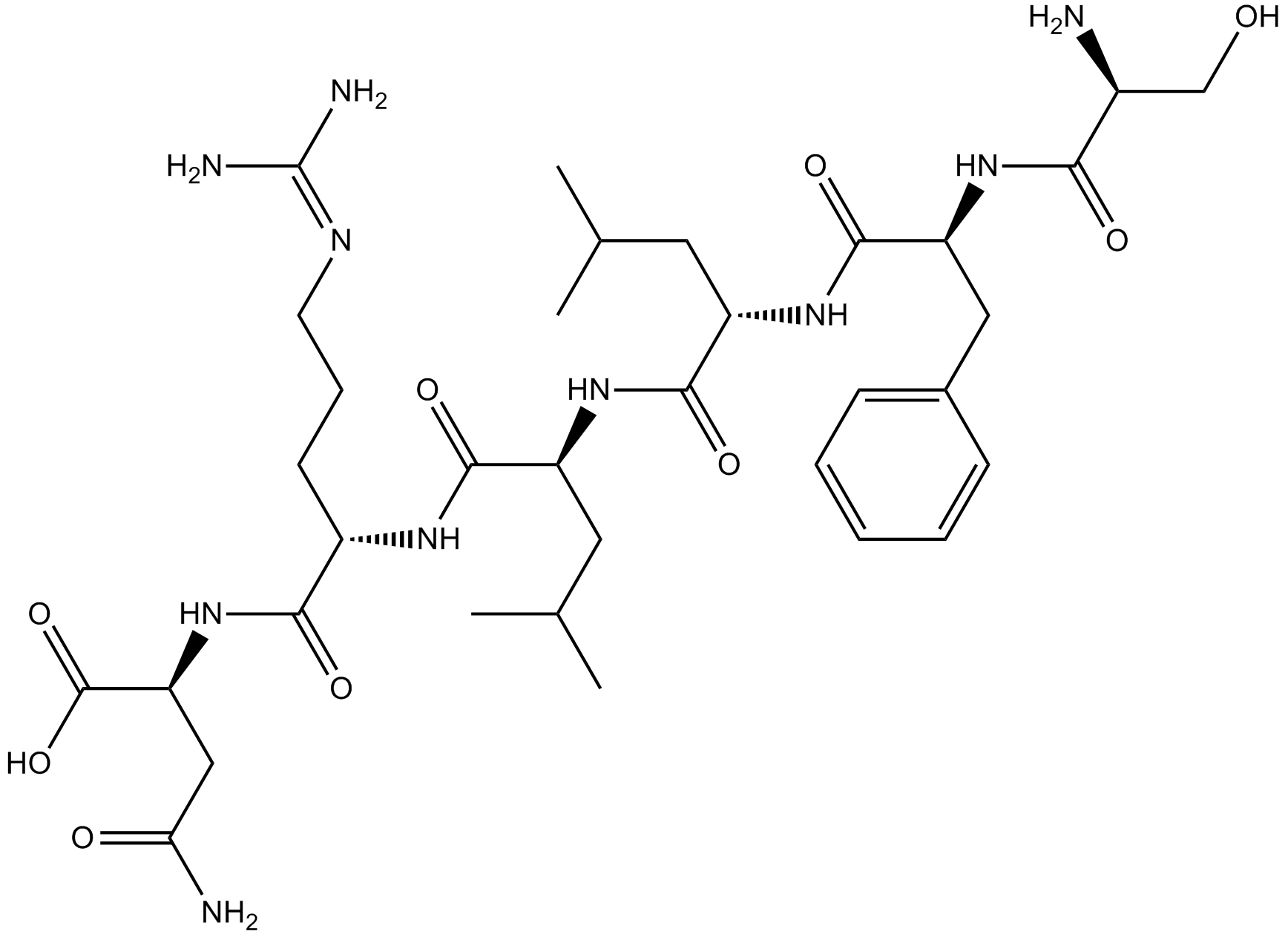
TRAP-6 (Synonyms: PAR-1 agonist peptide; Thrombin Receptor Activator Peptide 6) |
Catalog No.GC11662
 One-Click Copy Product Info
|

TRAP-6 es un agonista selectivo del receptor activado por proteasas 1 (PAR1) compuesto por seis aminoácidos.
Products are for research use only. Not for human use. We do not sell to patients.
Cas No.: 141136-83-6
Sample solution is provided at 25 µL, 10mM.
_1-3.$$$39978408@51.jpg');)
_1-9.$$$38538795@65.jpg');)
_1-9.$$$39112701@51.jpg');)
_1-7.$$$37316672@70.jpg');)
_366-372.$$$36198801@70.jpg');)
.$$$38565142@65.jpg');)
_1867-1883.$$$33248023@67.jpg');)
_eads6055.$$$39977546@45.jpg');)
_eadm9805.$$$40080571@45.jpg');)
_eadj3020.$$$39666821@45.jpg');)
_1-20.$$$39757301@28.jpg');)
_1-24.$$$38898113@28.jpg');)
_273-287.$$$36806353@46.jpg');)
_1-16.$$$37156877@44.jpg');)
_1-19.$$$37460805@44.jpg');)
_1291-1307.$$$34518654@46.jpg');)
TRAP-6 es un agonista selectivo del receptor activado por proteasas 1 (PAR1) compuesto por seis aminoácidos. Presenta la arquitectura general sencilla y compacta, existiendo como un péptido lineal y flexible. Esta flexibilidad estructural facilita los cambios estructurales al ligar el receptor, lo que conlleva a la señalización intracelular posterior [1]. TRAP-6 se emplea habitualmente en estudios sobre la función plaquetaria, los mecanismos de coagulación y las enfermedades cardiovasculares[2,3].
In vitro, el tratamiento con TRAP-6 (100, 200μM) durante 24h indujo la proliferación de células microgliales de ratón silvestre[4]. En células estromales deciduales (DSCs), el tratamiento con TRAP-6 (100μM) durante 8 aumentó la expresión de mRNA de IL-8, MCP-1 y MMP-1[5]. El pretratamiento de plaquetas lavadas humanas con el inhibidor de P2Y12 MRS2395 (10μM) durante 15min, seguido de estimulación con TRAP-6 (10μM) durante 30s, potenció la liberación de granulos densos inducida por TRAP-6, elevó los niveles citosólicos de Ca2+ y promovió la fosofrilación de GSK3β-Ser9[6].
In vivo, la inyección intraperitoneal de TRAP-6 (10mg/kg; tres veces por semana) durante 3 semanas en un modelo murino de enfermedad aguda C57BL/6→BALB/c injerto-contra-huésped (GvHD) redujo las puntuaciones clínicas de GvHD, mejoró la supervivencia y atenuó las lesiones histopatlógicas en colon y hígado[7]. La aplicación tópica de TRAP-6 (2mM; 30μL) en heridas cutáneas de ratas anestesiadas con pentobarbital activó los mastocitos del tejido adiposo subtáneo al cabo sde 3 días, provocando una reducción de 5.4 veces en el contenido de heparina de mastocitos y un aumento marcado en los índices de desgranulación y granulólisis[8].
References:
[1] ANDERLUH M, DOLENC M. Thrombin receptor antagonists, recent advances in PAR-1 antagonist development[J]. Current Medicinal Chemistry, 2002, 9(13): 1229-1250.
[2] WEBER M, GERDSEN F, GUTENSOHN K, et al. Enhanced platelet aggregation with TRAP-6 and collagen in platelet aggregometry in patients with venous thromboembolism[J]. Thrombosis Research, 2002, 107(6): 325-328.
[3] MÉNDEZ D, URRA F A, MILLAS-VARGAS J P, et al. Synthesis of antiplatelet ortho-carbonyl hydroquinones with differential action on platelet aggregation stimulated by collagen or TRAP-6[J]. European Journal of Medicinal Chemistry, 2020, 192: 112187.
[4] SUO Z, WU M, AMEENUDDIN S, et al. Participation of protease-activated receptor-1 in thrombin-induced microglial activation[J]. Journal of Neurochemistry, 2002, 80(4): 655-666.
[5] GOTO K, KAWANO Y, UTSUNAMIYA T, et al. Decidualization modulates a signal transduction system via protease-activated receptor-1 in endometrial stromal cells[J]. American Journal of Reproductive Immunology, 2018, 80(5): e13036.
[6] MITRUGNO A, RIGG R A, LASCHOBER N B, et al. Potentiation of TRAP-6-induced platelet dense granule release by blockade of P2Y12T activating GPR15[J]. Leukemia, 2024, 38(6): 1390-1402.
[8] UMAROVA B A, DUGINA T N, SHESTAKOVA E V, et al. Activation of rat mast cells upon stimulation of protease-activated receptor (PAR-1)[J]. Bulletin of Experimental Biology and Medicine, 2000, 129(4): 314-317.
| Experimentos celulares [1]: | |
Líneas celulares | DSCs (células estromales descidualizadas) |
Método de preparación | Los DSCs cultivados se estimularon con TRAP-6 de 100μM durante 8 horas. El RNA total se extrajo de las células y se sometió a PCR en tiempo real para determinar los niveles de IL-8, MCP-1 y MMP-1 mRNA. |
Condiciones de reacción | 100μM; 8h |
Áreas de aplicación | El tratamiento de DSCs con TRAP-6 (100μM) durante 8h indujo la expresión de mRNA de IL-8, MCP-1 y MMP-1. |
| Experimentos con animales [2]: | |
Modelos animales | Modelos de GvHD agudos de alotrasplante murino(C57BL/6→BALB/c) |
Método de preparación | Para el modelo C57BL/6 →BALB/c, los receptores de BALB/c irradiados se infundieron con 5 × 10⁶ células de médula ósea agotadas de células T (TCD-BM) y 1 × 10⁶ células T del donante WT C57BL/6. Los ratones receptores fueron inyectados por vía intraperitoneal con TRAP-6 tres veces por semana durante 3 semanas después del trasplante. La supervivencia y las puntuaciones agudas de GvHD se controlaron continuamente. Los tejidos del colon y del hígado se obtuvieron de los receptores el día 21 después del trasplante. La tinción H&E y el análisis histológico se realizaron para evaluar las careacterísticas agudas de GvHD en el colon y el hígado. |
Forma de dosificación | 10mg/kg; tres veces/semana; 3 semanas; i.p. |
Áreas de aplicación | 10mg/kg TRAP-6 disminuyó las puntuaciones agudas de GvHD y aumentó la supervivencia de los ratones receptores. El análisis histológico mostró que TRAP-6 disminuyó las características agudas de GvHD en los tejidos del colon y el hígado. |
References: | |
| Cas No. | 141136-83-6 | SDF | |
| Sinónimos | PAR-1 agonist peptide; Thrombin Receptor Activator Peptide 6 | ||
| Chemical Name | (2S)-4-amino-2-[[(2S)-2-[[(2S)-2-[[(2S)-2-[[(2S)-2-[[(2S)-2-amino-3-hydroxypropanoyl]amino]-3-phenylpropanoyl]amino]-4-methylpentanoyl]amino]-4-methylpentanoyl]amino]-5-(diaminomethylideneamino)pentanoyl]amino]-4-oxobutanoic acid | ||
| Canonical SMILES | CC(C)CC(C(=O)NC(CC(C)C)C(=O)NC(CCCN=C(N)N)C(=O)NC(CC(=O)N)C(=O)O)NC(=O)C(CC1=CC=CC=C1)NC(=O)C(CO)N | ||
| Formula | C34H56N10O9 | M.Wt | 748.88 |
| Solubility | Soluble to 1 mg/ml in sterile water | Storage | Desiccate at -20°C |
| General tips | Please select the appropriate solvent to prepare the stock solution according to the
solubility of the product in different solvents; once the solution is prepared, please store it in
separate packages to avoid product failure caused by repeated freezing and thawing.Storage method
and period of the stock solution: When stored at -80°C, please use it within 6 months; when stored
at -20°C, please use it within 1 month. To increase solubility, heat the tube to 37°C and then oscillate in an ultrasonic bath for some time. |
||
| Shipping Condition | Evaluation sample solution: shipped with blue ice. All other sizes available: with RT, or with Blue Ice upon request. | ||
| Prepare stock solution | |||

|
1 mg | 5 mg | 10 mg |
| 1 mM | 1.3353 mL | 6.6766 mL | 13.3533 mL |
| 5 mM | 267.1 μL | 1.3353 mL | 2.6707 mL |
| 10 mM | 133.5 μL | 667.7 μL | 1.3353 mL |
Step 1: Enter information below (Recommended: An additional animal making an allowance for loss during the experiment)
 g
μL
g
μL
Step 2: Enter the in vivo formulation (This is only the calculator, not formulation. Please contact us first if there is no in vivo formulation at the solubility Section.)
Calculation results:
Working concentration: mg/ml;
Method for preparing DMSO master liquid: mg drug pre-dissolved in μL DMSO ( Master liquid concentration mg/mL, Please contact us first if the concentration exceeds the DMSO solubility of the batch of drug. )
Method for preparing in vivo formulation: Take μL DMSO master liquid, next addμL PEG300, mix and clarify, next addμL Tween 80, mix and clarify, next add μL saline, mix and clarify.
Method for preparing in vivo formulation: Take μL DMSO master liquid, next add μL Corn oil, mix and clarify.
Note: 1. Please make sure the liquid is clear before adding the next solvent.
2. Be sure to add the solvent(s) in order. You must ensure that the solution obtained, in the previous addition, is a clear solution before proceeding to add the next solvent. Physical methods such as vortex, ultrasound or hot water bath can be used to aid dissolving.
3. All of the above co-solvents are available for purchase on the GlpBio website.
Quality Control & SDS
- View current batch:
- Purity: >99.50% Appearance: A solid
- COA (Certificate of Analysis)
- SDS (Safety Data Sheet)
- Datasheet
Average Rating: 5 (Based on Reviews and 11 reference(s) in Google Scholar.)