

Trichostatin A (TSA) (Synonyms: TSA) |
Catalog No.GC15526
 One-Click Copy Product Info
|

Trichostatin A (TSA) es un potente inhibidor de la histona desacetilasa (HDAC) y un antibiótico antifúngico con un valor IC50 de 1,8 nM para HDAC,que tiene las propiedades de inhibir el crecimiento celular e inducir la diferenciación celular.
Products are for research use only. Not for human use. We do not sell to patients.
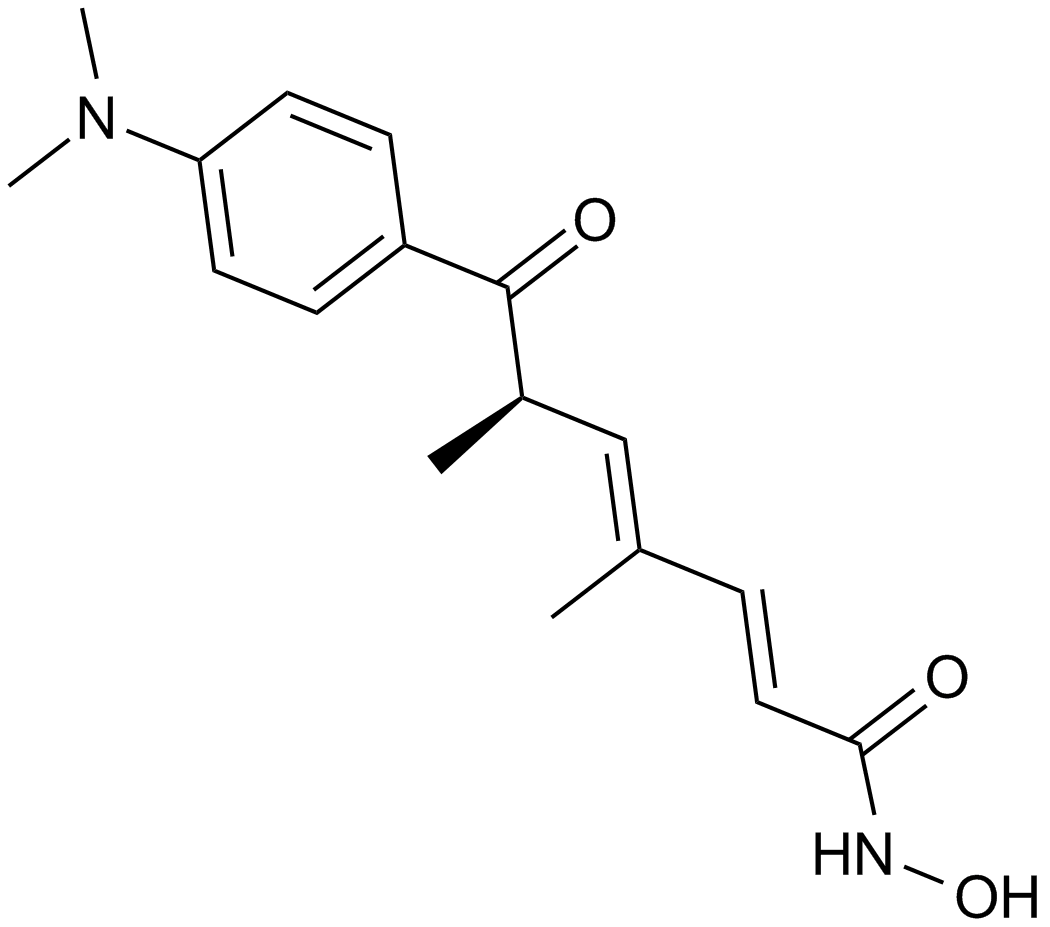
Cas No.: 58880-19-6
Sample solution is provided at 25 µL, 10mM.
Trichostatin A (TSA) es un potente inhibidor de la histona desacetilasa (HDAC) y un antibiótico antifúngico con un valor IC50 de 1,8 nM para HDAC[1],que tiene las propiedades de inhibir el crecimiento celular e inducir la diferenciación celular.
Trichostatin A (TSA) puede detener las células en las fases G1 y G2,inducir la diferenciación celular y restaurar la morfología transformada de las células cultivadas.Trichostatin A (TSA) inhibe la proliferación de las células de cáncer de mama en líneas celulares de cáncer de mama humano y dio lugar a la hiperacetilación de la histona H4[1]. Trichostatin A (TSA) promueve la apoptosis y el daño del ADN inducido por radiación en las células metóticas G2 gap 2 (G2/M) detenidas.Trichostatin A (TSA) puede `participar directamente en el daño del ADN en las células de cáncer de esófago al reducir la acetilación de la proteína genómica H3 asociada al crecimiento[2].El pretratamiento de las células RLE-6TN con Trichostatin A (TSA) inhibió las alterciones morfológicas similares a la EMT inducidas por la radiación,inducido el nivel elevado de proteínas de α-SMA y Snail,la reducción de la expresión de E-cadherina,la fosforilación mejorada de GSK3β y ERK1/2, el aumento de la generación de ROS[3].Las capacidades invasivas y migratorias de las células MCF-7 se suprimieron significativamente tras el tratamiento con Trichostatin A (TSA).El tratamiento con Trichostatin A (TSA) condujo a un aumento del nivel de expresión de E-cadherina y una disminución de la expresión de vimentina y,en las células MCF-7[4]. Trichostatin A (TSA) mejoró la radiosensibilidad de las células de cáncer de colon,la muerte celular apoptótica inducida por la radiación mejoró con el tratamiento conTrichostatin A (TSA).Trichostatin A (TSA) también indujo una respuesta autofágica en las células de cáncer de colo,mientras que la inhibición de la autofagia condujo a la apoptosis celular y mejoró la radiosensibilidad de las células de cáncer de colon5].
Trichostatin A (TSA) tuvo una actividad antitumoral pronunciada en el cuerpo cuando se administró a 16 animales a una dosis de 500 microg/kg mediante inyección diaria durante 4 semanas en comparación con 14 animales de control.Además,Trichostatin A (TSA) no causó ninguna toxicidad medible en dosis de hasta 5 mg/kg por inyección.Trichostatin A (TSA) tiene una actividad antitumoral significativa en el cuerpo la activida antitumoral de Trichostatin A (TSA) se atribuye a la inducción de la diferenciación[1].En embriones SCNT porcinos,la quetocina,Trichostatin A (TSA) y la combinación aumentaron significativamente pa tasa de escisión y formación de blastocistos,la tasa de blastocistos de eclosión/eclosión y el número de células y la tasa de supervivencia.El tratamiento combinado mejoró la tasa de desarrollo de blastocistos más que la quetocina o Trichostatin A (TSA) solas[6].Estas disminución de la emocionalidad observada en los ratones desadaptados al esttrés se recuperó significativamente mediante el tratamiento crónico con Trichostatin A (TSA) 2 h antes de la exposición diaria al estrés de restricción,lo que confirmó el desarrollo de la adaptación al estréa.El inhibidor de HDAC Trichostatin A (TSA) puede tener un efecto beneficioso sobre la adaptación al estrés al afectar la función neuronal de 5-HT en el cerebro y aliviar la anormalidad emocional en condiciones de estrés excesivo[7].
References:
[1]: Vigushin DM, Ali S, et,al. Trichostatin A is a histone deacetylase inhibitor with potent antitumor activity against breast cancer in vivo. Clin Cancer Res. 2001 Apr;7(4):971-6. PMID: 11309348.
[2]: Wang S, Song M, et,al. Trichostatin A enhances radiosensitivity and radiation-induced DNA damage of esophageal cancer cells. J Gastrointest Oncol. 2021 Oct;12(5):1985-1995. doi: 10.21037/jgo-21-560. PMID: 34790366; PMCID: PMC8576220.
[3]: Nagarajan D, Wang L, et,al. Trichostatin A inhibits radiation-induced epithelial-to-mesenchymal transition in the alveolar epithelial cells. Oncotarget. 2017 Oct 9;8(60):101745-101759. doi: 10.18632/oncotarget.21664. PMID: 29254201; PMCID: PMC5731911.
[4]: Wang X, Chen S, et,al. Trichostatin A reverses epithelial-mesenchymal transition and attenuates invasion and migration in MCF-7 breast cancer cells. Exp Ther Med. 2020 Mar;19(3):1687-1694. doi: 10.3892/etm.2020.8422. Epub 2020 Jan 3. PMID: 32104221; PMCID: PMC7027139.
[5]: He G, Wang Y, et,al. Inhibition of autophagy induced by TSA sensitizes colon cancer cell to radiation. Tumour Biol. 2014 Feb;35(2):1003-11. doi: 10.1007/s13277-013-1134-z. PMID: 24122231.
[6]: Jeong PS, Yang HJ, et,al. Combined Chaetocin/Trichostatin A Treatment Improves the Epigenetic Modification and Developmental Competence of Porcine Somatic Cell Nuclear Transfer Embryos. Front Cell Dev Biol. 2021 Oct 6;9:709574. doi: 10.3389/fcell.2021.709574. PMID: 34692674; PMCID: PMC8526721.
[7]: Kimijima H, Miyagawa K, et,al. Trichostatin A, a histone deacetylase inhibitor, alleviates the emotional abnormality induced by maladaptation to stress in mice. Neurosci Lett. 2022 Jan 1;766:136340. doi: 10.1016/j.neulet.2021.136340. Epub 2021 Nov 10. PMID: 34774702.
| Experimentos celulares [1]: | |
Líneas celulares | Línea celular de cáncer de mama humano |
Método de preparación | Se agregó Trichostatin A (TSA) al medio de cultivo celular. |
Condiciones de reacción | 10 µM of Trichostatin A (TSA) durante 96 h |
Áreas de aplicación | Trichostatin A (TSA) inhibió la proliferación de 8 líneas celulares de cáncer de mama, con una valor promedio de IC50 de 124.4±120.4 nM. El tratamiento con Trichostatin A (TSA) resultó en una hiperacetilación significativa de la histona H4. |
| Experimentos con animales [2]: | |
Modelos animales | Xenoinjertos tumorales inducidos por NMU de las ratas vírgenes hembras endogámicas (Ludwig/Wistar/Olac) |
Método de preparación | Dieciséis animales fueron inyectados Trichostatin A (TSA) a una dosis diaria de 500 microg/kg durante 4 semanas |
Forma de dosificación | 500 µg/kg/day Trichostatin A (TSA), 4 semanas; inyectado |
Áreas de aplicación | Trichostatin A (TSA) tuvo una actividad antitumoral pronunciada en el cuerpo cuando se administró a 16 animales a una dosis de 500 microg/kg mediante inyección diaria durante 4 semanas en comparación con 14 animales de control.Además,Trichostatin A (TSA) no causó ninguna toxicidad medible en dosis de hasta 5 mg/kg por inyección.Trichostatin A (TSA) tiene una actividad antitumoral significativa en el cuerpo la activida antitumoral de Trichostatin A (TSA) se atribuye a la inducción de la diferenciación. |
References: | |
| Cas No. | 58880-19-6 | SDF | |
| Sinónimos | TSA | ||
| Chemical Name | (2E,4E,6R)-7-[4-(dimethylamino)phenyl]-N-hydroxy-4,6-dimethyl-7-oxohepta-2,4-dienamide | ||
| Canonical SMILES | CC(C=C(C)C=CC(=O)NO)C(=O)C1=CC=C(C=C1)N(C)C | ||
| Formula | C17H22N2O3 | M.Wt | 302.37 |
| Solubility | ≥ 15.12mg/mL in DMSO, ≥ 16.56 mg/mL in EtOH with ultrasonic | Storage | Desiccate at -20°C |
| Shipping Condition | Evaluation sample solution: shipped with blue ice. All other sizes available: with RT, or with Blue Ice upon request. | ||
| Prepare stock solution | |||

|
1 mg | 5 mg | 10 mg |
| 1 mM | 3.3072 mL | 16.536 mL | 33.0721 mL |
| 5 mM | 661.4 μL | 3.3072 mL | 6.6144 mL |
| 10 mM | 330.7 μL | 1.6536 mL | 3.3072 mL |
Step 1: Enter information below (Recommended: An additional animal making an allowance for loss during the experiment)
 g
μL
g
μL
Step 2: Enter the in vivo formulation (This is only the calculator, not formulation. Please contact us first if there is no in vivo formulation at the solubility Section.)
Calculation results:
Working concentration: mg/ml;
Method for preparing DMSO master liquid: mg drug pre-dissolved in μL DMSO ( Master liquid concentration mg/mL, Please contact us first if the concentration exceeds the DMSO solubility of the batch of drug. )
Method for preparing in vivo formulation: Take μL DMSO master liquid, next addμL PEG300, mix and clarify, next addμL Tween 80, mix and clarify, next add μL saline, mix and clarify.
Method for preparing in vivo formulation: Take μL DMSO master liquid, next add μL Corn oil, mix and clarify.
Note: 1. Please make sure the liquid is clear before adding the next solvent.
2. Be sure to add the solvent(s) in order. You must ensure that the solution obtained, in the previous addition, is a clear solution before proceeding to add the next solvent. Physical methods such as vortex, ultrasound or hot water bath can be used to aid dissolving.
3. All of the above co-solvents are available for purchase on the GlpBio website.
Quality Control & SDS
- View current batch:
- Purity: >98.00% Appearance: A solid
- COA (Certificate of Analysis)
- SDS (Safety Data Sheet)
- Datasheet
-
Related Biological Data

ATL targets GAPDH to inhibit the inflammatory process.(H) Immunoprecipitated GAPDH from the control, LPS-treated (100 ng/ml), and LPS (100 ng/ml) + ATL (20 μM)-treated RAW264.7 cells and samples probed with an anti-mal-K antibody (lower panel).
The cell protein lysates were collected, 3 μM trichostatin A(GLPBIO, Montclair, United States) and 50mM nicotinamide were added for protein extraction.
Frontiers in pharmacology 12 (2021): 665376. PMID: PMID: 34335244 IF: 5.81 -
Related Biological Data

Effects of PGPSt on histone acetylation and its enzymes in 3D4/21 cells infected with PCV2 (A) Western blot detection of AcH3 and AcH4 protein expression.
the treatment groups in 6-well plates were divided into control group, TSA group(100 ng/mL), DMSO group (0.01%), PCV2 group and PGPSt treatment Groups (PCV2 + 50 μg/mL, PCV2 + 100 μg/mL, and PCV2 + 200 μg/mL PGPSt)
Microbial Pathogenesis (2024): 106592. PMID: 38423406 IF: 3.8001
Average Rating: 5 (Based on Reviews and 30 reference(s) in Google Scholar.)