

BML-284 (Wnt agonist 1) (Synonyms: BML-284) |
Catalog No.GC17764
 One-Click Copy Product Info
|

BML-284 (Wnt agonist 1) es un potente activador de la vía Wnt. Cuenta con un valor EC50 de 0.7μM para inducir la actividad transcripcional dependiente de β-catenin- y TCF
Products are for research use only. Not for human use. We do not sell to patients.
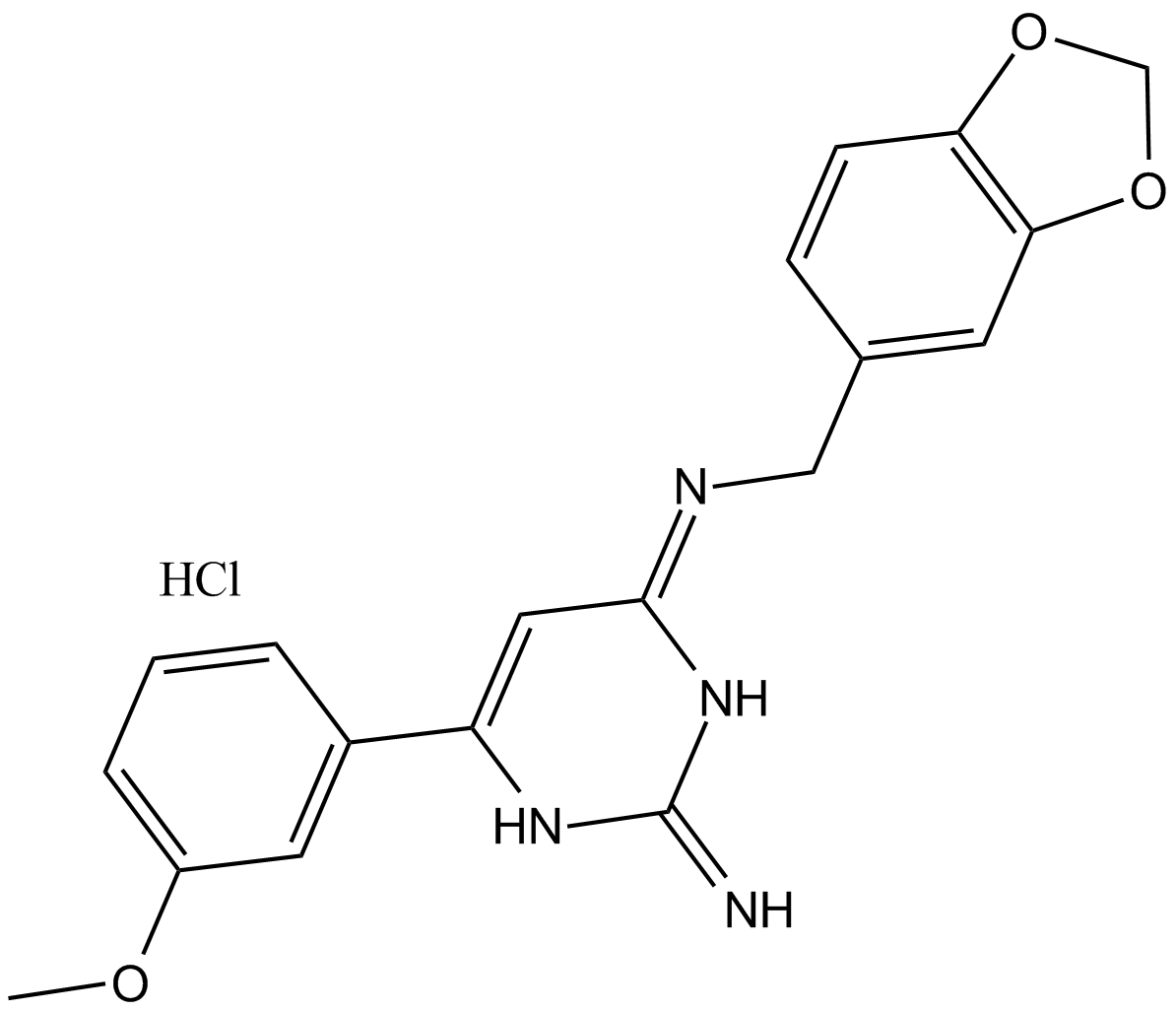
Cas No.: 853220-52-7
Sample solution is provided at 25 µL, 10mM.
_1-3.$$$39978408@51.jpg');)
_1-9.$$$38538795@65.jpg');)
_1-9.$$$39112701@51.jpg');)
_1-7.$$$37316672@70.jpg');)
_366-372.$$$36198801@70.jpg');)
.$$$38565142@65.jpg');)
_1867-1883.$$$33248023@67.jpg');)
_eads6055.$$$39977546@45.jpg');)
_eadm9805.$$$40080571@45.jpg');)
_eadj3020.$$$39666821@45.jpg');)
_1-20.$$$39757301@28.jpg');)
_1-24.$$$38898113@28.jpg');)
_273-287.$$$36806353@46.jpg');)
_1-16.$$$37156877@44.jpg');)
_1-19.$$$37460805@44.jpg');)
_1291-1307.$$$34518654@46.jpg');)
BML-284 (Wnt agonist 1) es un potente activador de la vía Wnt. Cuenta con un valor EC50 de 0.7μM para inducir la actividad transcripcional dependiente de β-catenin- y TCF[1]. Se une al sitio de la colchicina y forma un enlace de hidrógeno de baja barrera con el residuo E198 de la β-tubulin. Así favorece la degradación de la αβ-tubulin por la vía ubiquitin-proteasome[2]. Se usa mucho como molde para obtener derivados azoicos fotosensibles. Estos sufren isomerización cis-trans reversible con luz visible, y la forma cis activa la señalización Wnt[3].
En estudios in vitro, el tratamiento con IBML-284 durante 72 horas frenó la proliferación de células HeLa, HCT116, MCF-7 y K562. Sus valores IC50 fueron 0.09µM, 0.52µM, 0.69µM y 0.10µM, respectivamente[4]. El tratamiento con 1µM de BML-284 durante 24 horas impulsó la invasión y redujo la apoptosis en células A549 transfectadas con pcDNA-AOC4P[5]. La preincubación de células musculares lisas de aorta humana (HA-VSMCs) con 10µM de BML-284 durante 24 horas activó la vía Wnt. Aumentó la expresión proteica de Wnt3a y β-catenin. Y anuló los efectos protectores de si-SOX2 sobre la calcificación, la expresión de proteínas osteogenic/contractile y la actividad autofágica[6].
En estudios in vivo, la inyección de BML-284 (5μl; 0.5μg/ojo) en la conjuntiva cerca del limbo corneal durante 48 horas ayudó a lareparación epitelial y nerviosa corneal en ratones diabéticos[7]. La inyección intravenosa diaria de BML-284 500µl (2mg/ml) durante 14 días bloqueó el efecto protector del Triptolide (TP) frente a la fibrosis miocárdica. Lo consigue activando la vía Wnt/β-catenin, y agrava la disfunción cardíaca en ratas[8].
References:
[1] Liu J, Wu X, Mitchell B, et al. A small‐molecule agonist of the Wnt signaling pathway[J]. Angewandte Chemie International Edition, 2005, 44(13): 1987-1990.
[2] Yang J, Li Y, Qiu Q, et al. Small molecules promote selective denaturation and degradation of tubulin heterodimers through a low-barrier hydrogen bond[J]. Journal of Medicinal Chemistry, 2022, 65(13): 9159-9173.
[3] Ahmad S, Hashim P K, Imajo M, et al. Photoswitchable agonists for visible-light activation of the Wnt signaling pathway[J]. Organic & Biomolecular Chemistry, 2025, 23(17): 4240-4245.
[4] Zhang C, Yan W, Liu Y, et al. Structure-based design and synthesis of BML284 derivatives: A novel class of colchicine-site noncovalent tubulin degradation agents[J]. European Journal of Medicinal Chemistry, 2024, 268: 116265.
[5] Li F, Rong T, Cao G, et al. AOC4P suppresses viability and invasion and induces apoptosis in NSCLC cells by inhibiting the Wnt/β-catenin pathway[J]. Chemico-Biological Interactions, 2020, 325: 109110.
[6] Xiang H, Hong J, Zhang Y, et al. Inhibition of SOX2 mitigates vascular calcification mediated by autophagy through Wnt signaling pathway[J]. Egyptian Journal of Medical Human Genetics, 2025, 26(1): 189.
[7] Yang S, Zhang Y, Zhang Z, et al. Insulin promotes corneal nerve repair and wound healing in type 1 diabetic mice by enhancing Wnt/β-catenin signaling[J]. The American Journal of Pathology, 2020, 190(11): 2237-2250.
[8] Zhang Y, Lu F. Molecular mechanism of triptolide in myocardial fibrosis through the Wnt/β-catenin signaling pathway[J]. Scandinavian Cardiovascular Journal, 2024, 58(1): 2295785.
| Experimentos celulares [1]: | |
Líneas celulares | Células HeLa |
Método de preparación | Las células HeLa se sembraron en placas de 96 pozos a una densidad de 5000 células/pocillo y se mantuvieron en una incubadora con un 5% de CO2 a 37°C durante la noche. Posteriormente, las células fueron tratadas con el BML-284 en las concentraciones indicadas (0.001, 0.01, 0.1, 1 y 10µM) durante 72h. Paclitaxel se utilizó como control positivo. El polvo de MTT se disolvió en solución salina fisiológica para obtener una solución de 5mg/ml; luego, se añadieron 20μl de solución de MTT a cada pozo y se incubaron a 37°C durante 2h. La absorbancia de cada pozo se determinó a 570nm. |
Condiciones de reacción | 0.001, 0.01, 0.1, 1 y 10µM; 72h |
Áreas de aplicación | El tratamiento con BML-284 inhibió la viabilidad celular de las células HeLa de una manera dependiente de la dosis. |
| Experimentos con animales [2]: | |
Modelos animales | Ratas Sprague-Dawley macho |
Método de preparación | Setenta y dos ratas Sprague-Dawley machos (8 semanas de edad, 220±20g) fueron alojadas indivualmente en jaulas mantenidas a 23±1°C con un ciclo de luz/oscuridad de 12 horas y acceso ad libitum a alimentos y agua. Después de 1 semana de aclimatación, isoproterenol (ISO) se disolvió en solución salina normal y se inyectó por vía subcutánea en las ratas a una dosis de 5mg/kg/día durante 14 días consecutivos para establecer un modelo de rata de foibrosis miocárdica (MF). Las ratas se dividieron en cuatro grupos: grupo de control normal (grupo NC), grupo ISO, grupo TP+ISO y grupo BML-284+TP+ISO. Las ratas de los grupos ISO, TP+ISO y BML-284+TP+ISO se inyectaron por vía con ISO (5mg/kg/día), y las ratas del grupo NC se inyectarion por vía con el mismo volumen de solución salina normal. Las ratas del grupo TP+ISO fueron inyectadas por vía con TP a una concentración de 150μg/kg. En el grupo de ratas BML-284+TP+ISO, se administró una inyección intravenosa diaria de 500µl de BML-284 (2mg/ml), junto con inyecciones de TP (μg/kg) e ISO (5mg/kg) durante un período de 14 días. Se eliminaron los corazones de rata para su análisis. |
Forma de dosificación | 500µl (2mg/ml); una vez al día durante 14 días; i.v. |
Áreas de aplicación | BML-284 antagonizó el efecto protector de TP contra MF al activar la vía Wnt/β-catenin y agravó la disfunción cardíaca en ratas. |
References: | |
| Cas No. | 853220-52-7 | SDF | |
| Sinónimos | BML-284 | ||
| Chemical Name | (Z)-1-(benzo[d][1,3]dioxol-5-yl)-N-(2-imino-6-(3-methoxyphenyl)-2,3-dihydropyrimidin-4(1H)-ylidene)methanamine hydrochloride | ||
| Canonical SMILES | COC1=CC=CC(C(NC2=N)=C/C(N2)=N/CC3=CC4=C(OCO4)C=C3)=C1.Cl | ||
| Formula | C19H19ClN4O3 | M.Wt | 386.83 |
| Solubility | ≥ 38.7mg/mL in DMSO | Storage | Store at -20°C |
| General tips | Please select the appropriate solvent to prepare the stock solution according to the
solubility of the product in different solvents; once the solution is prepared, please store it in
separate packages to avoid product failure caused by repeated freezing and thawing.Storage method
and period of the stock solution: When stored at -80°C, please use it within 6 months; when stored
at -20°C, please use it within 1 month. To increase solubility, heat the tube to 37°C and then oscillate in an ultrasonic bath for some time. |
||
| Shipping Condition | Evaluation sample solution: shipped with blue ice. All other sizes available: with RT, or with Blue Ice upon request. | ||
| Prepare stock solution | |||

|
1 mg | 5 mg | 10 mg |
| 1 mM | 2.5851 mL | 12.9256 mL | 25.8511 mL |
| 5 mM | 517 μL | 2.5851 mL | 5.1702 mL |
| 10 mM | 258.5 μL | 1.2926 mL | 2.5851 mL |
Step 1: Enter information below (Recommended: An additional animal making an allowance for loss during the experiment)
 g
μL
g
μL
Step 2: Enter the in vivo formulation (This is only the calculator, not formulation. Please contact us first if there is no in vivo formulation at the solubility Section.)
Calculation results:
Working concentration: mg/ml;
Method for preparing DMSO master liquid: mg drug pre-dissolved in μL DMSO ( Master liquid concentration mg/mL, Please contact us first if the concentration exceeds the DMSO solubility of the batch of drug. )
Method for preparing in vivo formulation: Take μL DMSO master liquid, next addμL PEG300, mix and clarify, next addμL Tween 80, mix and clarify, next add μL saline, mix and clarify.
Method for preparing in vivo formulation: Take μL DMSO master liquid, next add μL Corn oil, mix and clarify.
Note: 1. Please make sure the liquid is clear before adding the next solvent.
2. Be sure to add the solvent(s) in order. You must ensure that the solution obtained, in the previous addition, is a clear solution before proceeding to add the next solvent. Physical methods such as vortex, ultrasound or hot water bath can be used to aid dissolving.
3. All of the above co-solvents are available for purchase on the GlpBio website.
Quality Control & SDS
- View current batch:
- Purity: >99.50% Appearance: A solid
- COA (Certificate of Analysis)
- SDS (Safety Data Sheet)
- Datasheet
Average Rating: 5 (Based on Reviews and 16 reference(s) in Google Scholar.)