

1,4-DPCA (Synonyms: 1,4-dihydrophenonthrolin-4-one-3-Carboxylic acid) |
رقم الكتالوجGC12845
 One-Click Copy Product Info
|

1،4-DPCA ، مثبط قوي للبروليل 4-هيدروكسيلاز ، هو مثبط هيدروكسيل الكولاجين في الخلايا الليفية للقلفة البشرية مع IC50 من 2.4 ميكرومتر1،4-DPCA يثبط بروبيل-4-هيدروكسيلازز α يستقر بروتين HIF-1α1،4-DPCA يثبط أيضًا عامل تثبيط HIF (FIH) مع IC 50 من 60 ميكرومتر
Products are for research use only. Not for human use. We do not sell to patients.
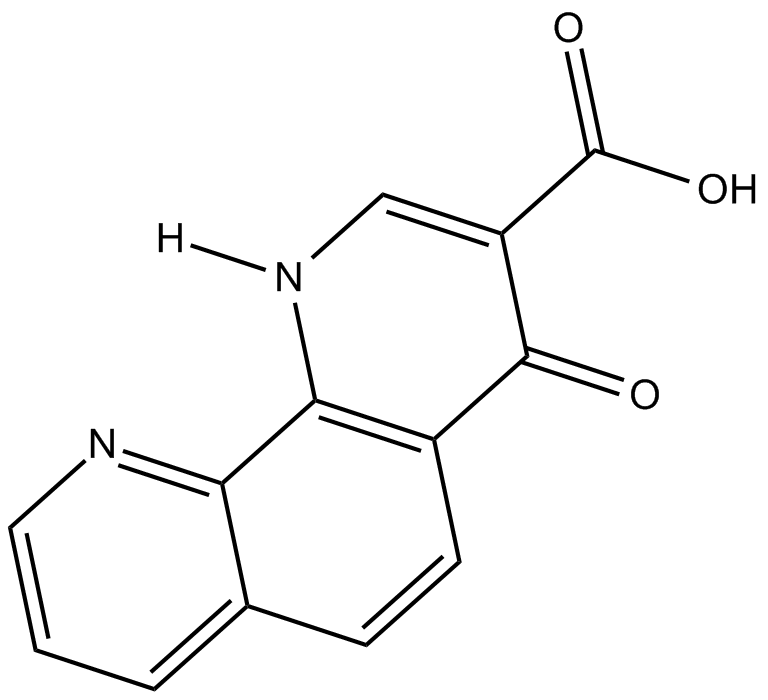
Cas No.: 331830-20-7
Sample solution is provided at 25 µL, 10mM.
1,4-DPCA is a potent and selective prolyl-4-hydroxylase inhibitor (IC₅₀=2.4μM) that also suppresses the activity of asparagine hydroxylase factor FIH (IC₅₀=60μM)[1-2]. 1,4-DPCA has potential applications in the treatment of myocardial infarction[3-4].
In vitro, treatment of various breast cancer cell lines (including T4-2, ZR-75-1, MDA-MB-157, and MDA-MB-231) cultured in three-dimensional models with 1,4-DPCA (10–20μM) for 4 days significantly inhibited cell proliferation and reduced invasive phenotypes[5]. Exposure of multiple cell lines (such as H9C2, L929, and cardiomyocytes) to 1,4-DPCA (10–20μM) markedly upregulated HIF-1α protein expression and enhanced cell proliferation [6].
In vivo, a single intramyocardial injection of 1,4-DPCA (delivered via ALG-CHO-TA/DPCA@PDA/MMP-SP/HA-SH hydrogel) at a dose of 100μL (equivalent to 0.4mg/kg) in a rat model of myocardial infarction significantly improved cardiac function and promoted myocardial repair[7]. In a lipopolysaccharide (LPS)-induced septic acute lung injury model in 6–8 week-old C57BL/6J mice, a single tail vein injection of 1,4-DPCA (10mg/kg) acted as a HIF-1α activator, effectively reversing the protective effect of GDF15 overexpression against lung injury[8].
References:
[1] Zhang Y, Strehin I, Bedelbaeva K, et al. Drug-induced regeneration in adult mice. Sci Transl Med. 2015 Jun 3;7(290):290ra92.
[2] Love RJ, Jones KS. Transient inhibition of connective tissue infiltration and collagen deposition into porous poly(lactic-co-glycolic acid) discs. J Biomed Mater Res A. 2013 Dec;101(12):3599-606.
[3] Wang K, Yao SY, Wang Z, et al. A Sequential Dual Functional Supramolecular Hydrogel with Promoted Drug Release to Scavenge ROS and Stabilize HIF-1α for Myocardial Infarction Treatment. Adv Healthc Mater. 2024 Mar;13(6):e2302940.
[4] Zebrowitz E, Aslanukov A, Kajikawa T, et al. Prolyl-hydroxylase inhibitor-induced regeneration of alveolar bone and soft tissue in a mouse model of periodontitis through metabolic reprogramming. Front Dent Med. 2022;3:992722.
[5] Xiong G, Deng L, Zhu J, et al. Prolyl-4-hydroxylase α subunit 2 promotes breast cancer progression and metastasis by regulating collagen deposition. BMC Cancer. 2014 Jan 2;14:1.
[6] Deng K, Hua Y, Gao Y, et al. Thermosensitive Hydrogel with Programmable, Self-Regulated HIF-1α Stabilizer Release for Myocardial Infarction Treatment. Adv Sci (Weinh). 2024 Nov;11(43):e2408013.
[7] Wei X, Chen S, Xie T, et al. An MMP-degradable and conductive hydrogel to stabilize HIF-1α for recovering cardiac functions. Theranostics. 2022 Jan 1;12(1):127-142.
[8] Kuang X, Niu Z, Huang Z, et al. GDF15 attenuates sepsis-induced acute lung injury by suppressing the HIF-1α/LDHA pathway. Int Immunopharmacol. 2025 Oct 10;163:115198.
| Cell experiment [1]: | |
|
Cell lines |
HMT-3522 T4-2, MDA-MB-231, ZR-75-1, and MDA-MB-157 breast cancer cell lines |
|
Preparation Method |
Cells were cultured in three-dimensional (3D) laminin-rich extracellular matrix (lrECM) on-top cultures. T4-2 and ZR-75-1 cells were seeded at a density of 2.1×10⁴ cells per cm²; MDA-MB-157 and MDA-MB-231 cells were seeded at 1.4×10⁴ cells per cm². Cells were treated with 1,4-DPCA (10–20μM) at specified concentrations for 4 days. |
|
Reaction Conditions |
10–20μM; 4 days |
|
Applications |
1,4-DPCA significantly reduced colony sizes of T4-2 and ZR-75-1 cells and suppressed invasive branches in MDA-MB-231 and MDA-MB-157 cells in 3D culture. Treatment with 1,4-DPCA also inhibited cell proliferation, as evidenced by decreased EdU-positive cells, and impaired collagen I and IV deposition. |
| Animal experiment [2]: | |
|
Animal models |
C57BL/6J mice |
|
Preparation Method |
Mice were intravenously injected with rAAV8-CMV-mGdf15 or control vector(rAAV8-CMV-LacZ). After 1 week of viral expression, acute lung injury(ALI) was induced by intraperitoneal injection of LPS (20mg/kg). 1,4-DPCA (10mg/kg) was administered via tail vein injection 2 hours prior to LPS challenge. |
|
Dosage form |
10mg/kg; i.v; Single injection. |
|
Applications |
1,4-DPCA administration partially abolished the protective effects of GDF15 overexpression on LPS-induced lung injury, as evidenced by increased expression of endothelial adhesion molecules (VCAM-1 and ICAM-1) and elevated serum pro-inflammatory cytokine levels (IL-6 and TNF-α). 1,4-DPCA also reversed GDF15-mediated suppression of HIF-1α/LDHA pathway activation. |
|
References: |
|
| Cas No. | 331830-20-7 | SDF | |
| المرادفات | 1,4-dihydrophenonthrolin-4-one-3-Carboxylic acid | ||
| Chemical Name | 4,4α-dihydro-4-oxo-1,10-phenanthroline-3-carboxylic acid | ||
| Canonical SMILES | O=C1C2=C(C3=NC=CC=C3C=C2)N([H])C=C1C(O)=O | ||
| Formula | C13H8N2O3 | M.Wt | 240.2 |
| الذوبان | ≤3mg/ml in DMSO;3mg/ml in dimethyl formamide | Storage | Store at -20°C |
| General tips | Please select the appropriate solvent to prepare the stock solution according to the
solubility of the product in different solvents; once the solution is prepared, please store it in
separate packages to avoid product failure caused by repeated freezing and thawing.Storage method
and period of the stock solution: When stored at -80°C, please use it within 6 months; when stored
at -20°C, please use it within 1 month. To increase solubility, heat the tube to 37°C and then oscillate in an ultrasonic bath for some time. |
||
| Shipping Condition | Evaluation sample solution: shipped with blue ice. All other sizes available: with RT, or with Blue Ice upon request. | ||
| Prepare stock solution | |||

|
1 mg | 5 mg | 10 mg |
| 1 mM | 4.1632 mL | 20.816 mL | 41.632 mL |
| 5 mM | 832.6 μL | 4.1632 mL | 8.3264 mL |
| 10 mM | 416.3 μL | 2.0816 mL | 4.1632 mL |
Step 1: Enter information below (Recommended: An additional animal making an allowance for loss during the experiment)
 g
μL
g
μL
Step 2: Enter the in vivo formulation (This is only the calculator, not formulation. Please contact us first if there is no in vivo formulation at the solubility Section.)
Calculation results:
Working concentration: mg/ml;
Method for preparing DMSO master liquid: mg drug pre-dissolved in μL DMSO ( Master liquid concentration mg/mL, Please contact us first if the concentration exceeds the DMSO solubility of the batch of drug. )
Method for preparing in vivo formulation: Take μL DMSO master liquid, next addμL PEG300, mix and clarify, next addμL Tween 80, mix and clarify, next add μL saline, mix and clarify.
Method for preparing in vivo formulation: Take μL DMSO master liquid, next add μL Corn oil, mix and clarify.
Note: 1. Please make sure the liquid is clear before adding the next solvent.
2. Be sure to add the solvent(s) in order. You must ensure that the solution obtained, in the previous addition, is a clear solution before proceeding to add the next solvent. Physical methods such as vortex, ultrasound or hot water bath can be used to aid dissolving.
3. All of the above co-solvents are available for purchase on the GlpBio website.
Quality Control & SDS
- View current batch:
- Purity: >98.00% Appearance: A solid
- COA (Certificate of Analysis)
- SDS (Safety Data Sheet)
- Datasheet
Average Rating: 5 (Based on Reviews and 40 reference(s) in Google Scholar.)