
MPEP |
| رقم الكتالوجGC10864 |
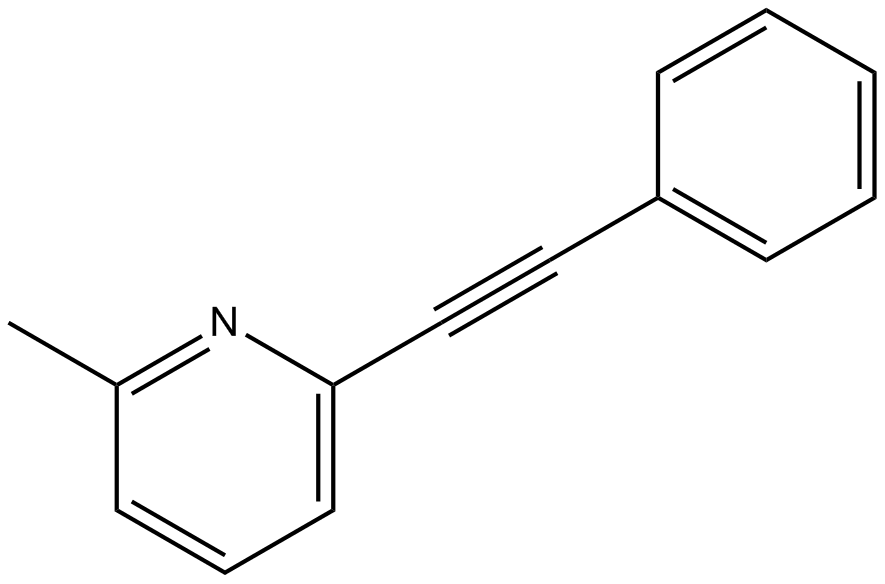
MPEP هو مضاد لمستقبلات mGlu5 فعال وانتقائي وغير تنافسي ونشط عن طريق الفم ، مع IC 50 من 36 نانومتر لتثبيط التحلل المائي بفوسفوينوسيتيد (PI) المحفز تمامًا
Products are for research use only. Not for human use. We do not sell to patients.
Cas No.: 96206-92-7
Sample solution is provided at 25 µL, 10mM.
MPEP is a noncompetitive, selective, potent, orally active and systemically active mGlu5 receptor antagonist, with an IC50 of 36nM for completely inhibiting quisqualate-stimulated phosphoinositide (PI) hydrolysis[1]. MPEP has anxiolytic-or antidepressant-like effects[2] and is usually used in the study of neurological disorders, such as fragile X syndrome[3] and epilepsy[4] .
In vitro, pretreatment of MN9D cells with 10μM MPEP 30min prior to rotenone exposure reversed the increase in p-PERK and γ -H2AX expression levels and alleviated the decrease in tyrosine hydroxylase induced by rotenone treatment[5] .
In vivo, intraperitoneal injection of MPEP(30mg/kg; 3days) lowered alcohol consumption during Drinking in the Dark (DID) in male and female C57BL/6 mice without changes in Homer2/Erk2 expression[6] . Intraperitoneal injection of MPEP (3 mg/kg, 30min) facilitates amphetamine-induced effects independently on the behavior measured both in naïve and in dopamine lesioned mice[7].
References:
[1] Gasparini, F., Lingenhöhl, K., Stoehr, N., Flor, P. J., Heinrich, M., Vranesic, I., Biollaz, M., Allgeier, H., Heckendorn, R., Urwyler, S., Varney, M. A., Johnson, E. C., Hess, S. D., Rao, S. P., Sacaan, A. I., Santori, E. M., Veliçelebi, G., & Kuhn, R. (1999). 2-Methyl-6-(phenylethynyl)-pyridine (MPEP), a potent, selective and systemically active mGlu5 receptor antagonist. Neuropharmacology, 38(10), 1493–1503.
[2] Tatarczyńska, E., Klodzińska, A., Chojnacka-Wójcik, E., Palucha, A., Gasparini, F., Kuhn, R., & Pilc, A. (2001). Potential anxiolytic- and antidepressant-like effects of MPEP, a potent, selective and systemically active mGlu5 receptor antagonist. British journal of pharmacology, 132(7), 1423–1430.
[3] Castrén, M. L., & Castrén, E. (2014). BDNF in fragile X syndrome. Neuropharmacology, 76 Pt C, 729–736.
[4] Moldrich, R. X., Chapman, A. G., De Sarro, G., & Meldrum, B. S. (2003). Glutamate metabotropic receptors as targets for drug therapy in epilepsy. European journal of pharmacology, 476(1-2), 3–16.
[5] Gu, L., Luo, W. Y., Xia, N., Zhang, J. N., Fan, J. K., Yang, H. M., Wang, M. C., & Zhang, H. (2022). Upregulated mGluR5 induces ER stress and DNA damage by regulating the NMDA receptor subunit NR2B. Journal of biochemistry, 171(3), 349–359.
[6] Huang, G., Thompson, S. L., & Taylor, J. R. (2021). MPEP Lowers Binge Drinking in Male and Female C57BL/6 Mice: Relationship with mGlu5/Homer2/Erk2 Signaling. Alcoholism, clinical and experimental research, 45(4), 732–742.
[7] Managò, F., Lopez, S., Oliverio, A., Amalric, M., Mele, A., & De Leonibus, E. (2013). Interaction between the mGlu receptors 5 antagonist, MPEP, and amphetamine on memory and motor functions in mice. Psychopharmacology, 226(3), 541–550.
| Cell experiment [1]: | |
Cell lines | MN9D cells |
Preparation Method | MN9D cells were pretreated with 10μM MPEP for 30min followed by different concentration of rotenone or (RS)-2-chloro-5- hydroxyphenylglycine (CHPG) treatment for indicated time. The expression levels of p-PERK, γ -H2AX and tyrosine hydroxylase were detected by Western blot. |
Reaction Conditions | 10μM; 30min |
Applications | MPEP reversed the increase in p-PERK and γ -H2AX expression levels and alleviated the decrease in tyrosine hydroxylase induced by rotenone treatment. |
| Animal experiment [2]: | |
Animal models | C57BL/6NCrl mice |
Preparation Method | The animals used in this study were male and female C57BL/6NCrl mice purchased from Charles River Laboratories (Strain Code #027) at seven weeks of age. Upon delivery, mice were singly housed with food ad libitum. Water was provided ad libitum via a water bottle except for during the Drinking in the Dark (DID) sessions. A 20% ethanol drinking solution for the DID experiments was made with 200 proof ethanol diluted with tap water (v/v) and used within 24h. MPEP was dissolved in saline and injected i.p. at 10 ml/kg body weight. A range of doses from 0–30mg/kg MPEP were used in these studies. After the completion of the final MPEP dose the animals continued on DID for three days to test for blood ethanol concentrations. |
Dosage form | 0–30mg/kg for 3days; i.p. |
Applications | 30mg/kg MPEP lowered alcohol consumption during DID in male and female C57BL/6 mice without changes in Homer2/Erk2 expression. |
References: | |
| Cas No. | 96206-92-7 | SDF | |
| Chemical Name | 2-methyl-6-(2-phenylethynyl)pyridine | ||
| Canonical SMILES | CC1=CC=CC(=N1)C#CC2=CC=CC=C2 | ||
| Formula | C14H11N | M.Wt | 193.24 |
| الذوبان | ≥ 9.95mg/mL in DMSO | Storage | Store at -20°C |
| General tips | Please select the appropriate solvent to prepare the stock solution according to the
solubility of the product in different solvents; once the solution is prepared, please store it in
separate packages to avoid product failure caused by repeated freezing and thawing.Storage method
and period of the stock solution: When stored at -80°C, please use it within 6 months; when stored
at -20°C, please use it within 1 month. To increase solubility, heat the tube to 37°C and then oscillate in an ultrasonic bath for some time. |
||
| Shipping Condition | Evaluation sample solution: shipped with blue ice. All other sizes available: with RT, or with Blue Ice upon request. | ||
| Prepare stock solution | |||
|
1 mg | 5 mg | 10 mg |
| 1 mM | 5.1749 mL | 25.8746 mL | 51.7491 mL |
| 5 mM | 1.035 mL | 5.1749 mL | 10.3498 mL |
| 10 mM | 517.5 μL | 2.5875 mL | 5.1749 mL |
Step 1: Enter information below (Recommended: An additional animal making an allowance for loss during the experiment)
Step 2: Enter the in vivo formulation (This is only the calculator, not formulation. Please contact us first if there is no in vivo formulation at the solubility Section.)
Calculation results:
Working concentration: mg/ml;
Method for preparing DMSO master liquid: mg drug pre-dissolved in μL DMSO ( Master liquid concentration mg/mL, Please contact us first if the concentration exceeds the DMSO solubility of the batch of drug. )
Method for preparing in vivo formulation: Take μL DMSO master liquid, next addμL PEG300, mix and clarify, next addμL Tween 80, mix and clarify, next add μL ddH2O, mix and clarify.
Method for preparing in vivo formulation: Take μL DMSO master liquid, next add μL Corn oil, mix and clarify.
Note: 1. Please make sure the liquid is clear before adding the next solvent.
2. Be sure to add the solvent(s) in order. You must ensure that the solution obtained, in the previous addition, is a clear solution before proceeding to add the next solvent. Physical methods such as vortex, ultrasound or hot water bath can be used to aid dissolving.
3. All of the above co-solvents are available for purchase on the GlpBio website.
Quality Control & SDS
- View current batch:
- Purity: >98.00%
- COA (Certificate Of Analysis)
- SDS (Safety Data Sheet)
- Datasheet
Average Rating: 5 (Based on Reviews and 10 reference(s) in Google Scholar.)
GLPBIO products are for RESEARCH USE ONLY. Please make sure your review or question is research based.
Required fields are marked with *


