

A 366 |
رقم الكتالوجGC16015
 One-Click Copy Product Info
|

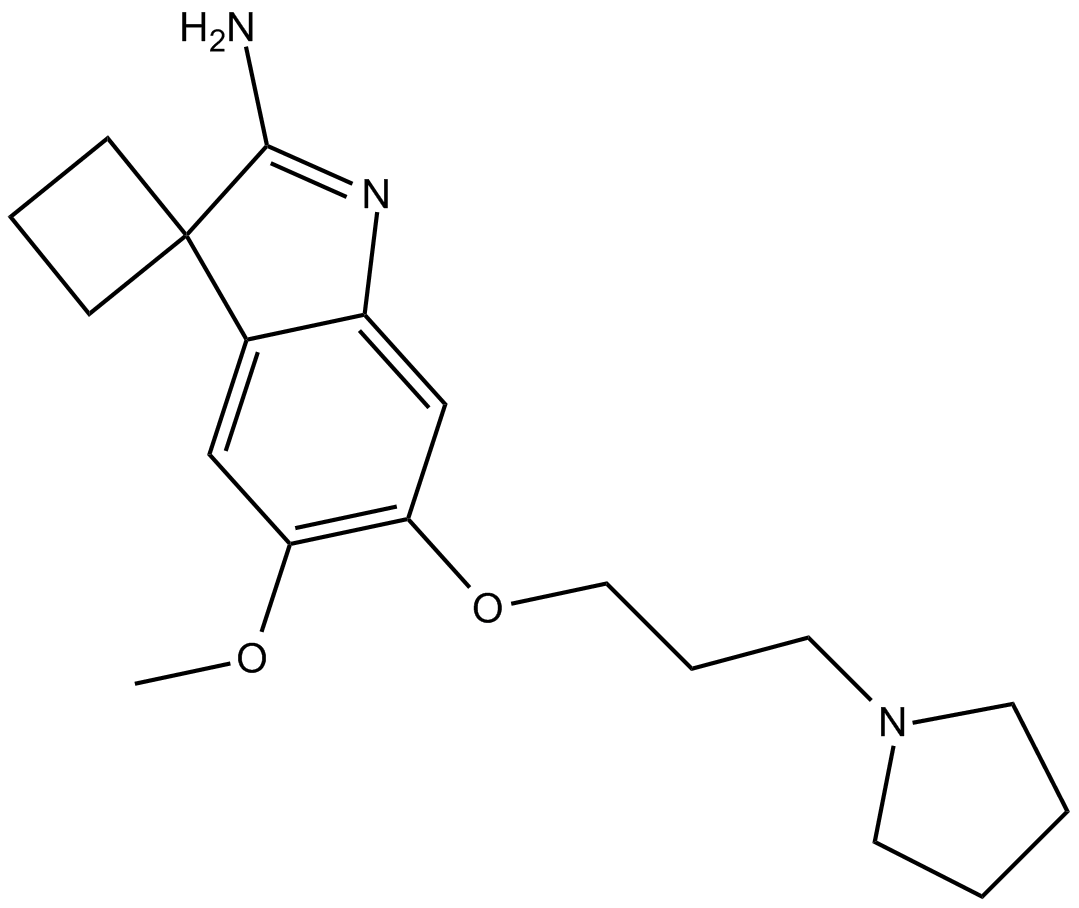
A 366 هو مثبط هيستون ميثيل ترانسفيراز G9a قوي ، انتقائي للغاية ، منافس للببتيد مع IC50s من 3.3 و 38 نانومتر لـ G9a و GLP (EHMT1) ، على التوالي. يُظهر A 366\u003e انتقائية بمقدار 1000 ضعف على 21 ميثيل ترانسفيرازات أخرى. A 366 هو أيضًا مثبط قوي ، نانومولار لتفاعل Spindlin1-H3K4me3 (IC50 \u003d 182.6 نانومتر). يُظهر A 366 تقاربًا كبيرًا في مستقبلات الهيستامين البشري H3 (Ki \u003d 17 نانومتر) ويظهر انتقائية النوع الفرعي بين مجموعات فرعية من عائلات مستقبلات الهيستامين والدوبامين.
Products are for research use only. Not for human use. We do not sell to patients.
Cas No.: 1527503-11-2
Sample solution is provided at 25 µL, 10mM.
_1-3.$$$39978408@51.jpg');)
_1-9.$$$38538795@65.jpg');)
_1-9.$$$39112701@51.jpg');)
_1-7.$$$37316672@70.jpg');)
_366-372.$$$36198801@70.jpg');)
.$$$38565142@65.jpg');)
_1867-1883.$$$33248023@67.jpg');)
_eads6055.$$$39977546@45.jpg');)
_eadm9805.$$$40080571@45.jpg');)
_eadj3020.$$$39666821@45.jpg');)
_1-20.$$$39757301@28.jpg');)
_1-24.$$$38898113@28.jpg');)
_273-287.$$$36806353@46.jpg');)
_1-16.$$$37156877@44.jpg');)
_1-19.$$$37460805@44.jpg');)
_1291-1307.$$$34518654@46.jpg');)
A 366 is a selective G9a/GLP histone methyltransferase inhibitor that inhibits the activity of G9a (IC50=3.3nM) and GLP (IC50=38nM). A 366 suppresses H3K9me2 methylation and interferes with the binding of Spindlin1 to H3K4me3[1-2]. A 366 can be used in research related to leukemia, prostate cancer, and autism spectrum disorders[3-4].
In vitro, U2OS human osteosarcoma cells were treated with A 366 (10μM) in combination with phleomycin (0.5–1μM) or etoposide (100nM) for 0-180 minutes. A 366 significantly impaired DNA double-strand break repair, enhanced DNA damage accumulation, and synergistically induced tumor cell death[5]. Human monocytes, M1/M2 monocyte-derived macrophages, CD4+ T cells, and B cells were pretreated with A 366 (5–50μM) for 30 minutes, followed by incubation with different inducters for 24 hours to 5 days. A 366 attenuated the M2 polarization of macrophages; A 366 also significantly inhibited the proliferation of B cells, the formation of plasmablasts, and the release of immunoglobulins G and A[6].
In vivo, Balb/c nu/nu mice bearing OPM2 multiple myeloma xenografts were treated with A 366 alone (8mg/kg; i.p.; for 6 days) or in combination with decitabine (0.2mg/kg) for the final 3 days. A 366 significantly inhibited tumor growth in the xenograft model, and the combination therapy demonstrated a synergistic antitumor effect without causing significant toxicity[7]. Wistar rats were treated with A 366 (25mg/kg; a single intraperitoneal injection). A 366 significantly reduced the clonogenic capacity of bone marrow-derived mesenchymal stem cells (BM-MSCs), prolonged their population doubling time, increased their adipogenic differentiation potential, and decreased their osteogenic differentiation potential[8].
References:
[1] Reiner D, Seifert L, Deck C, et al. Epigenetics meets GPCR: inhibition of histone H3 methyltransferase (G9a) and histamine H3 receptor for Prader-Willi Syndrome. Sci Rep. 2020 Aug 11;10(1):13558.
[2] Wagner T, Greschik H, Burgahn T, et al. Identification of a small-molecule ligand of the epigenetic reader protein Spindlin1 via a versatile screening platform. Nucleic Acids Res. 2016 May 19;44(9):e88.
[3] Sweis RF, Pliushchev M, Brown PJ, et al. Discovery and development of potent and selective inhibitors of histone methyltransferase g9a. ACS Med Chem Lett. 2014 Jan 2;5(2):205-9.
[4] Pappano WN, Guo J, He Y, et al. The Histone Methyltransferase Inhibitor A-366 Uncovers a Role for G9a/GLP in the Epigenetics of Leukemia. PLoS One. 2015 Jul 6;10(7):e0131716.
[5] Agarwal P, Jackson SP. G9a inhibition potentiates the anti-tumour activity of DNA double-strand break inducing agents by impairing DNA repair independent of p53 status. Cancer Lett. 2016 Oct 1;380(2):467-475.
[6] Schiffmann S, Henke M, Weber F, et al. Immune-modulatory effects of Spindlin-1 inhibitors. Clin Exp Immunol. 2025 Jan 21;219(1):uxaf013.
[7] Nylund P, Garrido-Zabala B, Tziola SI, et al. Dual targeting of G9a and DNMTs induces antitumor effects in multiple myeloma. Blood Adv. 2025 Oct 14;9(19):4825-4841.
[8] Khanban H, Fattahi E, Talkhabi M. In vivo administration of G9a inhibitor A366 decreases osteogenic potential of bone marrow-derived mesenchymal stem cells. EXCLI J. 2019 Jun 3;18:300-309.
| Cell experiment [1]: | |
Cell lines | U2OS cells (human osteosarcoma cell line) and HCT116 cells (human colorectal carcinoma cell line, both p53 wild-type and p53 knockout variants) |
Preparation Method | Cells were cultured in DMEM supplemented with 10% fetal bovine serum (FBS) at 37°C under 5% CO₂. For testing, U2OS cells were treated with A 366 (10μM) in combination with the DNA double-strand break (DSB) inducing agents phleomycin or etoposide. |
Reaction Conditions | 10μM; 0-180min. |
Applications | A 366 significantly potentiated the anti-tumour activity of DSB-inducing agents. A 366 hypersensitized U2OS tumor cells to low doses of phleomycin or etoposide, impairing DSB repair and leading to increased accumulation of DNA damage markers (γH2AX and 53BP1 foci) and ultimately tumor cell death. This effect was independent of p53 status. |
| Animal experiment [2]: | |
Animal models | Balb/c nu/nu mice bearing subcutaneous OPM2 multiple myeloma xenografts |
Preparation Method | Female immunodeficient mice were inoculated with OPM2 cells. For monotherapy, mice were treated with A366 via intraperitoneal injection daily for 9 days. For combination therapy, mice were treated with A 366 (8mg/kg) daily for 6 days, with the DNMT inhibitor decitabine co-administered during the final 72 hours. |
Dosage form | 8mg/kg; i.p.; daily for 6-9 days. |
Applications | A 366 monotherapy significantly inhibited tumor growth in vivo and demonstrated on-target activity by reducing global H3K9me2 levels in tumors. The combination of A 366 and decitabine resulted in a synergistic antitumor effect, leading to robust tumor regression superior to either agent alone, and was well-tolerated without significant toxicity. |
References: | |
| Cas No. | 1527503-11-2 | SDF | |
| Chemical Name | 5'-methoxy-6'-(3-(pyrrolidin-1-yl)propoxy)spiro[cyclobutane-1,3'-indol]-2'-amine | ||
| Canonical SMILES | NC1=NC2=CC(OCCCN3CCCC3)=C(OC)C=C2C14CCC4 | ||
| Formula | C19H27N3O2 | M.Wt | 329.44 |
| الذوبان | ≥ 11.9mg/mL in DMSO | Storage | Store at -20°C |
| General tips | Please select the appropriate solvent to prepare the stock solution according to the
solubility of the product in different solvents; once the solution is prepared, please store it in
separate packages to avoid product failure caused by repeated freezing and thawing.Storage method
and period of the stock solution: When stored at -80°C, please use it within 6 months; when stored
at -20°C, please use it within 1 month. To increase solubility, heat the tube to 37°C and then oscillate in an ultrasonic bath for some time. |
||
| Shipping Condition | Evaluation sample solution: shipped with blue ice. All other sizes available: with RT, or with Blue Ice upon request. | ||
| Prepare stock solution | |||

|
1 mg | 5 mg | 10 mg |
| 1 mM | 3.0355 mL | 15.1773 mL | 30.3545 mL |
| 5 mM | 607.1 μL | 3.0355 mL | 6.0709 mL |
| 10 mM | 303.5 μL | 1.5177 mL | 3.0355 mL |
Step 1: Enter information below (Recommended: An additional animal making an allowance for loss during the experiment)
 g
μL
g
μL
Step 2: Enter the in vivo formulation (This is only the calculator, not formulation. Please contact us first if there is no in vivo formulation at the solubility Section.)
Calculation results:
Working concentration: mg/ml;
Method for preparing DMSO master liquid: mg drug pre-dissolved in μL DMSO ( Master liquid concentration mg/mL, Please contact us first if the concentration exceeds the DMSO solubility of the batch of drug. )
Method for preparing in vivo formulation: Take μL DMSO master liquid, next addμL PEG300, mix and clarify, next addμL Tween 80, mix and clarify, next add μL saline, mix and clarify.
Method for preparing in vivo formulation: Take μL DMSO master liquid, next add μL Corn oil, mix and clarify.
Note: 1. Please make sure the liquid is clear before adding the next solvent.
2. Be sure to add the solvent(s) in order. You must ensure that the solution obtained, in the previous addition, is a clear solution before proceeding to add the next solvent. Physical methods such as vortex, ultrasound or hot water bath can be used to aid dissolving.
3. All of the above co-solvents are available for purchase on the GlpBio website.
Quality Control & SDS
- View current batch:
- Purity: >97.00% Appearance: A solid
- COA (Certificate of Analysis)
- SDS (Safety Data Sheet)
- Datasheet
Average Rating: 5 (Based on Reviews and 36 reference(s) in Google Scholar.)