

AQC (Synonyms: 6-Aminoquinolyl-N-hydroxysuccinimidyl Carbamate) |
رقم الكتالوجGC39738
 One-Click Copy Product Info
|

موصل متفاعل لإشباع الأمينات الأولية والثانوية
Products are for research use only. Not for human use. We do not sell to patients.
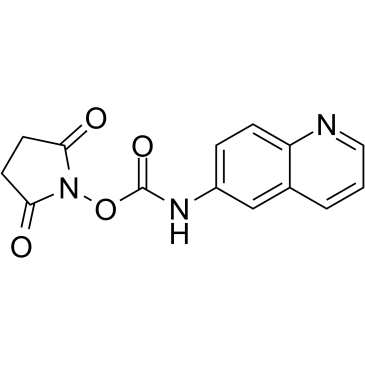
Cas No.: 148757-94-2
Sample solution is provided at 25 µL, 10mM.
_1-3.$$$39978408@51.jpg');)
_1-9.$$$38538795@65.jpg');)
_1-9.$$$39112701@51.jpg');)
_1-7.$$$37316672@70.jpg');)
_366-372.$$$36198801@70.jpg');)
.$$$38565142@65.jpg');)
_1867-1883.$$$33248023@67.jpg');)
_eads6055.$$$39977546@45.jpg');)
_eadm9805.$$$40080571@45.jpg');)
_eadj3020.$$$39666821@45.jpg');)
_1-20.$$$39757301@28.jpg');)
_1-24.$$$38898113@28.jpg');)
_273-287.$$$36806353@46.jpg');)
_1-16.$$$37156877@44.jpg');)
_1-19.$$$37460805@44.jpg');)
_1291-1307.$$$34518654@46.jpg');)
AQC is a reactive probe used for pre-column derivatization of primary and secondary amines—including amino groups in amino acids, peptides, proteins, and polyamines—yielding stable, highly fluorescent derivatives with excitation/emission maxima at 248/398nm. AQC has been employed for the chromatographic separation and analysis of amino acids and polyamines[1].
References:
[1] Pawlowska M, Chen S, Armstrong DW. Enantiomeric separation of fluorescent, 6-aminoquinolyl-N-hydroxysuccinimidyl carbamate, tagged amino acids. J Chromatogr. 1993 Jul 9;641(2):257-65.
This protocol is intended only as a general guide; please adapt it to your specific needs.
1 Protein Preparation
(1) For optimal labeling, prepare the protein (antibody) at 2mg/mL.
(2)Adjust the protein solution to pH 8.5 ± 0.5. If the pH is below 8.0, use 1M sodium bicarbonate to raise it.
(3) Labeling efficiency drops sharply when the protein concentration is < 2mg/mL. For best results, work within a final protein concentration range of 2–10mg/mL.
(4) The protein must be in a buffer free of primary amines (e.g., Tris or glycine) and ammonium ions, as these will reduce labeling efficiency.
2 Dye Preparation (using AQC as an example)
(1) Add anhydrous DMSO to the AQC vial to prepare a 10mM stock solution. Mix thoroughly by pipetting or vortexing.
3 Calculating Dye Amount
(1) The amount of AQC required depends on the quantity of protein to be labeled. The optimal molar ratio of AQC to protein is ~10:1.
(2) Example: To label 500µL of 2mg/mL IgG (MW = 150,000) with AQC dissolved in 100µL DMSO (1mg AQC), the required volume of AQC is 1.9µL.
Detailed calculation:
mmol(IgG) = [mg/mL(IgG) × mL(IgG)] / MW(IgG)= (2mg/mL × 0.5mL) / 150,000 mg/mmol= 6.7 × 10⁻⁶mmol
mmol(AQC) = mmol(IgG) × 10= 6.7 × 10⁻⁶mmol × 10= 6.7 × 10⁻⁵mmol
µL(AQC) = [mmol(AQC) × MW(AQC)] / (mg/µL AQC)= (6.7 × 10⁻⁵mmol × 285.25mg/mmol) / 0.01mg/µL≈ 1.9µL AQC
(4) Running the Conjugation Reaction
(1) Slowly add the freshly prepared 10mM AQC stock to 0.5mL of protein solution while gently swirling. Briefly centrifuge to collect the sample at the bottom of the tube. Do not vortex to avoid denaturation or loss of activity.
(2) Incubate the reaction tube at room temperature in the dark, gently swirling every 10–15min, for a total of 60min.
5 Purifying the Conjugate (example using a Sephadex G-25 column)
(1) Equilibrate a Sephadex G-25 column according to the manufacturer’s instructions.
(2) Load the reaction mixture onto the top of the column bed.
(3) As soon as the sample has entered the resin, immediately add PBS (pH 7.2–7.4).
(4) Continue adding PBS (pH 7.2–7.4) until the desired fractions have been collected and the column run is complete.
References:
[1]Bosch L, Alegría A, Farré R. Application of the 6-aminoquinolyl-N-hydroxysccinimidyl carbamate (AQC) reagent to the RP-HPLC determination of amino acids in infant foods. J Chromatogr B Analyt Technol Biomed Life Sci. 2006 Feb 2;831(1-2):176-83.
| Cas No. | 148757-94-2 | SDF | |
| المرادفات | 6-Aminoquinolyl-N-hydroxysuccinimidyl Carbamate | ||
| Canonical SMILES | O=C(ON1C(CCC1=O)=O)NC2=CC=C3N=CC=CC3=C2 | ||
| Formula | C14H11N3O4 | M.Wt | 285.25 |
| الذوبان | DMSO: 125 mg/mL (438.21 mM) | Storage | Store at -20°C |
| General tips | Please select the appropriate solvent to prepare the stock solution according to the
solubility of the product in different solvents; once the solution is prepared, please store it in
separate packages to avoid product failure caused by repeated freezing and thawing.Storage method
and period of the stock solution: When stored at -80°C, please use it within 6 months; when stored
at -20°C, please use it within 1 month. To increase solubility, heat the tube to 37°C and then oscillate in an ultrasonic bath for some time. |
||
| Shipping Condition | Evaluation sample solution: shipped with blue ice. All other sizes available: with RT, or with Blue Ice upon request. | ||
| Prepare stock solution | |||

|
1 mg | 5 mg | 10 mg |
| 1 mM | 3.5057 mL | 17.5285 mL | 35.057 mL |
| 5 mM | 701.1 μL | 3.5057 mL | 7.0114 mL |
| 10 mM | 350.6 μL | 1.7528 mL | 3.5057 mL |
Step 1: Enter information below (Recommended: An additional animal making an allowance for loss during the experiment)
 g
μL
g
μL
Step 2: Enter the in vivo formulation (This is only the calculator, not formulation. Please contact us first if there is no in vivo formulation at the solubility Section.)
Calculation results:
Working concentration: mg/ml;
Method for preparing DMSO master liquid: mg drug pre-dissolved in μL DMSO ( Master liquid concentration mg/mL, Please contact us first if the concentration exceeds the DMSO solubility of the batch of drug. )
Method for preparing in vivo formulation: Take μL DMSO master liquid, next addμL PEG300, mix and clarify, next addμL Tween 80, mix and clarify, next add μL saline, mix and clarify.
Method for preparing in vivo formulation: Take μL DMSO master liquid, next add μL Corn oil, mix and clarify.
Note: 1. Please make sure the liquid is clear before adding the next solvent.
2. Be sure to add the solvent(s) in order. You must ensure that the solution obtained, in the previous addition, is a clear solution before proceeding to add the next solvent. Physical methods such as vortex, ultrasound or hot water bath can be used to aid dissolving.
3. All of the above co-solvents are available for purchase on the GlpBio website.
Quality Control & SDS
- View current batch:
- Purity: >98.00% Appearance: A solid
- COA (Certificate of Analysis)
- SDS (Safety Data Sheet)
- Datasheet
Average Rating: 5 (Based on Reviews and 24 reference(s) in Google Scholar.)