
Accueil>>Natural Products>>AQC

AQC (Synonyms: 6-Aminoquinolyl-N-hydroxysuccinimidyl Carbamate)

Catalog No.GC39738

AQC est une sonde réactive utilisée pour la dérivatisation en phase pré-colonne d'amines primaires et secondaires (comprendre les groupes amino dans les acides aminés, les peptides, les protéines et les polyamines), générant des dérivés stables et hautement fluorescents avec des maximums d'excitation/émission à 248/398nm.

Products are for research use only. Not for human use. We do not sell to patients.
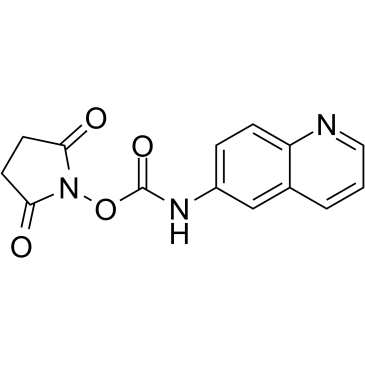
AQC Chemical Structure

Cas No.: 148757-94-2

Taille Prix Stock Qté
25mg
77,00 $US
En stock
50mg
126,00 $US
En stock
100mg
216,00 $US
En stock

Tel:(909) 407-4943 Email: sales@glpbio.com


Avis des clients

Based on customer reviews.

Sample solution is provided at 25 µL, 10mM.

Description of AQC

AQC est une sonde réactive utilisée pour la dérivatisation en phase pré-colonne d'amines primaires et secondaires (comprendre les groupes amino dans les acides aminés, les peptides, les protéines et les polyamines), générant des dérivés stables et hautement fluorescents avec des maximums d'excitation/émission à 248/398nm. AQC a été employé pour la séparation chromatographique et l'analyse d'acides aminés et de polyamines[1].

References:
[1] Pawlowska M, Chen S, Armstrong DW. Enantiomeric separation of fluorescent, 6-aminoquinolyl-N-hydroxysuccinimidyl carbamate, tagged amino acids. J Chromatogr. 1993 Jul 9;641(2):257-65.

Protocol of AQC

Ce protocole fournit seulement un guide général; veuillez l'adapter à vos besoins spécifiques.

1.Préparation de la Protéine

(1)Pour un marquage optimal, préparez la protéine (anticorps) à 2mg/mL.

(2)Ajuster la solution protéique à pH de 8.5 ± 0.5. Si pH est inférieur à 8,0, utilisez du carbonate de sodium 1M pour l'élever.

(3)L'efficacité de marquage diminue brusquement lorsque la concentration de protéine est < 2mg/mL. Pour obtenir les meilleurs résultats, travaillez dans une plage de concentration finale de protéine de 2–10mg/mL.

(4)La protéine doit se trouver dans un tampon exempt d'amines primaires (par exemple, Tris ou glycine) et d'ions ammonium, car ceux-ci réduiront l'efficacité de marquage.

2.Préparation du Colorant (en utilisant AQC comme exemple)

(1)Ajoutez DMSO anhydre au flacon AQC pour préparer une solution de stock à 10mM. Mélangez soigneusement par pipettage ou Vortexing.

3.Calcul de la Quantité de Colorant

(1)La quantité d'AQC requise dépend de la quantité de protéine à marquer. Le rapport molaire optimal d'AQC à protéine est approximativement 1.9µL.

(2)Exemple : Pour marquer 500µL d'IgG à 2mg/mL d'IgG (MW = 150,000) avec AQC dissous dans 100µL de DMSO (1mg AQC), le volume d'AQC requis est 1,9µL.

Calcul détaillé :

mmol(IgG) = [mg/mL(IgG) × mL(IgG)] / MW(IgG)= (2mg/mL × 0.5mL) / 150,000 mg/mmol= 6.7 × 10⁻⁶mmol

mmol(AQC) = mmol(IgG) × 10= 6.7 × 10⁻⁶mmol × 10= 6.7 × 10⁻⁵mmol

µL(AQC) = [mmol(AQC) × MW(AQC)] / (mg/µL AQC)= (6.7 × 10⁻⁵mmol × 285.25mg/mmol) / 0.01mg/µL≈ 1.9µL AQC

(4) Réalisation de la Réaction de Conjugaison

(1)Ajoutez lentement la solution de stock fraîche d' AQC à 10mM à 0,5mL de solution protéique en remuant délicatement. Centrifugez brièvement pour recueillir l'échantillon au fond du tube. N'utilisez pas de vortex pour éviter la dénaturation ou la perte d'activité.

(2)Incubez le tube de réaction à température ambiante en obscurité, en remuant délicatement toutes les 10-15 minutes, pour une durée totale de 60 minutes.

5.Purification du Conjugué (exemple utilisant une colonne Sephadex G-25)

(1)Equilibrez une colonne Sephadex G-25 selon les instructions du fabricant.

(2)Chargez le mélange réactionnel sur le dessus de la phase stationnaire de la colonne.

(3)Dès que l'échantillon a pénétré dans la résine, ajoutez immédiatement PBS (pH 7.2–7.4).

(4)Continuez d'ajouter PBS (pH 7.2–7.4) jusqu'à ce que les fractions désirées aient été collectées et que l'élution de la colonne soit terminée.

References:
[1]Bosch L, Alegría A, Farré R. Application of the 6-aminoquinolyl-N-hydroxysccinimidyl carbamate (AQC) reagent to the RP-HPLC determination of amino acids in infant foods. J Chromatogr B Analyt Technol Biomed Life Sci. 2006 Feb 2;831(1-2):176-83.

Chemical Properties of AQC

Cas No. 148757-94-2 SDF
Synonymes 6-Aminoquinolyl-N-hydroxysuccinimidyl Carbamate
Canonical SMILES O=C(ON1C(CCC1=O)=O)NC2=CC=C3N=CC=CC3=C2
Formula C14H11N3O4 M.Wt 285.25
Solubility DMSO: 125 mg/mL (438.21 mM) Storage Store at -20°C
General tips Please select the appropriate solvent to prepare the stock solution according to the solubility of the product in different solvents; once the solution is prepared, please store it in separate packages to avoid product failure caused by repeated freezing and thawing.Storage method and period of the stock solution: When stored at -80°C, please use it within 6 months; when stored at -20°C, please use it within 1 month.
To increase solubility, heat the tube to 37°C and then oscillate in an ultrasonic bath for some time.
Shipping Condition Evaluation sample solution: shipped with blue ice. All other sizes available: with RT, or with Blue Ice upon request.

Complete Stock Solution Preparation Table of AQC

Prepare stock solution
1 mg 5 mg 10 mg
1 mM 3.5057 mL 17.5285 mL 35.057 mL
5 mM 701.1 μL 3.5057 mL 7.0114 mL
10 mM 350.6 μL 1.7528 mL 3.5057 mL
  • Molarity Calculator

  • Dilution Calculator

  • Molecular Weight Calculator

Mass
=
Concentration
x
Volume
x
MW*


**When preparing stock solutions always use the batch-specific molecular weight of the product found on the vial label and MSDS / CoA (available online).

Calculate

In vivo Formulation Calculator (Clear solution) of AQC

Step 1: Enter information below (Recommended: An additional animal making an allowance for loss during the experiment)

mg/kg g μL

Step 2: Enter the in vivo formulation (This is only the calculator, not formulation. Please contact us first if there is no in vivo formulation at the solubility Section.)

% DMSO % % Tween 80 % ddH2O
%DMSO %

Calculation results:

Working concentration: mg/ml;

Method for preparing DMSO master liquid: mg drug pre-dissolved in μL DMSO ( Master liquid concentration mg/mL, Please contact us first if the concentration exceeds the DMSO solubility of the batch of drug. )

Method for preparing in vivo formulation: Take μL DMSO master liquid, next addμL PEG300, mix and clarify, next addμL Tween 80, mix and clarify, next add μL ddH2O, mix and clarify.

Method for preparing in vivo formulation: Take μL DMSO master liquid, next add μL Corn oil, mix and clarify.

Note: 1. Please make sure the liquid is clear before adding the next solvent.
2. Be sure to add the solvent(s) in order. You must ensure that the solution obtained, in the previous addition, is a clear solution before proceeding to add the next solvent. Physical methods such as vortex, ultrasound or hot water bath can be used to aid dissolving.
3. All of the above co-solvents are available for purchase on the GlpBio website.

Product Documents

Quality Control & SDS

View current batch:

Avis

Review for AQC

Average Rating: 5 ★★★★★ (Based on Reviews and 24 reference(s) in Google Scholar.)

5 Star
100%
4 Star
0%
3 Star
0%
2 Star
0%
1 Star
0%
Review for AQC

GLPBIO products are for RESEARCH USE ONLY. Please make sure your review or question is research based.

Required fields are marked with *

You may receive emails regarding this submission. Any emails will include the ability to opt-out of future communications.
