

AQC (Synonyms: 6-Aminoquinolyl-N-hydroxysuccinimidyl Carbamate) |
カタログ番号GC39738
 One-Click Copy Product Info
|

AQCは反応性プローブであり、アミノ酸、ペプチド、タンパク質、ポリアミンのアミノ基を含む第一級および第二級アミンのプレカラム誘導体化に使われ、安定した、高蛍光の誘導体を形成し、248/398nmの励起/発効最大値を持つ。
Products are for research use only. Not for human use. We do not sell to patients.
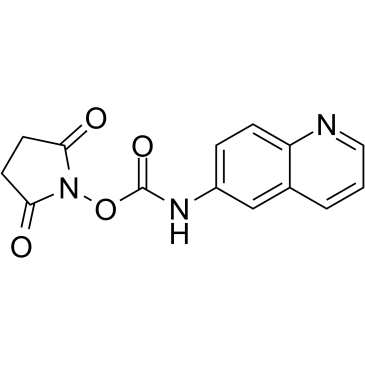
Cas No.: 148757-94-2
Sample solution is provided at 25 µL, 10mM.
_1-3.$$$39978408@51.jpg');)
_1-9.$$$38538795@65.jpg');)
_1-9.$$$39112701@51.jpg');)
_1-7.$$$37316672@70.jpg');)
_366-372.$$$36198801@70.jpg');)
.$$$38565142@65.jpg');)
_1867-1883.$$$33248023@67.jpg');)
_eads6055.$$$39977546@45.jpg');)
_eadm9805.$$$40080571@45.jpg');)
_eadj3020.$$$39666821@45.jpg');)
_1-20.$$$39757301@28.jpg');)
_1-24.$$$38898113@28.jpg');)
_273-287.$$$36806353@46.jpg');)
_1-16.$$$37156877@44.jpg');)
_1-19.$$$37460805@44.jpg');)
_1291-1307.$$$34518654@46.jpg');)
AQCは反応性プローブであり、アミノ酸、ペプチド、タンパク質、ポリアミンのアミノ基を含む第一級および第二級アミンのプレカラム誘導体化に使われ、安定した、高蛍光の誘導体を形成し、248/398nmの励起/発効最大値を持つ。AQCは、アミノ酸とポリアミンのクロマトグラフィー分離と分析に使われる[1]。
References:
[1] Pawlowska M, Chen S, Armstrong DW. Enantiomeric separation of fluorescent, 6-aminoquinolyl-N-hydroxysuccinimidyl carbamate, tagged amino acids. J Chromatogr. 1993 Jul 9;641(2):257-65.
このプロトコールはガイドのみであり、ご自分の具体的なニーズに合わせてご調整願います。
1.タンパク質の調製
(1)最適の標識のために、2mg/mLのタンパク質(抗体)を調製する。
(2)タンパク質溶液をpH 8.5 ± 0.5に調節する。pHが8.0以下であれば、1Mの重炭酸ナトリウムですすいだ。
(3)タンパク質の濃度が< 2mg/mLの時、標識の効率は著しく落ちる。一番良い結果を得るために、2–10mg/mLの範囲のタンパク質の最終濃度で作業することを推奨する。
(4)タンパク質は、第一級アミン(例えば、Trisまたはグリシン)とアンモニウムイオンのない緩衝液にある必要がある。さもなければ、標識の効率は落ちる。
2.染料の調製(AQCを例に)
(1)無水DMSOをAQCガラス瓶に添加し、10mMの貯蔵液を調製する。ピペッティングまたはボルテックスで徹底的に混合する。
3.染料量の計算
(1)必要なAQCの量は、標識されるタンパク質の量によって決められる。AQCとタンパク質の最適モル比は~10:1である。
(2)例:100µL DMSO (1mg AQC)に溶解されたAQCで、500µLの2mg/mL IgG (MW = 150,000)を標識し、必要なAQCの量は1.9µLである。
詳細の計算方法:
mmol(IgG) = [mg/mL(IgG) × mL(IgG)] / MW(IgG)= (2mg/mL × 0.5mL) / 150,000 mg/mmol= 6.7 × 10⁻⁶mmol
mmol(AQC) = mmol(IgG) × 10= 6.7 × 10⁻⁶mmol × 10= 6.7 × 10⁻⁵mmol
µL(AQC) = [mmol(AQC) × MW(AQC)] / (mg/µL AQC)= (6.7 × 10⁻⁵mmol × 285.25mg/mmol) / 0.01mg/µL≈ 1.9µL AQC
4.共役反応の実行
(1)新鮮に調製された10mM AQCを0.5mLのタンパク質溶液をゆっくり添加し、軽く掻き混ぜる。短く遠心分離し、チューブの底にサンプルを集める。変性または活性の喪失を避けるために、ボルテックスをしないで下さい。
(2)暗所、室温で、反応チューブを培養し、計60分間、10-15分ごとにゆっくり掻き混ぜる。
5.共役物の精製(Sephadex G-25カラムを例に)
(1)メーカーの指示に従い、Sephadex G-25を平衡化する。
(2)カラムベッドの上部に、反応混合物を載せる。
(3)サンプルがレジンに進入したら、PBS(pH 7.2–7.4)を直ちに添加する。
(4)必要な画分を収集し、カラムの実行が完了するまでに、引き続きPBS (pH 7.2–7.4)を添加すること。
References:
[1]Bosch L, Alegría A, Farré R. Application of the 6-aminoquinolyl-N-hydroxysccinimidyl carbamate (AQC) reagent to the RP-HPLC determination of amino acids in infant foods. J Chromatogr B Analyt Technol Biomed Life Sci. 2006 Feb 2;831(1-2):176-83.
| Cas No. | 148757-94-2 | SDF | |
| 同義語 | 6-Aminoquinolyl-N-hydroxysuccinimidyl Carbamate | ||
| Canonical SMILES | O=C(ON1C(CCC1=O)=O)NC2=CC=C3N=CC=CC3=C2 | ||
| Formula | C14H11N3O4 | M.Wt | 285.25 |
| 溶解度 | DMSO: 125 mg/mL (438.21 mM) | Storage | Store at -20°C |
| General tips | Please select the appropriate solvent to prepare the stock solution according to the
solubility of the product in different solvents; once the solution is prepared, please store it in
separate packages to avoid product failure caused by repeated freezing and thawing.Storage method
and period of the stock solution: When stored at -80°C, please use it within 6 months; when stored
at -20°C, please use it within 1 month. To increase solubility, heat the tube to 37°C and then oscillate in an ultrasonic bath for some time. |
||
| Shipping Condition | Evaluation sample solution: shipped with blue ice. All other sizes available: with RT, or with Blue Ice upon request. | ||
| Prepare stock solution | |||

|
1 mg | 5 mg | 10 mg |
| 1 mM | 3.5057 mL | 17.5285 mL | 35.057 mL |
| 5 mM | 701.1 μL | 3.5057 mL | 7.0114 mL |
| 10 mM | 350.6 μL | 1.7528 mL | 3.5057 mL |
Step 1: Enter information below (Recommended: An additional animal making an allowance for loss during the experiment)
 g
μL
g
μL
Step 2: Enter the in vivo formulation (This is only the calculator, not formulation. Please contact us first if there is no in vivo formulation at the solubility Section.)
Calculation results:
Working concentration: mg/ml;
Method for preparing DMSO master liquid: mg drug pre-dissolved in μL DMSO ( Master liquid concentration mg/mL, Please contact us first if the concentration exceeds the DMSO solubility of the batch of drug. )
Method for preparing in vivo formulation: Take μL DMSO master liquid, next addμL PEG300, mix and clarify, next addμL Tween 80, mix and clarify, next add μL saline, mix and clarify.
Method for preparing in vivo formulation: Take μL DMSO master liquid, next add μL Corn oil, mix and clarify.
Note: 1. Please make sure the liquid is clear before adding the next solvent.
2. Be sure to add the solvent(s) in order. You must ensure that the solution obtained, in the previous addition, is a clear solution before proceeding to add the next solvent. Physical methods such as vortex, ultrasound or hot water bath can be used to aid dissolving.
3. All of the above co-solvents are available for purchase on the GlpBio website.
Quality Control & SDS
- View current batch:
- Purity: >98.00% Appearance: A solid
- COA (Certificate of Analysis)
- SDS (Safety Data Sheet)
- Datasheet
Average Rating: 5 (Based on Reviews and 24 reference(s) in Google Scholar.)