

AQC (Synonyms: 6-Aminoquinolyl-N-hydroxysuccinimidyl Carbamate) |
Catalog No.GC39738
 One-Click Copy Product Info
|

AQC es una sonda reactiva utilizada para la derivatización previa a la columna de aminas primarias y secundarias, incluidos los grupos amino en aminoácidos, péptidos, proteínas y poliminas, lo que produce derivados estables y altamente fluorescentes con máximos de excitación/emisión a 248/398nm.
Products are for research use only. Not for human use. We do not sell to patients.
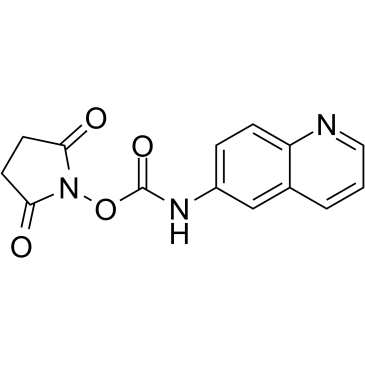
Cas No.: 148757-94-2
Sample solution is provided at 25 µL, 10mM.
_1-3.$$$39978408@51.jpg');)
_1-9.$$$38538795@65.jpg');)
_1-9.$$$39112701@51.jpg');)
_1-7.$$$37316672@70.jpg');)
_366-372.$$$36198801@70.jpg');)
.$$$38565142@65.jpg');)
_1867-1883.$$$33248023@67.jpg');)
_eads6055.$$$39977546@45.jpg');)
_eadm9805.$$$40080571@45.jpg');)
_eadj3020.$$$39666821@45.jpg');)
_1-20.$$$39757301@28.jpg');)
_1-24.$$$38898113@28.jpg');)
_273-287.$$$36806353@46.jpg');)
_1-16.$$$37156877@44.jpg');)
_1-19.$$$37460805@44.jpg');)
_1291-1307.$$$34518654@46.jpg');)
AQC es una sonda reactiva utilizada para la derivatización previa a la columna de aminas primarias y secundarias, incluidos los grupos amino en aminoácidos, péptidos, proteínas y poliminas, lo que produce derivados estables y altamente fluorescentes con máximos de excitación/emisión a 248/398nm. AQC se ha empleado para la separación cromatográfica y el análisis de aminoácidos y poliaminas [1].
References:
[1] Pawlowska M, Chen S, Armstrong DW. Enantiomeric separation of fluorescent, 6-aminoquinolyl-N-hydroxysuccinimidyl carbamate, tagged amino acids. J Chromatogr. 1993 Jul 9;641(2):257-65.
Este protocolo es solo una guía general; por favor, adáptelo a sus necesidades específicas.
1 Preparación de proteínas
(1) Para un etiquetado óptimo, prepare la proteína (anticuerpo) a 2 mg/mL.
(2) Ajustar la solución de proteína a pH 8,5 ± 0,5. Si el pH está por debajo de 8,0, use 1M de bicarbonato de sodio para elevarlo.
(3) La eficiencia del etiquetado disminuye drásticamente cuando la concentración de proteínas es < 2 mg/mL. Para obtener los mejores resultados, trabaje dentro de un rango de concentración final de proteínas de 2-10 mg/mL.
(4) La proteína debe estar en un amortiguador libre de aminas primarias (por ejemplo, Tris o glicina) e iones de amonio, ya que estos reducirán la eficiencia del etiquetado.
2 Preparación de tinte (usando AQC como ejemplo)
(1) Agregue DMSO anhidro al vial de AQC para preparar una solución de caldo de 10 mM. Mezcle bien por pipeteo o vortexing.
3 Cálculo de la cantidad de tinte
(1) La cantidad de AQC requerida depende de la cantidad de proteína a etiquetar. La proporción molar óptima de AQC a proteína es de ~10:1.
(2) Ejemplo: Para etiquetar 500 µL de 2 mg/mL de IgG (MW = 150.000) con AQC disuelto en 100µL de DMSO (1 mg de AQC), el volumen requerido de AQC es de 1,9 µL.
Cálculo detallado:
Mmol (IgG) = [mg/mL(IgG) × ml(IgG)] / MW(IgG)= (2mg/mL × 0,5 ml) / 150.000 mg/mmol= 6,7 × 10⁻⁶ mmol
Mmol (AQC) = mmol (IgG) × 10= 6,7 × 10⁻⁶ mmol × 10= 6,7 × 10−85 mmol
µL(AQC) = [mmol(AQC) × MW(AQC)] / (mg/µL AQC)= (6,7 × 10⁻⁵mmol × 285,25 mg/mmol) / 0,01 mg/µL≈ 1,9µL AQC
(4) Ejecutando la reacción de conjugación
(1) Añada lentamente el caldo AQC de 10 mM recién preparado a 0,5 ml de solución de proteínas mientras se agita suavemente. Centrifugar brevemente para recoger la muestra en la parte inferior del tubo. No vortex para evitar la desnaturalización o la pérdida de actividad.
(2) Incubar el tubo de reacción a temperatura ambiente en la oscuridad, girando suavemente cada 10-15 minutos, durante un total de 60 minutos.
5 Purificación del conjugado (ejemplo usando una columna Sephadex G-25)
(1) Equilibre una columna Sephadex G-25 según las instrucciones del fabricante.
(2) Cargue la mezcla de reacción en la parte superior del leche de la columna.
(3) Tan pronto como la muestra haya entrado en la resina, agregue inmediatamente PBS (pH 7,2–7.4).
(4) Continúe agregando PBS (pH 7,2–7.4) hasta que se hayan recogido las fracciones deseadas y se complete la ejecución de la columna.
References:
[1]Bosch L, Alegría A, Farré R. Application of the 6-aminoquinolyl-N-hydroxysccinimidyl carbamate (AQC) reagent to the RP-HPLC determination of amino acids in infant foods. J Chromatogr B Analyt Technol Biomed Life Sci. 2006 Feb 2;831(1-2):176-83.
| Cas No. | 148757-94-2 | SDF | |
| Sinónimos | 6-Aminoquinolyl-N-hydroxysuccinimidyl Carbamate | ||
| Canonical SMILES | O=C(ON1C(CCC1=O)=O)NC2=CC=C3N=CC=CC3=C2 | ||
| Formula | C14H11N3O4 | M.Wt | 285.25 |
| Solubility | DMSO: 125 mg/mL (438.21 mM) | Storage | Store at -20°C |
| General tips | Please select the appropriate solvent to prepare the stock solution according to the
solubility of the product in different solvents; once the solution is prepared, please store it in
separate packages to avoid product failure caused by repeated freezing and thawing.Storage method
and period of the stock solution: When stored at -80°C, please use it within 6 months; when stored
at -20°C, please use it within 1 month. To increase solubility, heat the tube to 37°C and then oscillate in an ultrasonic bath for some time. |
||
| Shipping Condition | Evaluation sample solution: shipped with blue ice. All other sizes available: with RT, or with Blue Ice upon request. | ||
| Prepare stock solution | |||

|
1 mg | 5 mg | 10 mg |
| 1 mM | 3.5057 mL | 17.5285 mL | 35.057 mL |
| 5 mM | 701.1 μL | 3.5057 mL | 7.0114 mL |
| 10 mM | 350.6 μL | 1.7528 mL | 3.5057 mL |
Step 1: Enter information below (Recommended: An additional animal making an allowance for loss during the experiment)
 g
μL
g
μL
Step 2: Enter the in vivo formulation (This is only the calculator, not formulation. Please contact us first if there is no in vivo formulation at the solubility Section.)
Calculation results:
Working concentration: mg/ml;
Method for preparing DMSO master liquid: mg drug pre-dissolved in μL DMSO ( Master liquid concentration mg/mL, Please contact us first if the concentration exceeds the DMSO solubility of the batch of drug. )
Method for preparing in vivo formulation: Take μL DMSO master liquid, next addμL PEG300, mix and clarify, next addμL Tween 80, mix and clarify, next add μL saline, mix and clarify.
Method for preparing in vivo formulation: Take μL DMSO master liquid, next add μL Corn oil, mix and clarify.
Note: 1. Please make sure the liquid is clear before adding the next solvent.
2. Be sure to add the solvent(s) in order. You must ensure that the solution obtained, in the previous addition, is a clear solution before proceeding to add the next solvent. Physical methods such as vortex, ultrasound or hot water bath can be used to aid dissolving.
3. All of the above co-solvents are available for purchase on the GlpBio website.
Quality Control & SDS
- View current batch:
- Purity: >98.00% Appearance: A solid
- COA (Certificate of Analysis)
- SDS (Safety Data Sheet)
- Datasheet
Average Rating: 5 (Based on Reviews and 24 reference(s) in Google Scholar.)